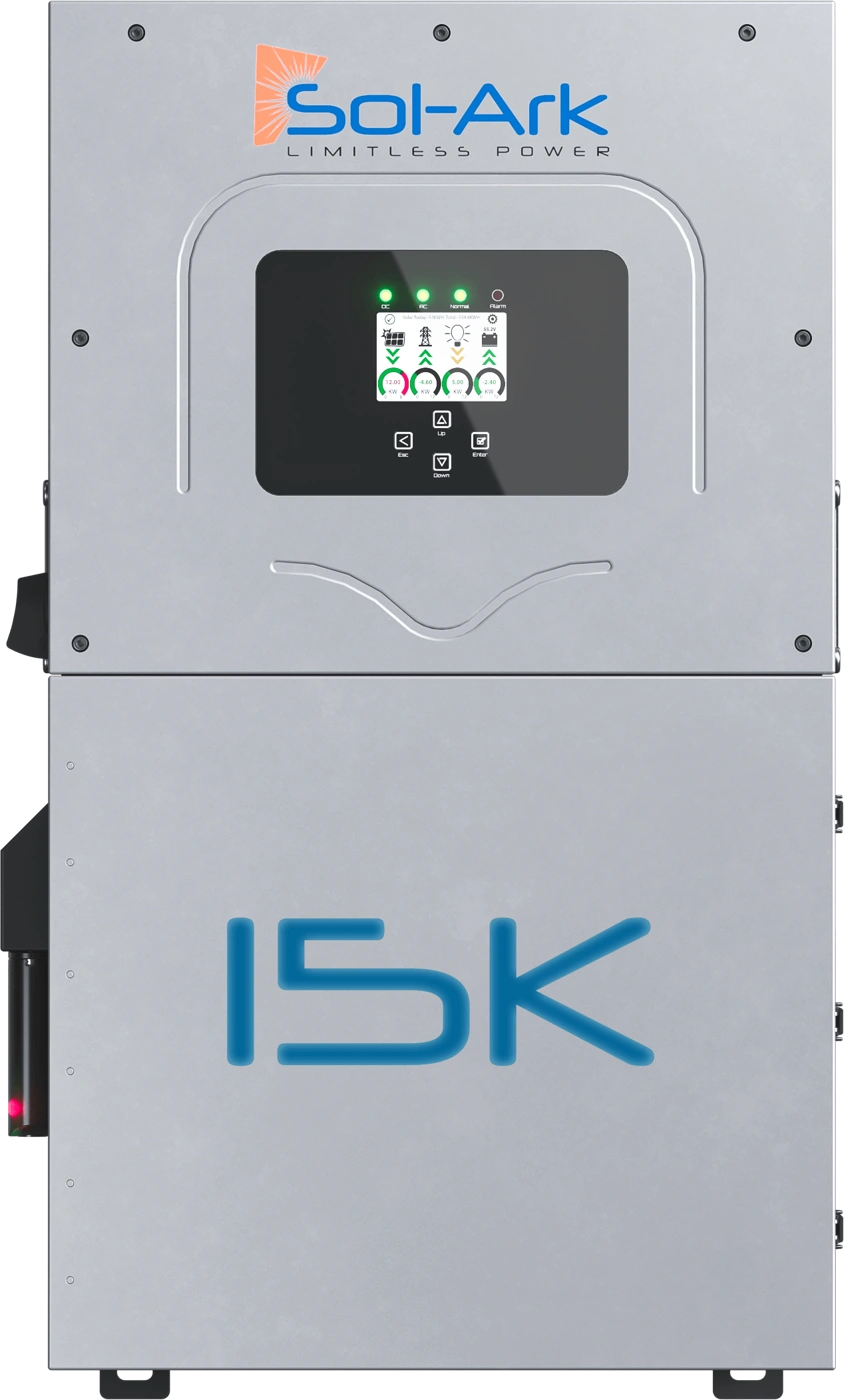
If you already have a working solar system, I don't automatically want to replace everything just because you're adding battery backup. The Sol-Ark 15K-2P gives us another path: we can evaluate whether your existing grid-tied solar inverter can become an alternating current (AC)-coupled solar source for the new battery system.
That can be a practical conversation for a Hawaii home. Your roof equipment may still have useful life, the array may already be producing well, and you may want outage protection without starting from zero. Sol-Ark's current 15K-2P-LV documentation supports both AC- and direct-current (DC)-coupled solar, so the inverter can fit a new installation or a carefully reviewed retrofit.
What AC coupling changes
With a new DC-coupled array, the solar panels connect directly to the Sol-Ark's maximum power point tracking (MPPT) inputs. The Sol-Ark controls that solar input directly and can send it to the loads, battery, or grid according to the system settings.
With AC coupling, your existing solar inverter changes the panels' DC power into 240-volt AC power first. The Sol-Ark can then use that AC power for household loads, battery charging, or grid export when the system and utility rules allow it. There is an additional conversion step, so DC coupling is generally more efficient for a brand-new system. But AC coupling can preserve useful equipment when you already own a suitable solar inverter.
Here is the kind of example I would want to review with you: an existing 8-kilowatt grid-tied solar system, followed by a Sol-Ark 15K-2P and a properly matched 48-volt battery bank. The 8-kilowatt figure describes the existing AC-coupled source. It does not automatically become 8 kilowatts of battery charging, because household loads, battery limits, inverter limits, and system controls all share the available power.
The GEN connection is the part I want planned carefully
Sol-Ark's current residential AC Coupling Guide identifies the GEN terminal as the preferred connection point for AC-coupled solar on the 15K-2P-LV. That arrangement requires a battery, supports AC-coupled production during a grid outage, preserves the inverter's normal backup behavior, and allows the source to be monitored through Sol-Ark's monitoring platform.
The current guide lists a maximum AC-coupled input of 19.2 kilowatts for the 15K-2P-LV. That is an absolute design limit, not a recommendation to fill the GEN input with the largest possible inverter. The existing inverter's voltage, phase, certification, output size, and behavior during frequency shifting still have to fit the Sol-Ark system.
A GRID-side AC-coupled arrangement is different. Sol-Ark describes that source as operating independently: it can produce while the utility is available, but it will not support the Sol-Ark's backed-up loads during a grid outage. It also needs external current transformers for grid interaction and does not provide the same clear AC-source monitoring. For a retrofit where backup is the goal, that is why I want the GEN-side option evaluated first.
The AC-coupled source also needs to meet the applicable Underwriters Laboratories (UL) 1741, UL 1741 SA, or UL 1741 SB requirements. Those certifications matter because the Sol-Ark may raise the system frequency to signal the AC-coupled inverter to reduce or stop production when the battery is full during off-grid operation.
Why the battery is part of the retrofit decision
A GEN-side AC-coupled system is not just an inverter swap. The battery gives the Sol-Ark somewhere to put surplus solar when the grid is unavailable and the loads are small. Sol-Ark's current datasheet lists a nominal 48-volt battery system and maximum charge and discharge currents of 275 amps, but the usable result still depends on the exact battery bank, its battery-management system, communication method, temperature, and manufacturer limits.
I also want the existing solar inverter and the new battery system considered together. A battery with enough kilowatt-hours for overnight use may still be unable to accept the available charging current. On the other hand, a large battery bank does not fix an incompatible AC-coupled inverter or an export arrangement that the utility will not approve.
Export rules and firmware matter
Sol-Ark's current residential guide says AC coupling is not recommended when the site cannot sell back to the grid. The reason is important: AC-coupled production may still export even when Grid Sell is disabled, because the Sol-Ark controls that source indirectly rather than with the same fine control it has over its own MPPT inputs. Hawaii utility approval and the existing interconnection arrangement belong in the design conversation from the beginning.
That same guide identifies COMM 1452 and MCU 7228 or later for 15K-2P-LV AC-coupling operation. I want to see the existing inverter model, its certification, the array size, the utility interconnection, the battery plan, and the current Sol-Ark firmware path before calling a retrofit a good fit.
For a general introduction, altE Store's Schneider Electric Discusses DC Coupling compares AC and DC coupling when adding batteries to an existing grid-tied array. It explains why a retrofit may keep or replace the existing inverter and why battery charging control matters. It is a general architecture lesson; Sol-Ark's own current guide remains the document we use for the 15K-2P's limits and settings.
If you already have solar and want battery backup, contact SolarMan with the existing inverter model, array size, battery goal, and the loads you want protected. I can help you determine whether the Sol-Ark 15K-2P is a sensible retrofit center or whether a different architecture will serve your home better.