Why I Like the MidNite Barcelona for Two Different Solar Roof Areas
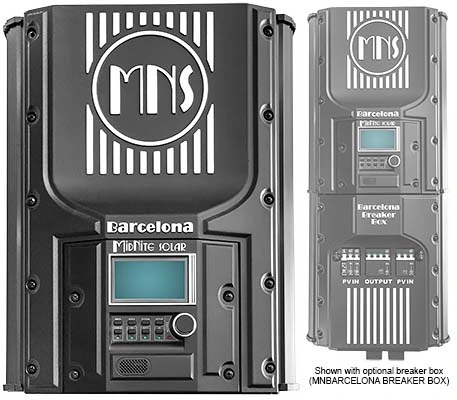
One reason I like the MidNite Barcelona is that it gives a larger battery system room to breathe. Instead of forcing every solar panel into one identical array, you get two independent Maximum Power Point Tracking (MPPT) inputs feeding one 48-volt battery bank.
That matters when your solar does not all live in the same perfect rectangle. A Hawaii home might have one roof plane facing a different direction from another. A carport may be a better place for part of the array. You may also want to add a second solar section later. The Barcelona gives me a practical way to plan those sections separately while keeping the charging equipment in one serious package.
Two solar sections, one battery bank
Each Barcelona PV input has its own tracker. In plain language, each tracker looks for the best voltage and current combination from its own solar section. That is useful because two sections receiving different sunlight do not have to behave identically all day.
For example, imagine one group of panels on a morning-sun roof and another group on an afternoon-sun roof. The two sections will reach their strongest production at different times. Independent tracking lets the Barcelona manage those inputs separately instead of treating the whole array as one compromise.
This does not make shade disappear, and it does not make a poor layout good. I still want each input connected to a properly planned, electrically compatible PV section. But the dual-MPPT design gives us more useful choices before we start moving equipment or giving up on a good roof area.
Why the high-voltage input is useful
The Barcelona is designed for a 48-volt battery bank, while the solar array operates at a much higher voltage. MidNite lists a 220-volt minimum PV open-circuit voltage requirement, a 600-volt maximum PV open-circuit rating, and an MPPT window listed from 185 to 585 volts on its product information.
Those are separate checks. The array needs enough voltage for the controller to start and track properly, but the cold-corrected open-circuit voltage of the string must never exceed the Barcelona’s maximum. Solar panels produce higher voltage when they are cold. Hawaii usually gives us a mild climate, but the actual panel datasheet and the site temperature assumption still belong in the calculation.
Higher array voltage can also reduce current on a long PV run, which may make voltage-drop planning easier. It does not automatically make every installation cheaper. The wire, overcurrent protection, disconnects, conduit, and installation method still have to match the actual design.
There is another current check that I do not skip. The Barcelona documentation lists a maximum PV operating current of 36 amps and a maximum PV short-circuit current of 40 amps. Those numbers are not interchangeable. Operating current describes the current expected while the array is producing power; short-circuit current is the fault-condition value used for a different part of the design review. I check the panel datasheet and the applicable Barcelona manual rather than guessing from panel wattage alone.
A useful size example
The Barcelona is rated for up to 200 amps of combined charging output, with 100 amps assigned to each MPPT side. That is a substantial charging platform for a 48-volt battery system.
As a simple starting point, 200 amps multiplied by 48 volts equals 9,600 watts of nominal DC charging power. That is not a promise that the array will deliver 9,600 watts every day. Sun angle, heat, clouds, panel layout, battery voltage, and controller limits all affect real production. I use the calculation to understand the scale of the equipment, then size the array and battery bank from the actual loads.
The two inputs also give us a clean way to divide a larger array. One section might use one MPPT channel and a second matched section might use the other. The exact string count depends on the panel’s voltage, current, temperature coefficient, cold-weather open-circuit voltage, and the Barcelona’s input limits. I do not recommend copying a string layout from another project just because the panel wattage looks similar.
Where the Rosie fits
The Barcelona is especially attractive when it is part of a MidNite system with a Rosie inverter. MidNite describes the Barcelona as a companion to the Rosie, and the MNGP2 display can provide a common place to view and adjust compatible MidNite equipment.
That does not mean the Barcelona replaces the inverter. The Barcelona manages solar energy into the 48-volt battery bank. The Rosie handles battery-based AC power for the home or other loads. Together, they create a straightforward division of jobs: solar charging on one side, usable household power on the other.
If you want to see the basic MPPT conversion rather than just hear me describe it, altE Store has a useful demonstration using a higher-voltage panel and a lower-voltage battery. It is a general lesson, not a review of the Barcelona, but it shows why an MPPT controller can convert extra panel voltage into useful battery-charging current.
I would look closely at the Barcelona for a large off-grid system, a battery-backed system with two distinct solar areas, or a project where higher-voltage PV strings make the layout cleaner. If you are considering one, send SolarMan the panel model, the number of panels, the battery voltage, the roof or ground-mount sections, and the distance to the equipment. I can help you decide whether the Barcelona’s two MPPT inputs and high-voltage range fit the system you actually want to build.
Watch how it works
altE Store explains “Comparing MPPT vs PWM charge controllers with a 24V panel and 12V battery” so you can see the main idea instead of only reading about it.
Comparing MPPT vs PWM charge controllers with a 24V panel and 12V battery — altE Store
Sources and product details
Manuals and product information behind the details above.
- MidNite Solar Barcelona Product Information (manufacturer product page)
- MidNite Solar Barcelona Manual, Revision A (manufacturer installation manual)
- MidNite Solar Barcelona Brochure, Revision B (manufacturer brochure)
- MidNite Solar Rosie and Barcelona Product Information (manufacturer system product page)
- Sizing MPPT Charge Controllers (technical educational reference)
- Comparing MPPT vs PWM Charge Controllers with a 24V Panel and 12V Battery (educational video)