Why I Like the Little Rosie RE for a Stationary 48-Volt System
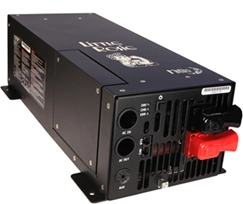
If you’re building a compact off-grid system for a home, cabin, workshop, or small office, I like the MidNite Little Rosie RE because it gives you the important pieces without turning the equipment room into a wall of hardware.
The exact stationary model is the MNLR4548RE. It takes power from a nominal 48-volt battery bank and produces 120-volt, true-sine-wave AC for ordinary household loads. When utility power or a suitable generator is accepted at the AC input, it can pass that AC through to the loads while also charging the batteries. That makes it useful as the center of a small battery-based system, not just as a battery inverter.
The RE model is the one I’d look at for a fixed building
MidNite also makes a mobile Little Rosie, the MNLR3648M, for applications such as recreational vehicles, trucks, and boats. The RE model is intended for stationary applications such as houses, offices, and cabins. They aren’t interchangeable names for the same product: the RE is rated for 4,500 volt-amperes of continuous output at 25°C, while the mobile model is rated for 3,600 volt-amperes at 40°C.
For a fixed Hawaii property, that distinction matters. The RE uses common input and output neutrals in the way MidNite describes for stationary building installations. The mobile model adds features intended for mobile applications, including automatic neutral-to-ground bond switching and a UL 458 listing. I’d rather start with the model that matches the building and electrical application than try to force an RV-oriented model into a house system.
What 4,500 VA means in everyday terms
VA means volt-amperes. It’s a way of describing inverter capacity using voltage and current together. The Little Rosie’s 4,500-VA rating at 120 volts works out to about 37.5 amps for a unity-power-factor load. That’s a useful sense of scale, not a substitute for a proper load calculation or breaker sizing.
A refrigerator, lights, communications equipment, pumps, and selected kitchen loads may fit comfortably depending on what runs at the same time. Large heating loads, electric water heaters, and cooking appliances can use a lot of battery energy very quickly.
The Little Rosie also has short-duration surge capability. MidNite’s current manual lists 4,950 watts for 30 minutes, 5,625 watts for five minutes, and 6,750 watts for five seconds. That extra headroom is helpful when a motor or compressor starts, but I still want to see the actual starting and running requirements of your equipment before recommending the inverter.
It is more than an inverter
The Little Rosie includes a 60-amp, multi-stage battery charger with power-factor correction. In practical language, that means a generator or other accepted AC source can do more than keep the lights on: it can replenish the 48-volt battery bank through the inverter/charger.
Its internal 30-amp transfer function can pass incoming AC to the loads when the source is accepted. If that source disappears, the unit can return to inverter operation. The charger also has automatic back-off behavior, which helps prioritize the incoming AC for the loads instead of asking a limited source to do everything at once.
That combination is valuable on an island system. Solar can carry the normal daytime work, batteries can handle the evening or an outage, and a correctly matched generator can provide another charging path when weather or unusually high demand leaves the batteries low. The generator still has to be compatible with the system settings and large enough to support the loads and charging demand.
Why I like pairing it with the Little Rosie E-Panel
The optional MNE125LR-120S Little Rosie E-Panel is designed specifically for the MNLR4548RE. It brings the AC input, AC output, and battery-side overcurrent protection and disconnect functions into a matching enclosure. It includes an 80-volt DC, 125-amp battery breaker, 30-amp AC input and 60-amp AC output breakers, a 30-amp bypass circuit, a ground busbar, and a place to attach compatible MidNite surge protection devices.
That doesn’t make system design automatic, and it doesn’t eliminate the need for a qualified installation. What I like is that the inverter and its supporting protection equipment are planned as a system instead of being assembled from unrelated boxes. The bypass function can also make service planning more practical because the loads have a defined way to be supplied from the accepted AC source while the inverter is taken out of service.
Where the Little Rosie fits best
I’d put the Little Rosie RE on my short list when you want a stationary 48-volt system with 120-volt loads, battery backup, generator or utility charging, and room for a MidNite solar charge controller such as the Barcelona or Hawke’s Bay. It is especially interesting when physical space matters: the inverter is listed at 15 pounds and measures about 20.25 by 9 by 6 inches.
I wouldn’t choose it from the VA number alone. We need to look at your loads, battery chemistry and capacity, solar charge controller, generator, expected runtime, ventilation, and the exact electrical service. If you’re in Hawaii and want to know whether the Little Rosie is the right center for your system, contact SolarMan. I can help match the inverter, battery bank, charging equipment, and E-Panel to the way you actually use the property.
For a general explanation of how a Rosie inverter can use battery power to reduce reliance on incoming AC, the video Grid Curtailment Using the Midnite Rosie Inverter is a useful companion lesson. It discusses the broader Rosie operating idea rather than reviewing this exact Little Rosie model.
Watch how it works
Around the Homestead with Sue & Ryan explains “Grid Curtailment Using the Midnite Rosie Inverter” so you can see the main idea instead of only reading about it.
Grid Curtailment Using the Midnite Rosie Inverter — Around the Homestead with Sue & Ryan
Sources and product details
Manuals and product information behind the details above.
- MidNite Solar MNLR4548RE Owner’s Manual, Rev. A (Official manufacturer manual)
- MidNite Solar MNLR4548RE Product Page (Official manufacturer product page)
- MidNite Solar MNLR3648M Mobile Owner’s Manual, Rev. A (Official manufacturer manual)
- MidNite Solar MNLR3648M Mobile Product Page (Official manufacturer product page)
- MidNite Solar Little Rosie E-Panel Product Page (Official manufacturer product page)
- MidNite Solar Inverter Product Category (Official manufacturer product category)
- Grid Curtailment Using the Midnite Rosie Inverter (Educational YouTube video)