Why I Like the EG4 LL-S Battery for a 48-Volt System That Can Grow
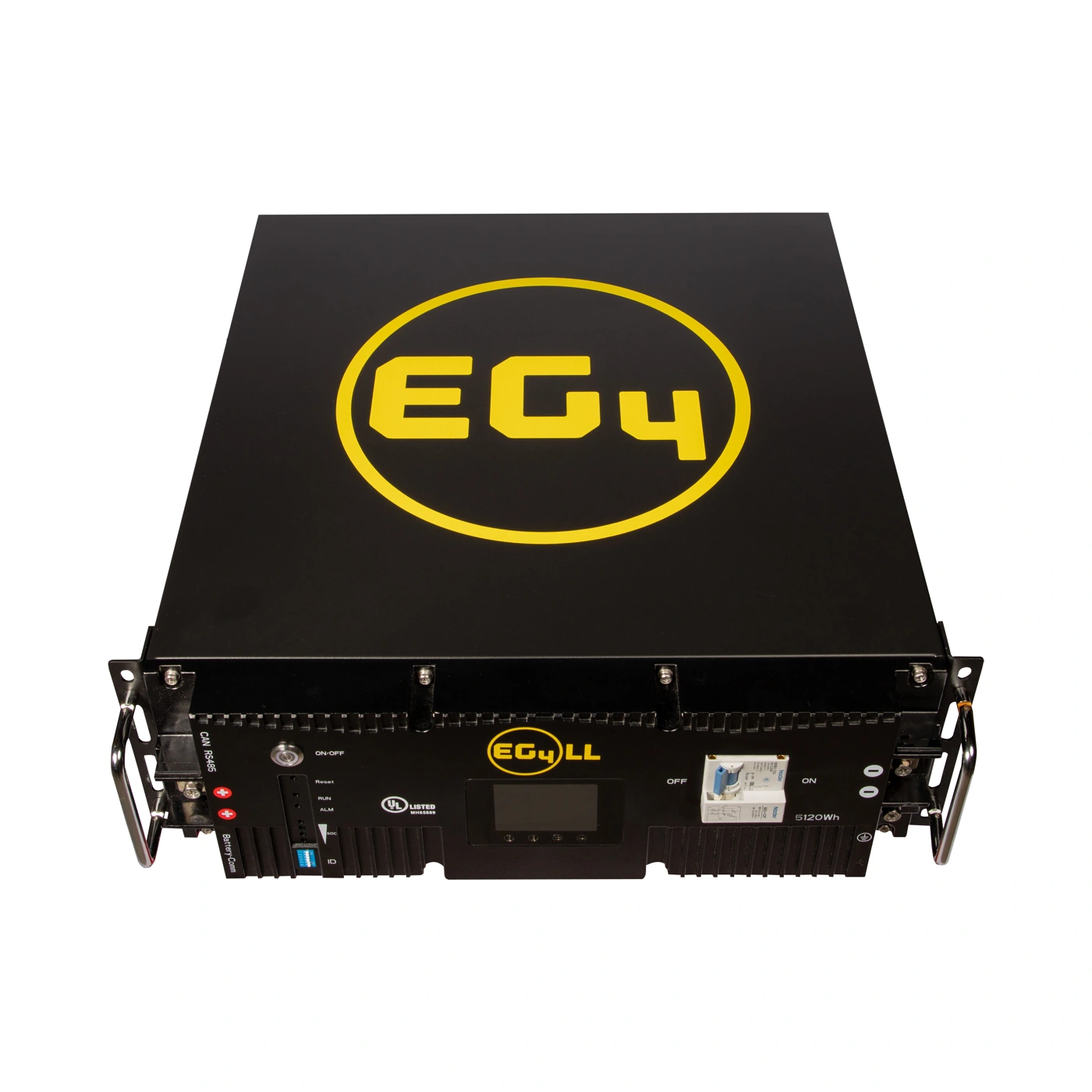
I like the EG4 LL-S when a customer wants a serious 48-volt battery system but doesn't want to guess the final size on day one. One battery gives you a useful starting point, and the rack format gives us a practical way to expand later when your loads, budget, or backup goals become clearer.
A useful amount of energy in one module
The current EG4 LL-S model is the SR-48-100-IN-01. Its battery voltage is 51.2 volts and its capacity is 100 amp-hours. The simple nameplate calculation is 51.2 × 100, or 5,120 watt-hours. That's 5.12 kilowatt-hours of rated battery energy.
That number helps us begin a conversation, but it isn't a promise that every bit of the nameplate energy will be available for your household loads. Inverter losses, reserve settings, battery-management limits, and the condition of the battery all matter. I use the 5.12 kWh figure as a planning number, then match the bank to the loads you actually want to run.
For example, two LL-S batteries provide 10.24 kWh of nameplate energy. Three provide 15.36 kWh. That doesn't automatically tell us how long your home will run, because a refrigerator, water pump, mini-split, well system, and internet equipment all use energy differently. It does give us a clean way to discuss the next step.
Why I pay attention to the battery's communication ports
The LL-S includes a battery management system, or BMS. Think of that as the battery's internal supervisor. It tracks information such as voltage, current, temperature, state of charge, and cell condition. The front LCD screen lets you see useful information at the battery instead of treating the enclosure like a black box.
The bigger advantage comes when the battery and inverter can communicate. With compatible equipment and the correct communication cable and protocol, the inverter can receive battery information and manage charging and discharging with more useful data than voltage alone. That is what people mean by closed-loop communication.
I don't treat a communication port as a guarantee of compatibility. The inverter model, cable pinout, protocol setting, firmware, and battery revision all have to match. That's why I want to identify the exact inverter before I promise a particular communication method. The LL-S supports communication with several inverter families, but the system still needs to be configured as a system.
Expansion is easier when the rack is planned first
Multiple LL-S batteries are connected in parallel. The bank remains a 48-volt-class battery bank while the amp-hour capacity increases. Six batteries, for example, remain at the same nominal system voltage but represent 600 amp-hours and 30.72 kWh of nameplate energy.
That growth has to be planned electrically and physically. The batteries need properly sized main cables, an appropriate busbar and overcurrent protection arrangement, and a rack or cabinet that can support the weight. Each battery in a communicating bank also needs its own address. The host battery uses address 1, and duplicate addresses are not acceptable.
One detail I consider especially important is balancing before expansion. EG4's current manual says batteries should be charged to 100 percent before they are paralleled or added to an existing bank. That helps the modules begin at a more comparable state instead of asking the communication system and battery-management systems to sort out a large difference between units.
Where this battery fits best
I see the LL-S fitting well in a Hawaii backup or off-grid system built around a compatible 48-volt inverter. It makes sense when you want a clean rack-mounted installation, visible battery information, and a path to add capacity later. It can also be a good choice when you want the battery bank and inverter to share information rather than relying on fixed guesses for charging.
It may not be the right answer for every installation. A small system with modest loads may not need a rack bank, while a system exposed to outdoor weather may require a different battery enclosure and location plan. The LL-S is a substantial battery module at about 99.6 pounds, so access, lifting, ventilation, and the finished rack location deserve attention before the equipment arrives.
EG4 also lists a design life of more than 6,000 deep cycles and a lifespan of more than 15 years when used under its stated conditions. I like those numbers, but I still explain them honestly: they describe the product's design expectations, not a guarantee of daily energy production or a promise that every installation will operate identically.
Let's match the battery to the whole system
My next step with an LL-S customer is simple. We look at the inverter, the loads you want during an outage, the space available for the rack, and whether you expect to expand. Then we can decide whether one battery is a sensible starting point or whether the system should begin with a larger bank.
If you're considering the EG4 LL-S 48V 100Ah battery for a Hawaii home, backup system, or off-grid project, contact SolarMan. I'll help you look at the battery, inverter, communications, and expansion plan together instead of treating them as separate purchases.
Watch how it works
This is a general educational lesson from EG4 Electronics showing how battery-management-system communication can connect an EG4 rack battery with a compatible inverter.
Sol-Ark and EG4-LL Lithium Battery BMS Communications — EG4 Electronics
Sources and product details
Manuals and product information behind the details above.
- EG4 LL-S 48V 100Ah product page (Official manufacturer product page)
- EG4 LL-S 48V 100Ah User Manual v2.3.3 (Official manufacturer technical manual)
- EG4 LL-S 48V 100Ah specification sheet (Official manufacturer specification sheet)
- Sol-Ark and EG4-LL Lithium Battery BMS Communications (Manufacturer educational video)