If you want a serious battery-based system for a Hawaii home, cabin, or off-grid property, I like putting the Pytes V16 and MidNite Rosie 7048 on the same planning table. The V16 gives you substantial storage and battery-side power in one outdoor-capable enclosure. The Rosie gives you a 120/240-volt inverter/charger with enough output to deserve a careful load plan.
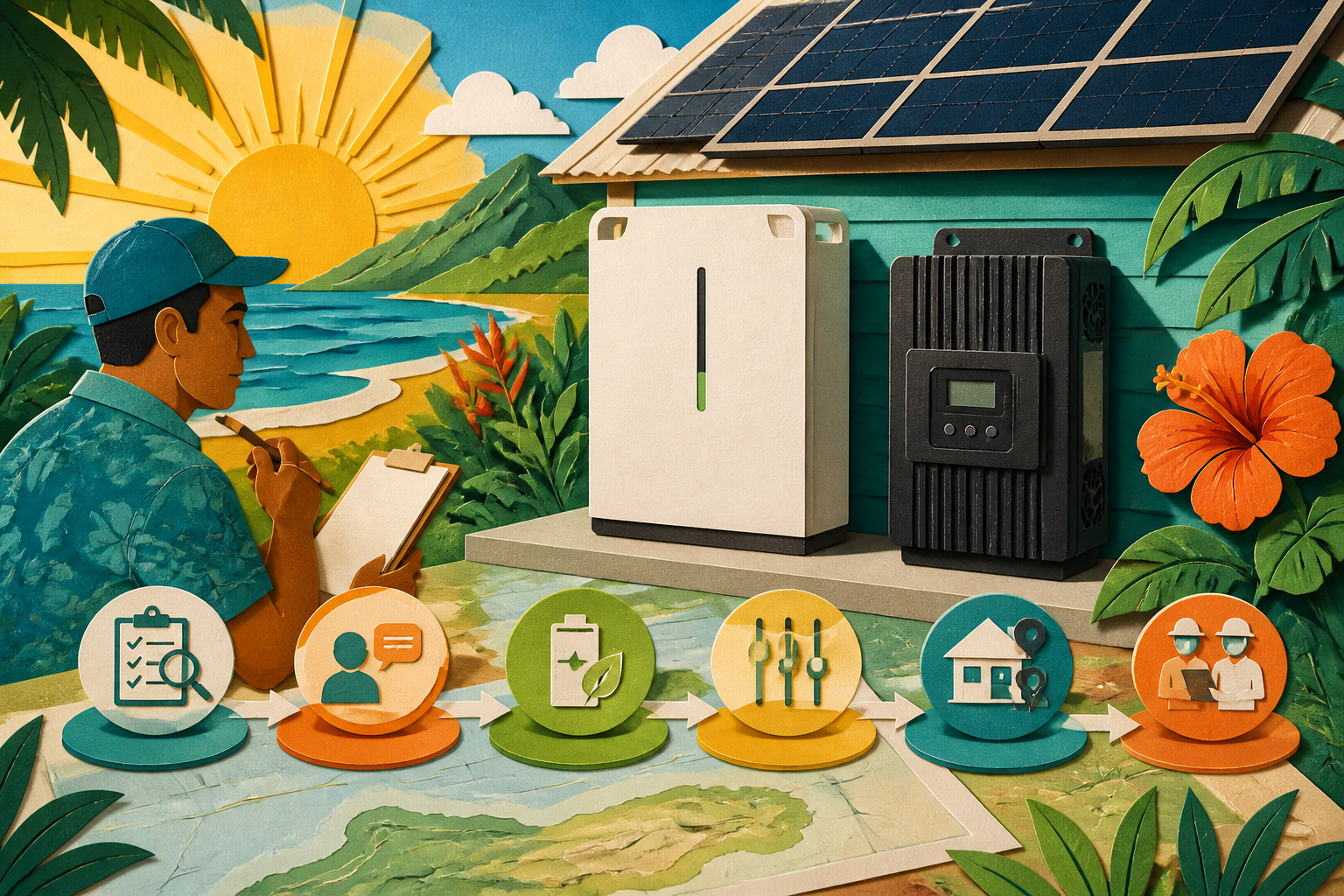
I’d call that a strong starting point, not an automatic plug-and-play pairing. The value is in planning the battery, inverter, loads, communication, and equipment locations as one system instead of buying two large boxes and hoping they agree later.
The electrical match is a sensible starting point
The Pytes V16 is a 51.2-volt lithium iron phosphate, or LFP, battery with a 314 amp-hour capacity and 16.07 kilowatt-hours of nominal energy. The stationary MidNite MNROSIE7048RE Rosie is designed for a 48-volt battery bank and accepts 40 to 65 volts DC at its battery input. In practical language, the V16 sits in the voltage family the Rosie is built to use.
One useful check is simple math: 51.2 volts multiplied by 314 amp-hours equals about 16.08 kilowatt-hours. That is the battery’s nameplate energy. It is not a promise that every one of those kilowatt-hours will reach your appliances. Inverter losses, reserve settings, temperature, battery protection, and the loads you choose all affect what you can actually use.
The V16’s recommended discharge current is 150 amps, or 7.68 kilowatts. Its maximum discharge current is 200 amps, or about 10.24 kilowatts. The Rosie is a 7,000-watt inverter. As a rough battery-side check, 7,000 watts divided by 51.2 volts is about 137 amps before conversion losses. That is close to the V16’s recommended 150-amp discharge current, so the combination has a sensible electrical foundation. I would still size the system around your real loads and starting surges rather than assuming the full inverter rating belongs to every appliance at once.
Communication is a separate question
The V16 provides CAN, RS485, Wi-Fi, and dry-contact communication. Pytes describes closed-loop communication with many mainstream inverter families. In a compatible system, the battery-management system can share information such as state of charge, alarms, temperature, and allowable current with the inverter.
But matching voltage is not the same as confirmed closed-loop communication. The Rosie manual documents CANBUS connections for the MidNite Graphics and Programming Panel 2 and other CANBUS-enabled MidNite devices. That tells us the Rosie has a CANBUS pathway; it does not, by itself, prove that the Rosie understands the Pytes V16 battery-management protocol.
Before I would promise a communicating Pytes-and-Rosie system, I would confirm the exact V16 revision, the exact stationary Rosie model, the supported battery profile or protocol, the correct cable, and any required firmware or address settings. If closed-loop communication is not confirmed, the system may still be designed with carefully selected voltage and current limits. I just would not describe it as fully communicating until that part is documented.
Charge settings should follow the V16
Pytes lists 125 amps, or about 6.4 kilowatts, as the V16’s recommended charge current. The Rosie has a 120-amp maximum battery charger, and its manual says the charging limit must be set from the battery manufacturer’s specifications. That is a good match in practice, but it is still a setting decision—not a number to guess from the inverter’s largest possible rating.
The Rosie manual also says lithium batteries should use zero millivolts-per-degree-Celsius temperature compensation because the battery-management system handles that job. Equalization is not applicable to lithium batteries. I would use the Pytes charging guidance and the applicable Rosie settings rather than copying an old lead-acid profile into a lithium system.
The battery can be outdoors; the Rosie needs protection
The V16’s IP66 enclosure, integrated heating system, and wall- or ground-mount options are useful when indoor battery space is limited. Hawaii weather still deserves a real location plan. Pytes calls for protection from direct sun, rain, snow, standing water, and excessive heat, along with a solid support surface and enough clearance for heat dissipation.
The battery weighs about 288 pounds, so its location affects more than weather. It affects cable length, disconnect placement, communication wiring, service access, and how the equipment will be supported over time. The stationary Rosie is a different matter: MidNite specifies indoor installation or installation inside a weatherproof enclosure. I would not place the Rosie in the same exposed outdoor location simply because the V16 is outdoor-capable.
I’d commission the system in stages
I would begin by confirming the exact equipment identities and current documents. Then I’d settle the V16 location, the Rosie location, the protection plan, cable routing, and the loads the system must support. Next comes the communication decision: confirm closed-loop operation, or document that the system will operate with carefully selected non-communicating settings.
After that, I’d enter the battery capacity, charge limits, lithium settings, low-voltage protection, and temperature behavior. Pytes’ quick guide puts battery startup ahead of inverter startup, but the complete sequence still belongs to the qualified installer and the applicable manuals. The final check should confirm expected battery voltage, normal battery status, clear alarms, correct charging, and proper response to load changes.
For a general lesson on the planning side, altE Store’s Solar Battery Bank Sizing video is useful because it shows why battery voltage, amp-hours, depth of discharge, temperature, inverter efficiency, and daily loads all matter together. It is a general educational lesson, not a review of the Pytes V16 or the Rosie 7048.
If you’re considering the Pytes V16 with a MidNite Rosie 7048, contact SolarMan with your major loads, solar equipment, desired backup circuits, and whether you want grid, generator, or fully off-grid operation. I can help determine whether this is a good match for your property and identify the communication, placement, and commissioning questions that need answers before the equipment is ordered.