When a customer tells me they want whole-home backup, I don’t start with the biggest number on an inverter label. I start with what you want the house to do during an outage and how long you want it to keep doing it.
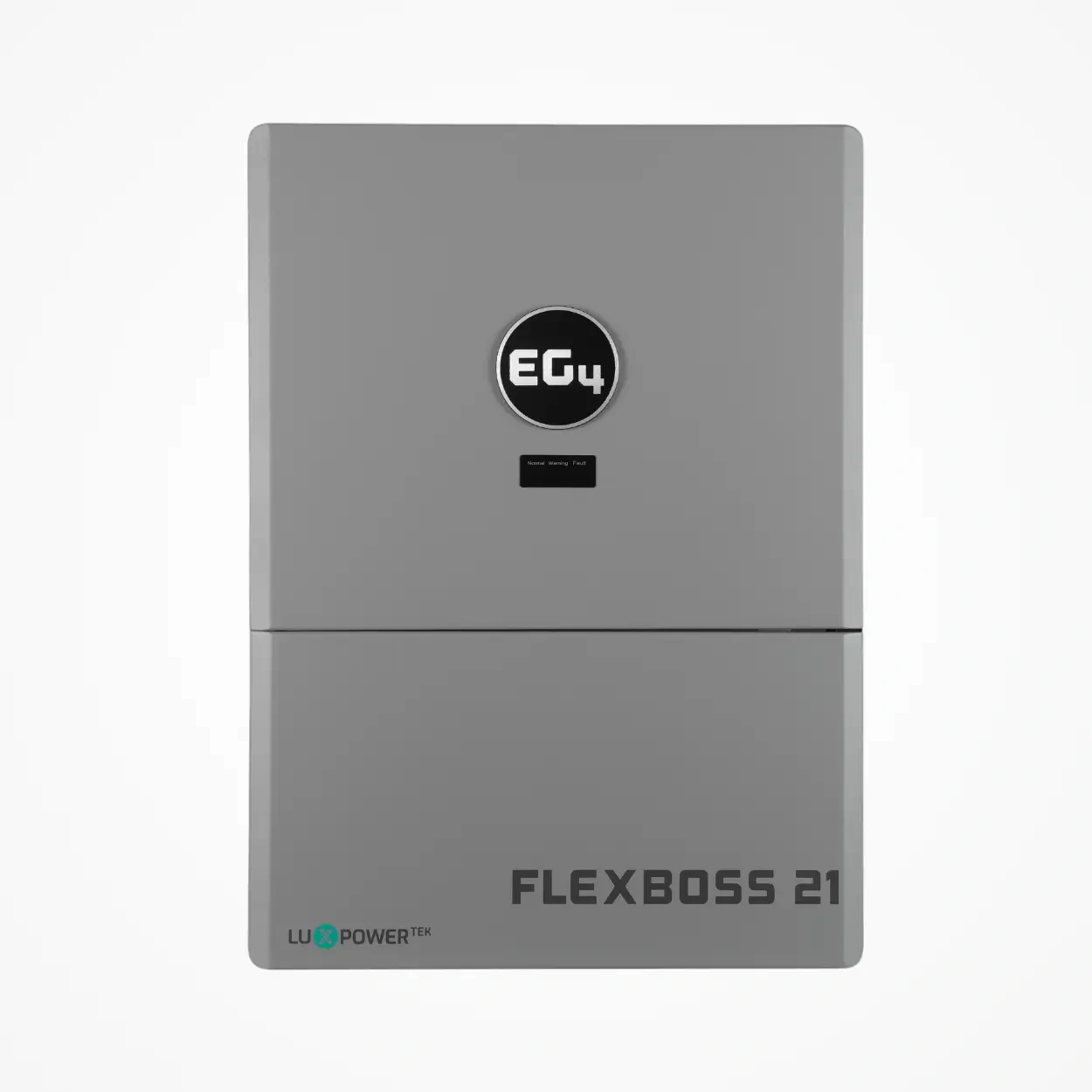
That’s why I like the EG4 FlexBOSS21 as a serious backup candidate. It gives you 12 kilowatts of continuous output from the battery alone, which is the number I use first when I’m thinking about grid-down operation. EG4 also publishes a 16-kilowatt continuous rating with photovoltaic (PV) power and the grid available. Those are different operating conditions, so I don’t use the 16-kilowatt figure as a blanket promise for an outage.
Start with the power your house needs at once
The FlexBOSS21 is a 120/240-volt split-phase inverter. Its battery-only rating is 12,000 watts, with up to 6 kilowatts listed for each 120-volt leg. That’s substantial backup power, but it still rewards sensible load planning.
A Hawaii home might have an air conditioner, refrigerator, well pump, microwave, water heater, and workshop equipment. The goal isn’t to run every large load at the exact same moment just because the service entrance is large. The goal is to keep the important loads operating while allowing starting surges and avoiding unnecessary battery drain.
Solar can help during the day by supplying loads and recharging the battery. Still, clouds arrive, the sun goes down, and a dependable design has to work from the battery when PV production is low. For that reason, I plan the backed-up loads around the 12-kilowatt battery-only figure first, then treat daytime solar production as helpful operating headroom rather than guaranteed inverter capacity.
Power tells you what runs; energy tells you how long
Here’s the distinction I want every customer to understand. Inverter output is the rate of power the system can provide right now. Battery capacity is the amount of energy stored for use over time.
EG4 lists a recommended minimum battery capacity of 600 amp-hours per inverter. At the FlexBOSS21’s nominal 51.2-volt battery voltage, that is about 30.72 kilowatt-hours of nominal battery energy: 51.2 × 600 ÷ 1,000 = 30.72. That is a planning reference, not the amount you should expect to use every day. Battery chemistry, the usable state-of-charge window, temperature, and the actual loads all affect runtime.
This is one reason I don’t size a whole-home system from inverter watts alone. A FlexBOSS21 may have enough output to start a large appliance, but the battery bank determines whether that appliance can run for minutes, hours, or much longer. The battery model and its communication settings also need to match the inverter plan.
Where GridBOSS makes the system more useful
The FlexBOSS21 can work as a hybrid inverter by itself, but I think its bigger system advantage appears when it is paired with the EG4 GridBOSS. GridBOSS gives the project a central way to organize utility power, backed-up loads, non-backed-up loads, generator input, smart loads, and AC-coupled solar equipment.
That gives us more practical choices for a Hawaii system. A generator can serve as reserve power during extended cloudy weather. A water heater or another flexible load can be managed according to battery state of charge. An existing solar inverter may also fit into the backup design through AC coupling when the equipment, wiring, utility requirements, and approval process all line up.
There’s an important architecture detail when the two products are paired: EG4 says the FlexBOSS21 load port and its supplied current transformers are not used in the normal GridBOSS arrangement because GridBOSS handles the system-level tracking. That isn’t a terminal-level wiring instruction. It’s simply a useful reason to have the final design reviewed by the licensed installer and the authority having jurisdiction.
If you want to see that relationship explained visually, Adam De Lay’s interview with EG4 founder James Showalter and product manager Markus Jackson walks through GridBOSS, smart loads, AC coupling, and the FlexBOSS21’s possible system arrangements. I’d use it as a helpful orientation lesson, then use the exact EG4 manuals for the final design.
When I’d put the FlexBOSS21 on the short list
I see the FlexBOSS21 as a good fit when you want substantial backup capability, a 48-volt battery system, high-voltage PV input, and room to build a more organized whole-home system around GridBOSS. It has three maximum-power-point tracking (MPPT) channels and a manufacturer-recommended maximum solar array size of 21 kilowatts. Its 600-volt figure is the maximum DC input limit, not the target string voltage; the manual lists 250–440 volts as the full-power MPPT range.
That combination can make sense for a larger home, a property with meaningful daytime loads, or a customer who wants backup to include more than lights and a refrigerator. It isn’t automatically the right answer for every house. A smaller load profile may not need this much inverter, while a high-energy home may need more battery capacity or more than one inverter.
The next step is straightforward: list the loads you actually care about during an outage, identify whether generator support matters, and then match the FlexBOSS21, batteries, solar array, and GridBOSS architecture to that plan. Contact SolarMan and I can help you decide whether this EG4 combination fits your home.