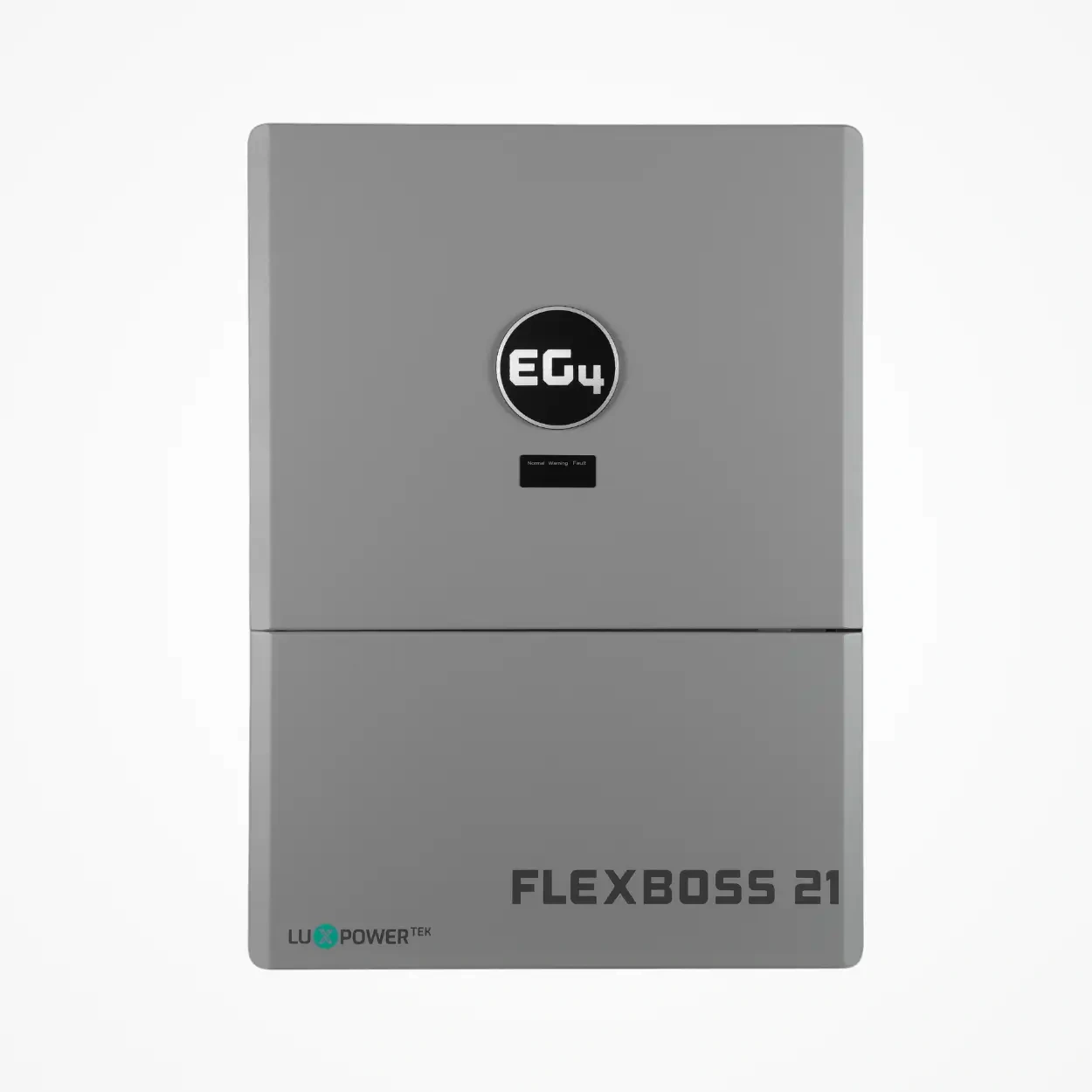
I like a generator in a FlexBOSS21 system when we give it a clear recovery job. It doesn't have to replace your solar array or battery bank. It can step in after several cloudy days, during a long outage, or when your essential loads are using more energy than the battery can comfortably provide.
The EG4 FlexBOSS21 is a strong center for that system. It can provide up to 12 kilowatts of continuous alternating-current output from the battery alone, and up to 16 kilowatts in the documented photovoltaic- and grid-supported operating condition. The generator relationship is the part we need to plan carefully: when the FlexBOSS21 is paired with a GridBOSS, generator support comes through the GridBOSS generator port.
GridBOSS gives the generator a controlled path
The GridBOSS is the gateway for the utility connection, backed-up loads, compatible hybrid inverters, and the generator. EG4 lists generator support up to 125 amps, or 30 kilowatts at 240 volts. That is a connection rating. It does not mean every home needs a 30-kilowatt generator.
For a Hawaii home, I start with the loads you actually want during an outage. Refrigeration, water pumps, communications equipment, lighting, and selected air-conditioning loads may matter more than every discretionary circuit. Then we look at how much generator capacity remains after those loads are operating. That remaining capacity is what can help charge the battery.
Loads and charging share the generator
Here is a simple example. Suppose the generator is supplying 10 kilowatts and the backed-up loads are using 6 kilowatts. That leaves roughly 4 kilowatts of headroom for battery charging before conversion losses, battery limits, and programmed settings are included. If the loads rise to 9 kilowatts, the charging headroom becomes much smaller.
That is why generator size and battery-charge settings belong in the same conversation. The GridBOSS provides settings for generator rated power and battery charging current. The battery manufacturer’s permitted charge current still controls the battery side, and a large generator does not force the battery to charge faster than those limits allow.
Traditional sizing and Generator Boost are different plans
If we want the generator to carry the loads and charging without relying heavily on the battery, EG4’s current GridBOSS manual recommends generator total harmonic distortion below 12 percent. It also says sizing the generator to at least 1.5 times the total output of the connected inverters supports both load operation and battery charging.
That is a traditional operating target. Generator Boost is the smaller-generator option. EG4 documents that if a small generator cannot fully power the critical loads, Generator Boost can allow the inverter to supplement the generator with available solar and battery power. It does not remove the generator’s voltage, frequency, power-quality, or battery-charge limits.
For example, a smaller generator may be useful as a recovery source rather than as a whole-home power plant. It can contribute its share while the FlexBOSS21 uses available solar or battery power to help cover a temporary load. That can reduce the need to buy a generator sized for every possible household load, but the final setting still has to match the generator and battery documentation.
What I want confirmed before commissioning
I want the generator’s 120/240-volt, 60-hertz compatibility, capacity, power quality, and automatic-start method checked before commissioning. The GridBOSS includes a two-wire start/stop connection for generators that support two-wire control. Its generator settings are handled through the EG4 Connect app or Monitor Center.
When the GridBOSS is managing the system, EG4 says the generator port on the hybrid inverter is not used. I also want the FlexBOSS21 firmware checked before the GridBOSS is configured. EG4 specifies minimum system firmware FAAB-1E1E for this pairing, along with the documented commissioning sequence.
For a broader way to think about the decision, the Home Battery vs. Generator: Which Backup Is Right? lesson from Back up Battery Systems compares battery and generator backup, critical loads, and runtime. It helps put the equipment choice in everyday terms. Your final FlexBOSS21 and GridBOSS design still needs to follow the current EG4 documentation and local electrical requirements.
If you are considering an EG4 FlexBOSS21, contact SolarMan. I can help you compare your backed-up loads, battery plan, solar production, and generator options before the equipment is selected.