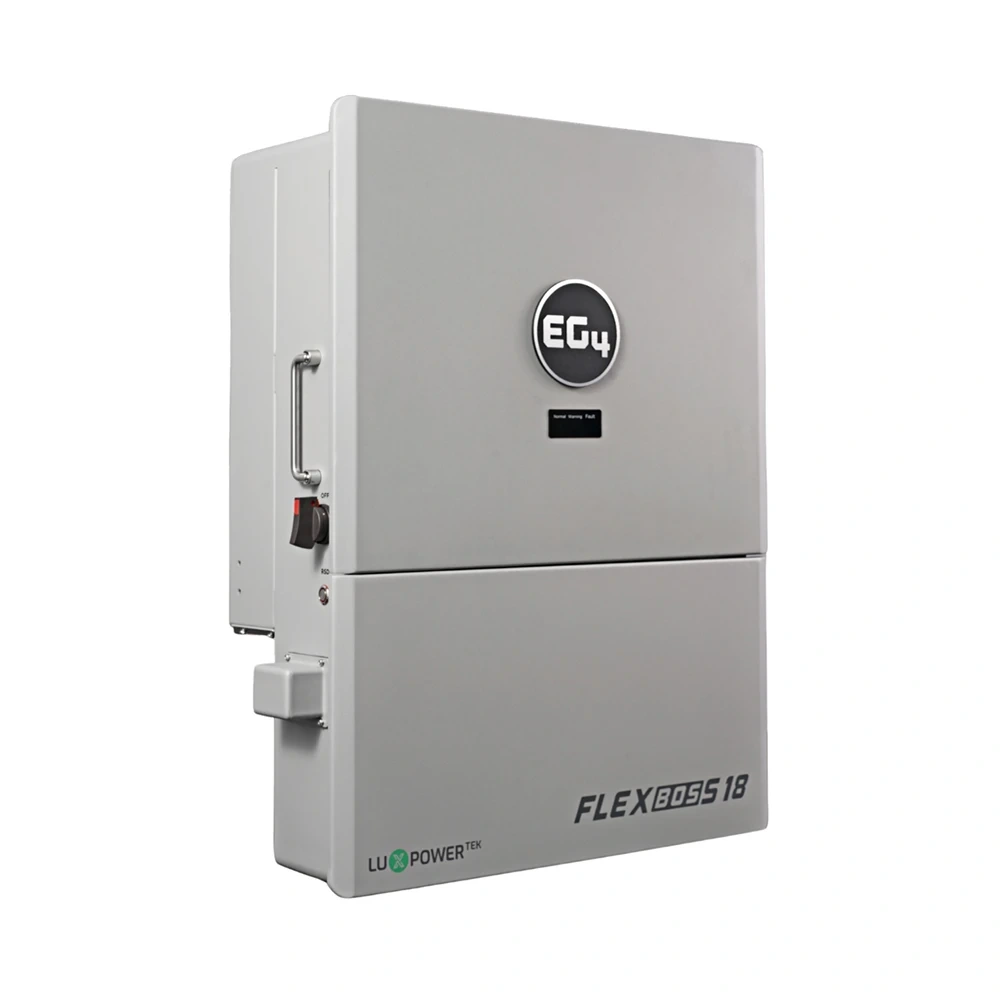
What I like about the EG4 FlexBOSS18 is that it gives us more than one answer to a power outage. Solar and batteries can carry a home through an ordinary interruption. If the outage lasts through several cloudy days, GridBOSS gives us a way to bring a generator into the larger plan instead of asking the battery bank to do everything.
The key is understanding the relationship. The FlexBOSS18 can operate as a hybrid inverter by itself, but EG4 documents its generator, smart-load, and AC-coupling functions with the GridBOSS power gateway. That makes the system architecture just as important as the inverter's headline wattage.
Solar and batteries handle the everyday work
On a normal day, the FlexBOSS18 can use photovoltaic (PV) energy from the array, charge the batteries, and supply the home's backed-up loads. EG4 rates it for up to 13 kilowatts of continuous output when PV and grid support are available, and 10 kilowatts of continuous output from the battery side without PV.
Those are inverter-output numbers, not battery-runtime numbers. A battery bank may run a refrigerator, internet equipment, water pump, and selected cooling circuits, but how long it lasts depends on the loads and the battery capacity. I would match the inverter, battery bank, and backed-up circuits as one design.
GridBOSS gives the generator a defined job
GridBOSS acts as the system's larger connection point for utility power, hybrid inverters, backed-up loads, smart loads, AC-coupled equipment, and a generator. EG4 lists the generator connection at up to 125 amps. At 240 volts, that is shown as up to 30 kilowatts of connection capacity. That is a GridBOSS rating, not a recommendation that every Hawaii home install a 30-kilowatt generator.
Most customers should be evaluated around the actual backed-up loads, battery-charging needs, generator output, fuel, and starting requirements. The useful point is that GridBOSS gives the generator a defined place in the system.
During a long outage, solar can serve the loads and recharge the batteries when production is available. The battery can bridge the gaps at night or during passing clouds. If PV is insufficient and the battery reserve keeps falling, the generator can support the system and, when the configuration and available capacity allow it, help restore the battery reserve.
Load planning matters more than a big number
Imagine a Big Island home with a refrigerator, internet equipment, water pump, and selected cooling circuits on backup power. A short outage may be easy: the FlexBOSS18 and battery bank carry the home while solar continues charging. If clouds settle in and the battery state of charge keeps dropping, generator support can provide a controlled recovery path through GridBOSS before the battery is nearly empty.
This is why I would not automatically back up every circuit in the house. We can decide which loads deserve battery priority, which equipment should wait, and which smart loads can operate only when the battery state of charge or solar production makes that reasonable. A thoughtful load plan gives both the battery and generator a clearer job.
Two details I would confirm early
First, I would confirm the FlexBOSS18 firmware against the current GridBOSS pairing documentation before commissioning. EG4's current GridBOSS Hardware Model 03 documentation lists FAAB-2021 as the minimum system firmware for the FlexBOSS18. When GridBOSS is managing the system's input and output data, the FlexBOSS18 Loads port remains unused and the inverter's supplied current-transformer clamps are not used for that monitoring arrangement.
Second, the generator still has to fit the real electrical conditions. Starting loads, battery-charging power, fuel type, transfer behavior, noise, and automatic-start capability all matter. The inverter and GridBOSS cannot make an undersized generator behave like a larger one.
For a general visual explanation of how an EG4 inverter can use generator input while battery or solar power helps support loads, TGBATG's EG4 inverter lesson is useful. It walks through generator input, load support, and the way different power sources can share the work before we apply that thinking to a FlexBOSS18 and GridBOSS design.
If you are considering the FlexBOSS18 for a Hawaii home, I can help you separate the inverter's output, the battery reserve, the backed-up circuits, and the generator's recovery role. That gives us a practical system match instead of choosing each component by its biggest number.