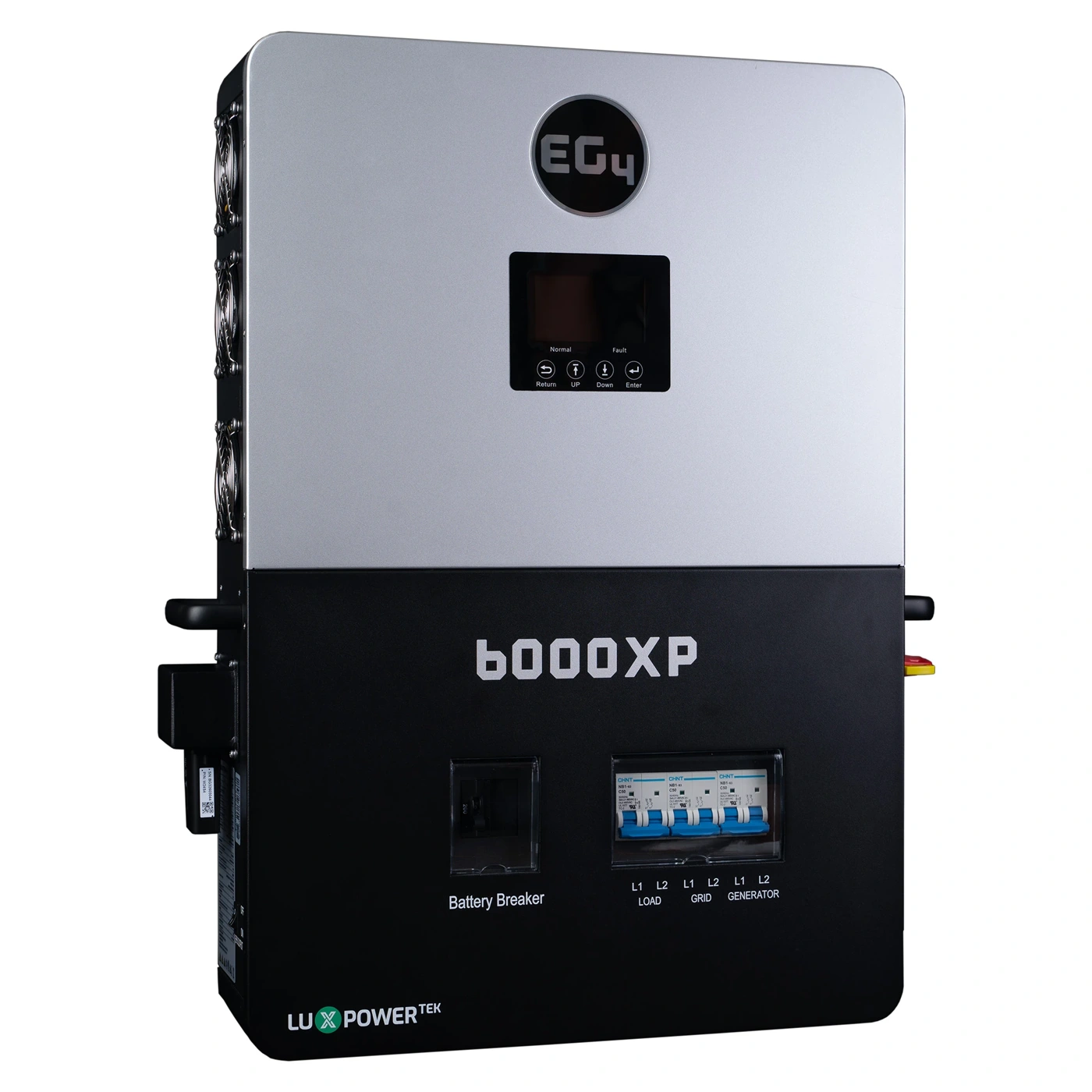
What I like about the EG4 6000XP GEN BOOST function is that it gives a generator a more manageable job. The generator doesn't have to carry every short-lived household peak by itself. When the generator is running but its available power is not enough for the connected load, the 6000XP can supplement that power with the photovoltaic array and battery.
That can matter in a Hawaii off-grid home when a pump starts, several appliances overlap, or a workshop load comes on while the generator is already helping recharge the battery. The benefit isn't that a small generator becomes a large one. The benefit is that the generator, battery, solar array, and inverter can share the work when the system is designed for it.
How GEN BOOST shares the load
Think of the generator as the steady source and the battery as the quick helper. The generator supplies its configured contribution through the 6000XP's generator input. If a temporary load rises above that contribution, GEN BOOST can pull supplemental power from both photovoltaic and battery sources.
Here is the arithmetic behind the idea. If the inverter is configured for 6,400 watts of generator input and the connected load briefly rises to 7,500 watts, the shortfall is about 1,100 watts:
7,500 W - 6,400 W = 1,100 W
That is a planning illustration, not a generator-sizing recommendation. EG4's GEN BOOST guide recommends setting the maximum generator input to 80% of the generator's total output. But EG4's 6000XP manual also lists more than 10 kW as the recommended generator capacity for one inverter, while the documented Max Generator Input Power setting tops out at 7,369 watts. We need to reconcile those numbers with the actual generator and inverter revision instead of applying one number by itself.
The generator still needs to be a good match
GEN BOOST does not remove the generator's basic requirements. EG4 calls for generator power with total harmonic distortion, or THD, below 3%. The generator also needs the right voltage and frequency for the installation, and it must be able to operate correctly while the inverter is charging the battery and serving loads.
There is another limit worth keeping separate. The 6000XP's generator terminal has a 50-amp pass-through relay, and EG4 says the total load and charging current must remain within that limit while the generator is operating. That is different from the generator's nameplate rating, the inverter's 6,000-watt output rating, and the temporary amount that PV and battery can contribute.
I also want to confirm the installed firmware before treating GEN BOOST as part of the design. EG4 introduced the function through a firmware update. The feature can be enabled through the EG4 Monitor System or the inverter's LCD, and the manual identifies setting 30 as GEN Boost. For remote Monitor Center changes, EG4 limits the function to installer or distributor accounts; an end user can set it through the front display.
When this helps in a Hawaii system
I see GEN BOOST as useful when the generator is capable but not intended to cover every brief surge alone. A water pump, refrigerator compressor, air conditioner, or shop tool may create a short demand that is much harder on a generator than a steady load. If the battery has enough discharge capability and the PV array is producing, the 6000XP can use those sources to help cover the difference.
That does not make an undersized battery safe for a large load. It also does not turn a poor-quality generator into a compatible one. The battery's state of charge, battery-management-system limits, inverter settings, available solar power, and the load's starting behavior all affect what GEN BOOST can actually do.
For a system with multiple 6000XPs operating in parallel, the planning becomes even more important. EG4's manual says the generator input must be provided to every inverter in the parallel system. Connecting a generator to only one inverter and assuming the others will automatically share that input is not the documented arrangement.
How I would evaluate the match
I would start with the loads you want to run during a cloudy stretch: pumps, refrigerators, freezers, air conditioning, well equipment, tools, and ordinary household circuits. Then I would separate steady demand from starting demand and identify how much battery power is available at the same time.
Next, I would compare the generator's actual output, voltage, frequency, and power quality with the 6000XP settings. I would check the battery's permitted discharge capability and whether the solar array is likely to contribute during the hours when the generator runs. That gives us a much better answer than simply asking whether the generator is 'big enough.'
For a broader foundation, altE Store's Solar Power Myths: Can you save money by going off-grid? explains why off-grid systems often combine solar, batteries, and a generator when weather does not cooperate. It isn't a review of the EG4 6000XP, but it gives a useful picture of why backup generation remains part of many off-grid designs.
If you're considering the EG4 6000XP for a Hawaii off-grid or backup system, contact SolarMan with your generator size, battery model, major loads, and solar plans. I can help you decide whether GEN BOOST solves a real design problem or whether the better answer is a different generator, a larger battery bank, or a simpler load plan.