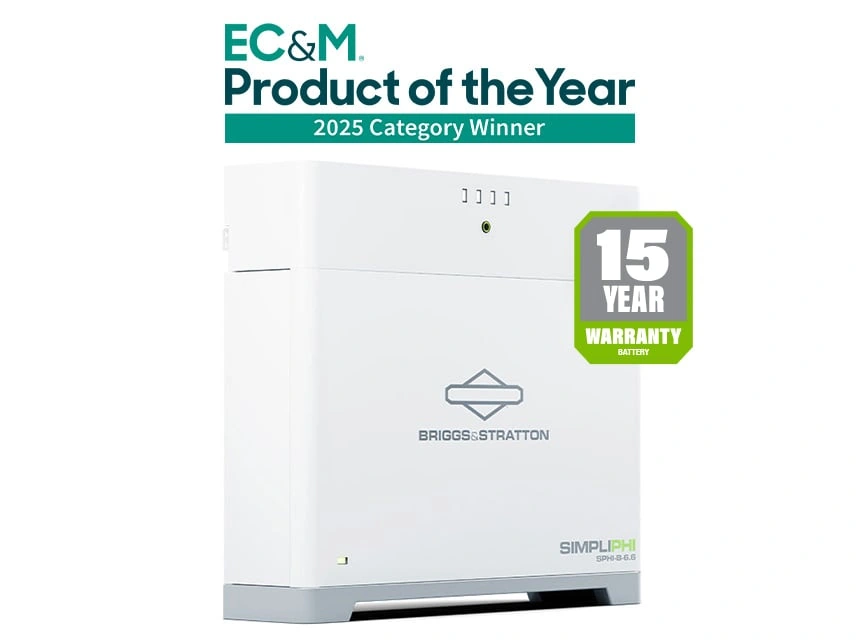
When battery space is tight, the location can shape the whole solar-storage project. That’s one reason I like the Briggs & Stratton SimpliPHI 6.6. It gives us more than one practical way to organize the battery bank instead of forcing every customer into the same cabinet or room.
The useful combination is its compact stackable format, RapidStak connections, and flexible installation options. Each battery provides 6.65 kilowatt-hours (kWh) of rated energy. Three batteries provide 19.95 kWh, and the system can scale to as many as 18 batteries, or 119.7 kWh, when the inverter, protection equipment, and site are designed for that size.
Start with a location you can actually service
The SimpliPHI 6.6 is designed for indoor or outdoor installation. It can be wall-mounted or ground-mounted, and its enclosure is rated IP65 when installed. That opens up useful choices for a garage, utility area, shed, or exterior wall.
Outdoor-rated does not mean “put it anywhere.” The battery still needs an approved non-habitable location, a suitable mounting surface, required clearances, protection from site hazards, and enough room for inspection and future service. I don’t want to squeeze a battery into the last available corner if doing so makes the wiring, clearances, cable routing, or service work awkward.
RapidStak keeps a tight wall cleaner
Traditional battery banks can involve multiple power cables, communication cables, switches, and connection points between modules. The SimpliPHI 6.6 uses RapidStak connectors so power and communications come together through the stack connection. Briggs & Stratton also describes the system as having no inter-battery wires and no DIP switches for the stack assembly.
That does not make the entire installation automatic. The battery controller, inverter connection, overcurrent protection, grounding, cabling, and system settings still have to be matched correctly. What RapidStak does is make the physical battery assembly more orderly. “Wire-free” describes the stack connections; it does not mean the finished energy-storage system has no electrical wiring.
Right- or left-side routing can save space
Briggs & Stratton also offers a dual-sided 6.6 Battery Controller that allows the inverter connection to be routed from either side of the stack. That is a small detail on paper, but it can matter when the inverter is already fixed on the wall.
If the inverter is to the right of the battery stack, the installer may be able to keep the connection path on that side instead of crossing in front of the batteries or adding unnecessary bends. The exact arrangement depends on the approved installation method, cable requirements, and the controller revision used at the site, but this is the kind of practical flexibility I look for before I recommend a battery.
Choose the battery count around the loads
A three-battery stack gives you nearly 20 kWh of nameplate storage, but that number is not the same thing as whole-home runtime. Your inverter, essential-load panel, battery settings, solar production, and the appliances running during an outage all affect the result.
A customer backing up refrigeration, internet equipment, lighting, medical equipment, and selected kitchen circuits may need a very different system from someone trying to run air conditioning, water heating, and a large range. I start by separating the loads you truly want during an outage from the loads that can wait. Then I match the battery count and inverter to that plan.
Match the inverter before finalizing the layout
The SimpliPHI 6.6 is a 51.2-volt battery with CAN and RS485 communications for supported inverter integrations. That communication matters because a compatible inverter can understand the battery’s operating limits instead of treating it like an unknown voltage source.
Briggs & Stratton publishes integration information for supported platforms and specific inverter models, including selected EG4, Sol-Ark, and Solis equipment. A 48-volt label by itself does not prove that an inverter will communicate correctly with the battery. I want the exact inverter model, communication method, protection equipment, and settings identified before we finalize the battery location.
Where this battery fits best
I see the SimpliPHI 6.6 as a strong candidate when you want a clean battery bank, flexible placement, and a practical path to expand storage in the same general area. Adding batteries later still depends on the inverter, controller, protection equipment, mounting space, and local requirements, so expansion is best planned from the beginning.
If your available space is unusual, send me the inverter model, a few photos of the proposed battery location, and a list of the loads you want to protect. I can help you decide whether the SimpliPHI 6.6’s layout flexibility is useful for your home and what size system deserves a closer look.