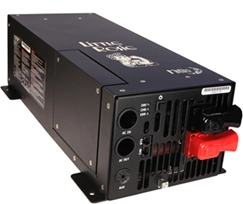
One feature I appreciate about the MidNite Little Rosie is that it gives a 48-volt battery system more than one way to get back on its feet. That matters with lithium batteries, because the battery-management system can disconnect the battery when voltage gets too low or another protective limit is reached.
That does not mean every battery problem is harmless or that the inverter can repair a damaged battery. It means the stationary MNLR4548RE has a documented recovery path when a compatible battery has temporarily disconnected or been deeply discharged.
A Little Rosie system has two normal jobs
The MNLR4548RE is a true-sine-wave inverter and charger for a stationary 48-volt system. On battery power, it supplies 120-volt alternating current (AC) to the loads. When qualified utility or generator power is available, it can transfer that AC to the loads and charge the battery bank.
The numbers give you a useful sense of its place in a system. The Little Rosie is rated for 4,500 volt-amperes of continuous output at 25°C, with a five-second surge rating of 6,750 watts. Its built-in charger can provide up to 60 amps of direct current (DC), subject to the battery manufacturer's requirements and the actual operating conditions.
That is a strong fit for a compact off-grid cabin, a small backup system, or selected household loads. It is not a promise that a small battery bank can run every large appliance indefinitely. The battery still has to provide the current, and the battery's stored energy still determines how long the loads can operate.
If you want to see the hardware itself, Current Connected's Little Rosie surge test and disassembly is a useful companion lesson. It shows the inverter being tested and then explains components inside the unit. It is not a battery-recovery procedure, but it gives you a clearer feel for the equipment behind the ratings.
What happens when a lithium battery disconnects?
Here is the practical example I want customers to understand. Suppose a lithium battery falls below the level at which its battery-management system protects the cells by disconnecting the output. The inverter may suddenly lose its normal battery connection even though the battery itself is not necessarily ruined.
MidNite documents a Lithium Battery Start mode for this situation. If the battery falls below 36 volts DC and disconnects, connecting qualified AC power allows the Little Rosie to place a limited 48-volt charging source at the battery terminals. Once the battery voltage rises, holding the inverter's momentary switch for at least 10 seconds exits that recovery mode and returns the unit to normal operation.
For a more deeply discharged battery, the manual also describes Dead Battery Boot. This mode must first be enabled with the MNGP2 remote, and it uses an adjustable higher charging current to attempt to bring the battery voltage back up. That is a commissioning and service function, not something I would treat as permission to ignore a battery alarm or manufacturer instructions.
The battery manufacturer still has the final say on acceptable voltage, current, temperature, and recovery procedure. If a battery will not accept charge, shows a persistent fault, or has opened its protection repeatedly, stop and investigate the battery and communications before continuing.
Why the battery match still matters
The Little Rosie accepts a battery input range of 40 to 63 volts DC, but voltage range alone does not make every 48-volt battery a good match. I also want to know the battery's continuous discharge rating, charge-current limit, low-temperature rules, communication options, and the way its battery-management system behaves during a protective shutdown.
The inverter includes a Controller Area Network, or CAN, connection for compatible devices. With the optional MNGP2 remote and a compatible current shunt and Whiz Bang Jr., the system can also track battery current and state of charge more intelligently. Those tools help separate “the battery is empty” from “the battery management system has disconnected” and from “there is a wiring or protection problem.”
For lithium batteries, MidNite's manual specifies zero temperature compensation from the Little Rosie by default because the battery-management system handles that function. That is an important setup detail. The correct charging profile belongs to the exact battery, not to a generic lithium label.
A useful fit for a supportable Hawaii system
I like the Little Rosie when the customer wants a compact stationary inverter/charger without giving up useful controls. It can provide 120-volt backup power, charge from utility or a compatible generator, work with a 48-volt battery bank, and give a qualified installer a defined path for low-voltage recovery.
The right next step is to match the MNLR4548RE to your actual loads and exact battery model before choosing settings. If you are planning a small off-grid system or backup panel in Hawaii, contact SolarMan and I can help you compare the battery, charger, solar-controller, and load requirements as one system.