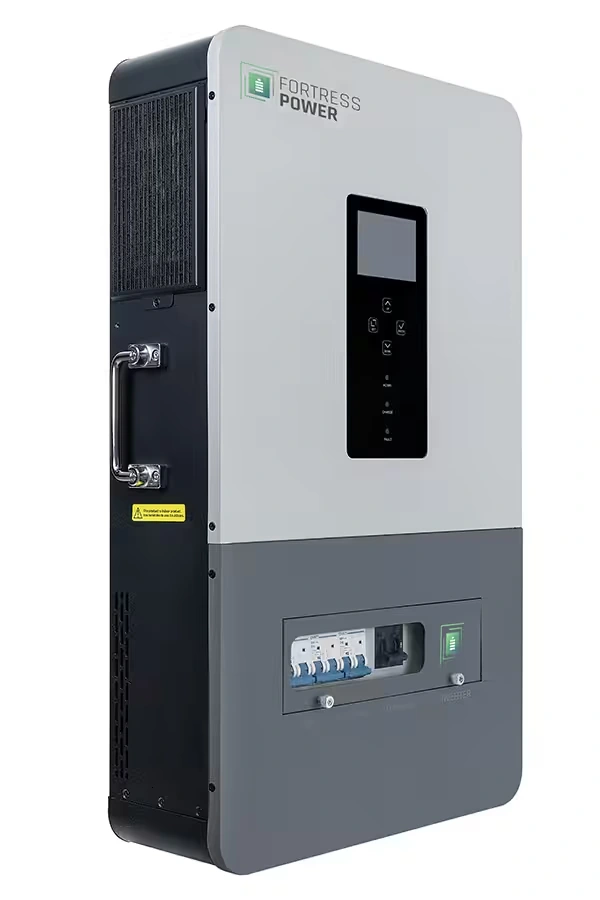
What I like about the Fortress Power Solo 6.5K is that it gives us two independent solar paths to work with. That can make a real difference when a Hawaii array is split between a main roof and a carport, or between two roof areas with different orientations. Instead of treating the whole array as one group, we can plan each maximum power point tracking, or MPPT, channel around the part of the array it actually serves.
That flexibility doesn’t mean every roof section automatically gets its own input. The panel strings still have to fit the inverter’s voltage, power, and current limits. But two independent MPPT channels give us a cleaner starting point, especially when the available roof space isn’t one perfectly uniform rectangle.
Give each array area the right path
The Solo 6.5K lists two MPPT channels with up to 5,000 watts assigned to each channel. Together, that is 10,000 watts of listed PV input. Think of that as the inverter’s planning envelope, not a promise that a 10 kW array will produce 10 kW all day. Sun angle, shade, temperature, panel orientation, and the battery’s ability to accept charge still matter.
Series-connected panels add voltage. Parallel strings add current. That simple distinction is the key to reading a Solo 6.5K PV plan. A string needs enough voltage to operate properly, while the current entering each MPPT must remain within the inverter’s input limits.
Keep the two current questions separate
This is where I slow down, because two current numbers can look similar while answering different questions. Operating current is the current the MPPT sees while the array is producing power. Short-circuit current, written as Isc, is a separate array and protection value. Passing one check does not automatically pass the other.
For example, if one string has about 13 amps of operating current, two matching strings in parallel would be about 26 amps at that operating point. That is above the manual’s 18-amp maximum usable-current figure. The strings’ short-circuit current needs its own check as well, and it will usually be higher than the operating-current figure.
There is also a documentation detail I want to handle honestly. The current Fortress product page and English data sheet list 18 amps per MPPT as maximum input short-circuit current. The installation manual’s data table lists 25 amps maximum DC short current and 18 amps maximum usable DC current, but the PV-connection section later states 18 amps per MPPT as maximum short-circuit current. Because the same manual does not present that limit consistently, I would not treat 25 amps as an automatic design allowance. I would use the conservative 18-amp working limit and get Fortress confirmation before approving an array that approaches it.
Voltage decides how many panels belong in a string
The published MPPT operating range is 150 to 450 volts DC. A proposed string should operate inside that range during normal production. Its open-circuit voltage must also be checked at the project’s lowest temperature, because panel voltage rises as the cells get colder.
There is another detail worth catching early. Fortress’s data tables list a 550-volt maximum PV voltage, but the PV connection section of the current installation manual tells installers to keep the cold-corrected string voltage at or below 500 volts. For a real design, I would follow that more conservative installation instruction unless Fortress confirms a different limit for the exact revision in hand.
That temperature correction is not just a mainland concern. Hawaii is mild, but the correct calculation still uses the panel manufacturer’s voltage-temperature coefficient and the actual project conditions. A string that looks acceptable at a room-temperature test point is not automatically acceptable at its coldest expected condition.
Where the Solo 6.5K fits well
I see this inverter fitting well when you want a 48-volt battery system, substantial solar charging, and the option of either 120-volt or 120/240-volt output depending on the system design. Fortress lists up to 140 amps of battery charging from PV, along with grid and generator input. That gives the inverter a useful role in a backup, self-consumption, or off-grid system without forcing the solar array into one simple roof layout.
The Solo 6.5K is approved for indoor installation. Fortress says it can be placed outdoors when installed inside the company’s FlexTower enclosure. That location decision belongs in the early planning, because the inverter, battery bank, PV conductors, and service equipment all need to work together.
Fortress Power’s short Solo 6.5K overview is useful if you want a quick introduction to the inverter’s output, solar charging, grid and generator inputs, and scalable design. It’s a product overview rather than a string-sizing lesson, so I would still use the exact installation manual and current Fortress sizing tools for the PV voltage and current checks.
Let’s match the array before you buy panels
Bring me the exact panel model, its voltage and current values, the number of panels you’re considering, the roof or carport layout, and a rough battery plan. I can then check each MPPT channel, the cold-corrected string voltage, both current limits, and the total PV power instead of simply adding panel wattage and hoping the rest works.
If you’re considering a Solo 6.5K for a Hawaii home, cabin, workshop, or backup system, contact SolarMan. I’ll help you see whether the panels, battery bank, inverter, and household loads belong together before the equipment is ordered.