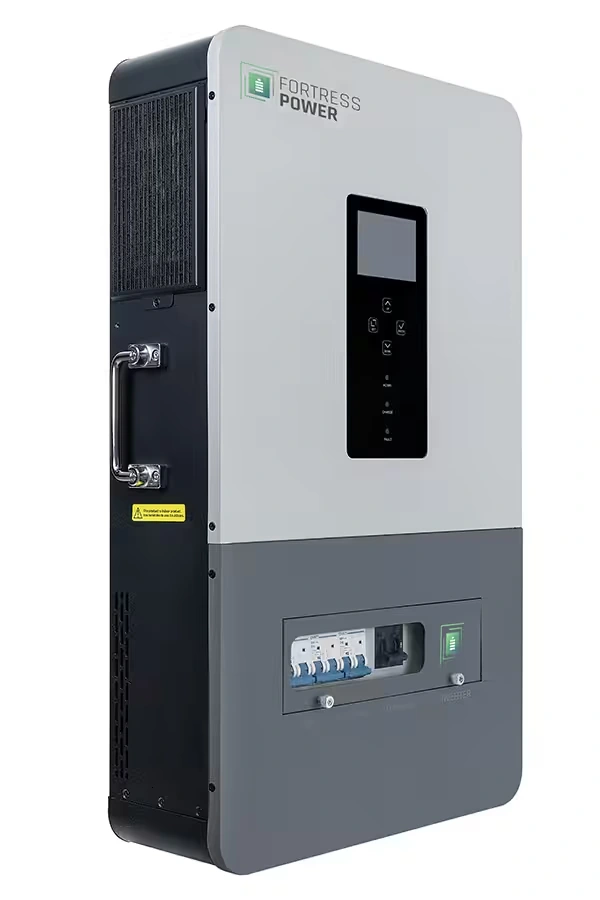
When I talk with a customer about the Fortress Power Solo 6.5K, I don’t start with the 6.5-kilowatt number by itself. I start with what you want to run, how long you want to run it, and what battery bank will support that plan.
That’s because inverter power and battery energy answer two different questions. The Solo 6.5K can deliver up to 6,500 watts of rated output. The battery bank determines how long that power is available. A strong inverter can still need more battery capacity when the goal is overnight operation or longer backup.
Start with the loads you actually care about
Power is what your equipment uses right now. Energy is the amount stored for later. A refrigerator, pump, microwave, or air conditioner may create a short high-demand moment. Lights, Wi-Fi equipment, and essential outlets may use less power but run for many hours.
Here’s a simple planning example. If your essential loads average 2,500 watts for four hours, that is 10 kilowatt-hours of energy before inverter losses, battery reserve, and other system limits. The math is 2,500 watts multiplied by four hours. That number gives us a much better starting point than simply saying, “I want a 6.5-kilowatt inverter.”
The Solo has room above a 2,500-watt running load, but I don’t treat the 6.5K label as permission to run every large appliance at once. I use it as a starting point for matching your load panel, battery bank, solar array, and backup goals.
Why 48 volts is a practical foundation
The Solo 6.5K uses a 48-volt direct-current battery platform. Higher battery voltage lets the system move substantial power with less current than a comparable 12-volt or 24-volt system.
Here’s the useful customer-level math: 6,500 watts divided by 48 volts is about 135 amps. That is a nominal starting calculation before inverter losses and the battery voltage changing under load. Fortress’s current manual lists a maximum battery discharge current of 150 amps, so the battery’s continuous discharge capability matters. This is not a place where I choose capacity alone and ignore current.
The bank also needs suitable overcurrent protection, correctly planned conductors, and battery communication when the selected battery supports it. Fortress’s manual lists different minimum battery quantities for compatible families. For one Solo 6.5K, the table shows one eBoost 16-kilowatt-hour battery, one eForce 9.6-kilowatt-hour battery, one eVault MAX 18.5-kilowatt-hour battery, or two eFlex MAX 5.4-kilowatt-hour batteries. That does not make every option equal; stored energy, discharge power, usable capacity, and expansion plans still need to match your loads.
Solar recovery is part of battery planning
The Solo 6.5K includes a built-in solar charge controller rated for up to 140 amps of battery charging. I like that for an off-grid home or a backup system that needs to recover after an outage.
But 140 amps of charging is not the same thing as 6,500 watts of AC output. Charging power flows into the battery. Inverter output power flows from the battery toward your household loads. The battery bank has to be comfortable with both directions, and the actual limits depend on the selected battery model and final system configuration.
The Solo has two maximum-power-point-tracking, or MPPT, solar channels. Fortress lists up to 5,000 watts per channel, a 550-volt maximum PV voltage, and a 150-to-450-volt MPPT operating range.
One detail I always keep straight is that PV operating current and array short-circuit current are not interchangeable. The current installation manual separates a 25-amp maximum short-circuit figure from an 18-amp maximum usable current per MPPT, while the current datasheet presents a different short-circuit-current label. I would have the installer use the exact document revision supplied with the unit. That check matters even more with bifacial panels, because rear-side contribution can raise array current.
When this approach fits a Hawaii system
I see the Solo 6.5K making sense when you want one inverter platform to coordinate solar, a 48-volt battery bank, and either grid or generator input. It supports backup and off-grid applications, with selectable 120-volt or 120/240-volt output planning for the loads the system is meant to serve.
The right battery choice depends on whether you care most about short high-power events, overnight energy, longer outage coverage, or future expansion. A compact essential-load panel may need a different bank than a system expected to support pumps, refrigeration, workshop equipment, or larger household loads.
Battle Born’s educational lesson, “How to Size an Inverter (And When Surge Limiting Is Needed),” is a helpful general introduction because it separates running loads, startup surge, and battery support. It isn’t a review of the Solo 6.5K, but those are the same three questions I use when I sit down with a customer.
If you’re considering the Solo 6.5K, send me your main loads, desired backup time, panel plan, and any generator information you already have. I can help you see whether the inverter and battery bank are sized as one working system. Contact SolarMan and we’ll talk through the match before you buy equipment.