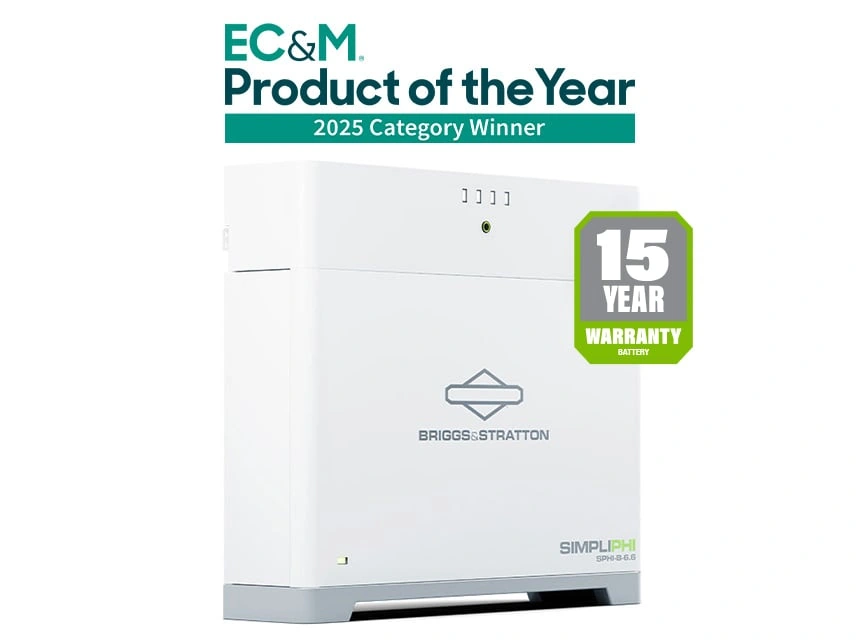
When someone tells me they want battery backup, I don't start by asking how many batteries they can fit on a wall. I start with what they want to keep running. Refrigeration, lights, internet equipment, medical devices, water pumps, and selected kitchen loads can lead to a very different battery plan than trying to run every appliance in the house.
That is one reason I like the Briggs & Stratton SimpliPHI 6.6. It gives us a useful building block instead of forcing every customer into one fixed battery size. Each battery is rated at 6.65 kilowatt-hours (kWh), and the system can use up to three batteries in one stack. That works out to 6.65, 13.30, or 19.95 kWh of rated energy before we even discuss larger multi-stack systems.
Start with the loads, not the battery count
Suppose your backup plan averages about 1 kilowatt of load while the battery is supporting the house. One SimpliPHI 6.6 has enough nameplate energy to give us a meaningful starting point for that conversation. Two batteries give us roughly twice the energy, and three give us roughly three times the energy. The actual runtime will depend on inverter efficiency, operating limits, the loads themselves, and how much energy the system reserves.
That last part matters. A battery's kWh rating is not a promise that your house will run for a certain number of hours. A refrigerator cycles. A pump may start with a short surge. A water heater or range can consume energy quickly. I use the rating to build the plan, then match the inverter and backup loads to what you really need during an outage.
The modular design gives you breathing room
Some customers know their target immediately. Others want backup now and more solar or storage later. The SimpliPHI 6.6 gives us a way to begin with one, two, or three batteries per stack, with the manufacturer describing expansion up to six stacks, or 18 batteries, for larger systems.
That does not mean every inverter can automatically use every possible battery arrangement. The inverter, battery communication method, system current, installation rules, and commissioning settings still have to match. But the modular format gives us a better conversation: we can size the first stage around your important loads instead of buying a much larger bank simply because the future is uncertain.
RapidStak removes a lot of ordinary installation clutter
The RapidStak connector is another feature I pay attention to. Briggs & Stratton designed it to bring power and communications together in one connection between batteries. There are no loose inter-battery cables in the stack and no battery DIP-switch setup to sort through.
That does not make the installation a do-it-yourself wiring project. Battery placement, mounting, protection, inverter settings, communications, and final commissioning still belong in a properly designed installation. What RapidStak can do is reduce the number of connection points that the installer has to manage and make a planned stack easier to assemble consistently.
Indoor or outdoor placement can help in Hawaii
The SimpliPHI 6.6 is designed for indoor or outdoor installation. Briggs & Stratton lists an IP65 rating when installed, along with ground- or wall-mount options. That gives us more flexibility when a customer has limited indoor utility-room space or would rather keep the batteries in a suitable protected outdoor location.
Outdoor-rated does not mean “put it anywhere.” The location still needs to meet the manufacturer's installation requirements, local electrical rules, clearances, temperature limits, and structural requirements. Hawaii's salt air and weather exposure make site selection especially important, so I look at the actual location rather than treating the rating as a shortcut.
Choose the inverter as part of the battery decision
The SimpliPHI 6.6 is intended to integrate with supported inverter platforms, including selected EG4, Growatt, Megarevo, Solis, and Sol-Ark equipment. Closed-loop communication means the inverter and battery can exchange operating information instead of relying only on fixed voltage assumptions.
The exact inverter model still matters. I want to confirm the approved integration guide, battery quantity, communications path, charge and discharge limits, and commissioning procedure before calling a combination a match. That is where a battery stops being a product on a shelf and becomes part of a working system.
Briggs & Stratton's SimpliPHI 6.6 Battery System video is useful because it shows the battery platform as an assembled system, including the stack and controller relationship. It is a practical introduction to why the wire-free design matters, not a substitute for the project-specific installation instructions.
If you are planning backup power, solar-plus-storage, or an off-grid system, contact SolarMan and tell me what you want to keep running first. I can help compare a one-, two-, or three-battery starting point and then check whether the SimpliPHI 6.6 fits the inverter and future expansion plan you have in mind.