I like the Pytes V16 because it gives us a serious storage platform without forcing the battery to live indoors. It has a 51.2-volt lithium iron phosphate battery system, about 16 kilowatt-hours of nameplate energy, outdoor-rated construction, and room to expand in parallel. But there’s one part of the match I want to get right before I recommend it: the inverter has to communicate with the battery properly.
That communication is what lets the battery-management system, or BMS, report useful information such as state of charge, temperature, charge limits, discharge limits, and faults. The inverter can then adjust its operation instead of treating the V16 as a simple battery with no feedback. Pytes lists CAN, RS485, RS232, dry-contact, and Wi-Fi interfaces for the V16, but those connection types do not mean every inverter uses the same cable, pinout, or software profile.
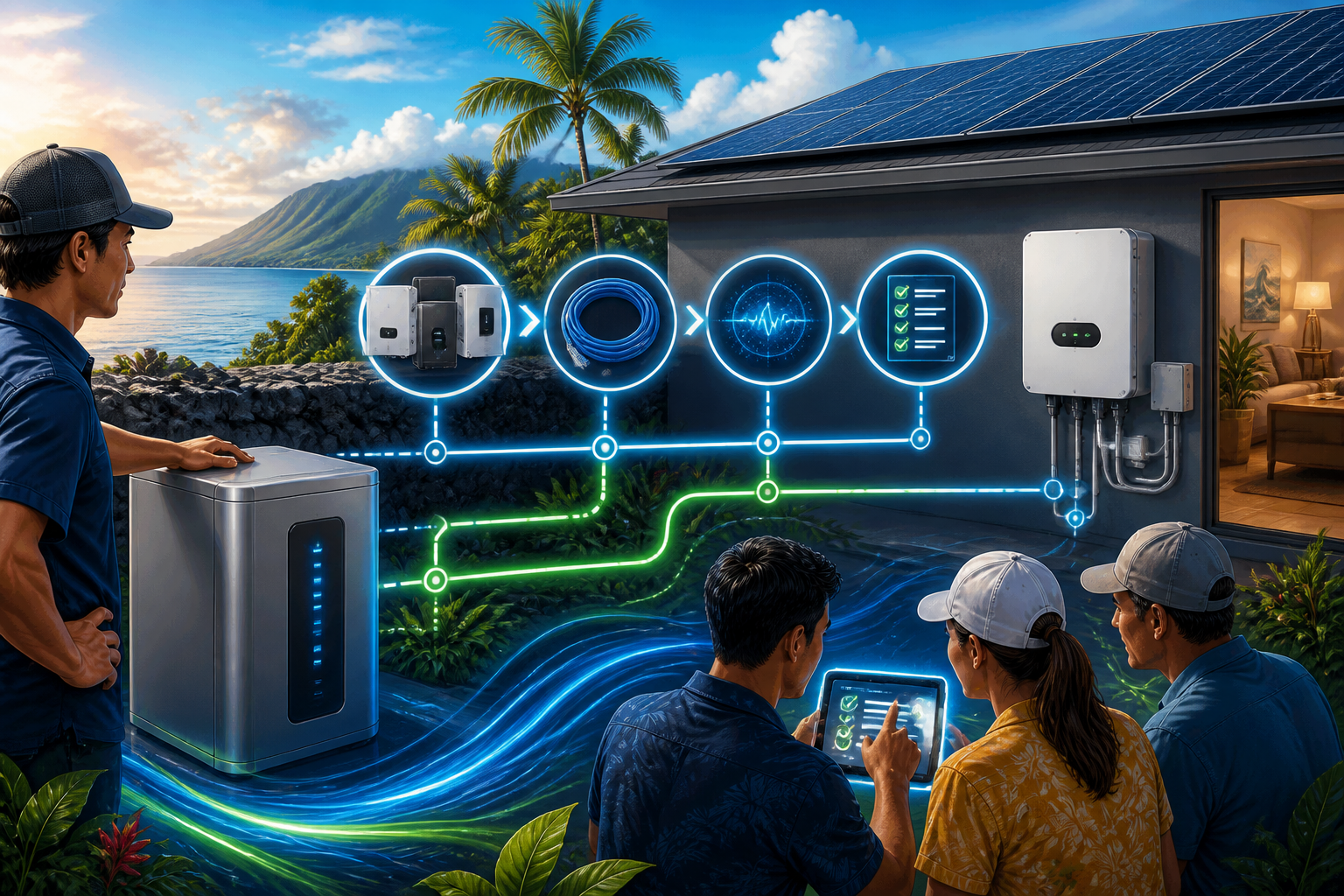
The Pytes compatibility list is a starting point
Pytes’ V16 documentation lists inverter families including Sol-Ark, Victron, Solis, Deye/Sunsynk, Luxpower, GoodWe, Growatt, SMA, Megarevo, Afore, Phocos, Voltronic, SRNE/INHENERGY, MUST, Studer, Hoymiles/APsystems, Ingeteam, Senergy, Aiswei/Solplanet, Livoltek, and Epever.
That gives us a useful starting point for a Hawaii design, especially when we’re planning around an inverter family I already know and support. Still, I don’t treat a brand name as a final approval. “Solis” or “Victron,” for example, covers multiple inverter models, firmware versions, and communication arrangements. The exact inverter model must be checked against the current Pytes documentation and the inverter manufacturer’s battery-compatibility information before the system is ordered.
51.2 volts is only the electrical starting point
A compatible battery voltage tells us that the V16 can operate on the inverter’s low-voltage battery bus. It does not prove that the inverter can read the V16’s BMS data.
That distinction matters. A system may be electrically capable of charging and discharging a 51.2-volt battery while still operating in an open-loop mode, where the installer enters fixed voltage and current settings manually. Closed-loop communication is different. The inverter receives live battery information and can respond to changing limits or faults. For a large battery like the V16, I prefer confirmed closed-loop communication whenever the inverter and documentation support it.
There are documented examples. Pytes describes CAN and RS485 communication between the V16 and Sol-Ark systems. Its Victron guidance requires a GX device such as a Cerbo GX and the correct BMS-CAN communication path for charge and discharge limits, error codes, and state-of-charge information. That is exactly why “it has a CAN port” is not enough by itself.
What I check before calling it a match
I want four pieces to agree: the exact Pytes V16 revision, the exact inverter model, the supported communication profile, and the correct communication cable. The V16 documentation directs the installer to use either the battery’s CAN or RS485 path according to the inverter protocol, then set the communication address with the documented DIP-switch position.
A cable that fits an RJ45-style port can still have the wrong internal pin arrangement, so physical fit is not proof of compatibility. I want the cable and pinout identified for that specific battery-and-inverter combination. I also want the battery profile and firmware requirements confirmed before the equipment is placed in service.
For a parallel battery bank, the communication plan matters even more. The batteries need to be arranged as a coordinated bank, with the designated master battery handling the inverter-facing communication path according to the Pytes instructions. I don’t want the inverter powered first while the batteries are still off. Pytes’ startup sequence calls for powering the V16 before the inverter to help avoid the inrush current associated with the inverter’s input capacitors.
After startup, I want to see the inverter receiving believable state-of-charge information, battery voltage, charge and discharge limits, temperature, and fault status. If those values are missing or clearly wrong, the system is not finished just because the inverter is producing power.
Where the V16 fits well
The V16 makes particular sense when you want substantial storage, outdoor placement, and a documented inverter relationship. One unit can be a strong starting point for essential-load backup. Multiple units can provide more energy and more battery-side capability, but the inverter, conductors, protection equipment, communication network, and load plan all have to grow with the bank.
The official Pytes video included with this lesson takes you inside the V16 rather than walking through a complete installation. Logan shows the shielded communication cables, BMS-related components, current measurement, inverter pre-charge circuit, and outdoor protection features. That makes the battery-to-inverter relationship easier to understand before we get into the exact system wiring and settings.
That’s the conversation I’d have with you before choosing the battery: not just “How many kilowatt-hours do you want?” but “Which exact inverter will manage them, and what will the system be able to show us when it’s running?” Send me the inverter model you’re considering, or your existing system information, and I can help check whether the Pytes V16 has a documented communication path that makes sense for your Hawaii project.