When I size an off-grid battery bank, I start after sunset. That is when your solar array stops helping and the batteries have to carry the home. For a Big Island house, I want to know what you actually need overnight, what may start suddenly, and how much reserve you want when clouds slow the next day's recharge.
For a general lesson on this process, altE Store's battery-bank sizing video walks through daily energy use, days of autonomy, depth of discharge, and the basic math behind choosing a bank. It isn't a review of the Pytes V16, but it teaches the same planning logic I use before matching the battery to an inverter and a real load list.
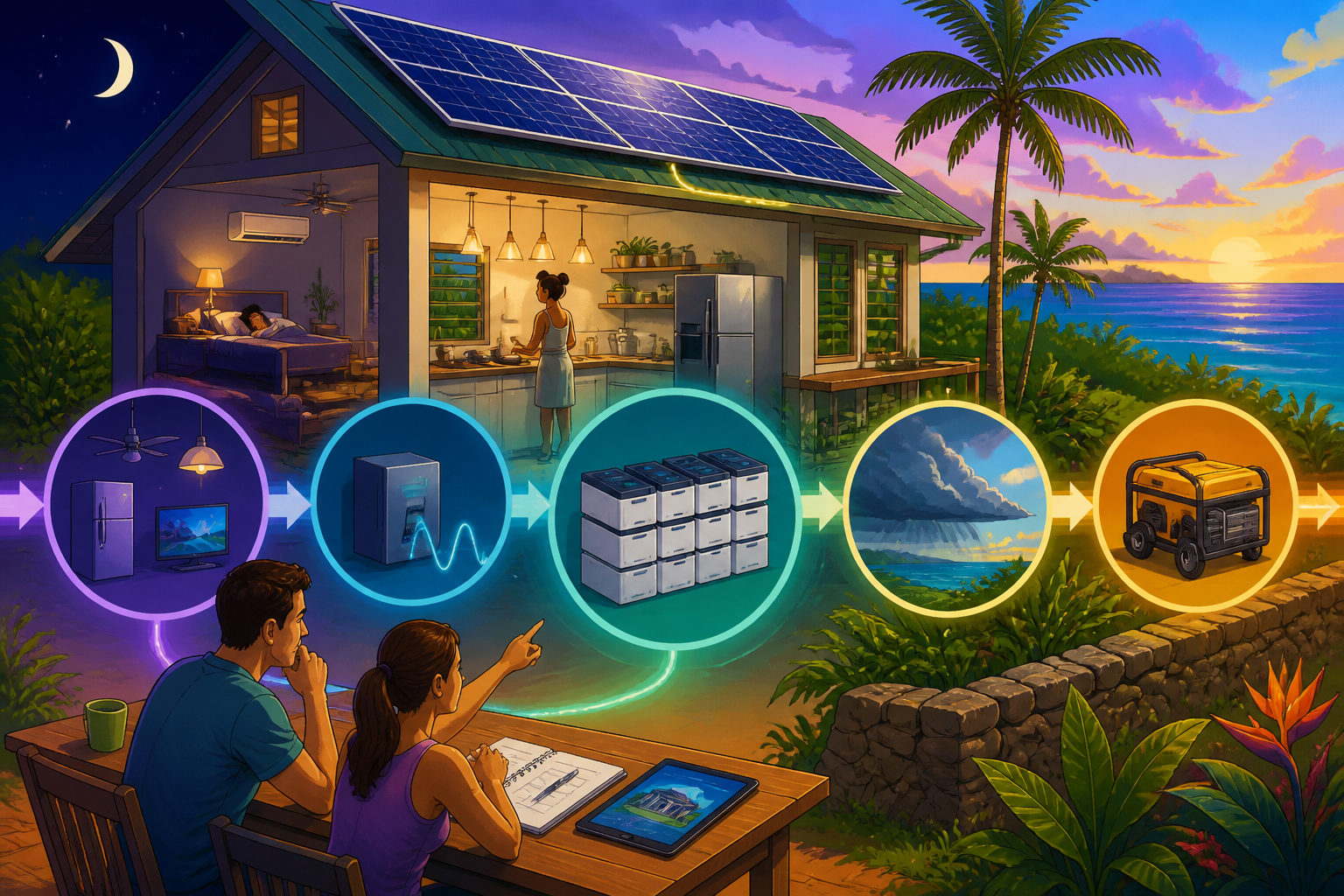
Begin with the overnight energy
Kilowatt-hours, or kWh, measure energy over time. If your home averages 2.5 kilowatts for 12 hours overnight, the basic calculation is:
2.5 kW × 12 hours = 30 kWh
That might include refrigeration, water pumps, internet equipment, lighting, fans, and selected outlets. It may not include electric cooking, water heating, air conditioning, or a large workshop load. Those choices can change the answer quickly, so I want to see the actual load list instead of guessing from the size of the house.
Leave room instead of using every last kilowatt-hour
I don't plan an off-grid battery bank around draining every battery completely each night. A reserve gives you an operating cushion when the weather changes or an unexpected load appears. As a simple planning example, I can reserve 25% of the V16's nominal energy for that cushion. That leaves about 12.05 kWh per battery for the main overnight budget, before inverter losses.
That 25% is a planning choice for this illustration, not a claim that Pytes requires exactly that reserve. For a 30 kWh overnight target, the arithmetic is approximately:
30 kWh ÷ 12.05 kWh = 2.49
That points us toward three V16 batteries as a reasonable starting conversation for this example. Three units provide 48.21 kWh of nominal storage, with about 36.16 kWh remaining after the illustrated 25% reserve. That is not a guarantee of runtime. It is a clear way to see why two batteries may feel tight while three give the system more breathing room.
Surge can change the battery count
Energy is only half the question. A well pump, compressor, or motor can demand much more power for a short time when it starts. The inverter must handle that starting surge, and the battery bank must supply the inverter without hitting its battery-input limit.
One V16 has a 150-amp recommended discharge figure, which is about 7.68 kW at 51.2 volts. Its 200-amp maximum discharge figure works out to about 10.24 kW on the battery side. I treat the recommended figure as the more useful everyday planning reference. The maximum figure is not a promise that every inverter will deliver that much alternating-current output or accept the same surge.
Adding batteries can increase available battery-side current, but it does not automatically make an undersized inverter handle a larger motor start. The inverter's continuous output, surge rating, battery-input limit, wiring, and protection equipment still have to agree.
Cloudy weather deserves its own decision
On the Big Island, solar production can vary with cloud cover, terrain, and the season. If you only want to carry one night, the three-battery example may be enough for the illustrated load. If you want to carry a second cloudy night without starting a generator, you need more storage and enough solar to refill it afterward.
That is where a fourth or fifth V16 may make sense—not because every home needs that many, but because you are buying more weather margin. Pytes documents expansion to as many as 16 V16 units in parallel without a Pytes hub. The inverter, busbars, protection, communications, physical layout, and commissioning plan still have to be designed for the full bank.
A generator is part of the recovery plan
A generator can reduce the amount of battery storage you need, but only if we plan how it will recover the bank. Suppose a cloudy day leaves the batteries 20 kWh short after the home's loads are served. Recovery time depends on the generator's actual net charging power after the home is running—not just the generator's nameplate size.
A properly matched generator can carry daytime loads while the inverter sends the remaining available power into the batteries. If the generator is too small, the system may need a longer run time. If the charge settings are too aggressive for the battery or inverter, charging may be limited. I want the generator, inverter, battery bank, and load priorities working together before I call the design complete.
My practical starting point
For an off-grid Big Island home, I would collect one day of real or estimated energy use, identify motor-starting loads, choose the overnight reserve, and decide whether you want one-night or multi-day autonomy. Then I would compare that information with the V16's energy and current ratings and the exact inverter being considered.
The Pytes V16 is attractive when you want a large outdoor-ready LFP battery with 16.07 kWh of nominal energy per unit, IP66 protection, integrated heating, and a path to parallel expansion. If you're planning a Big Island home, cabin, or farm system, contact SolarMan. I'll help turn your load list and weather expectations into a battery count that fits the way you actually live.