The useful news here is that this pairing has more than a hopeful voltage match behind it. I received direct confirmation from Fortress Engineering that the Fortress Power ENVY DUO 21 supports the Pytes V16. That gives us a real starting point for a whole-home backup or off-grid system.
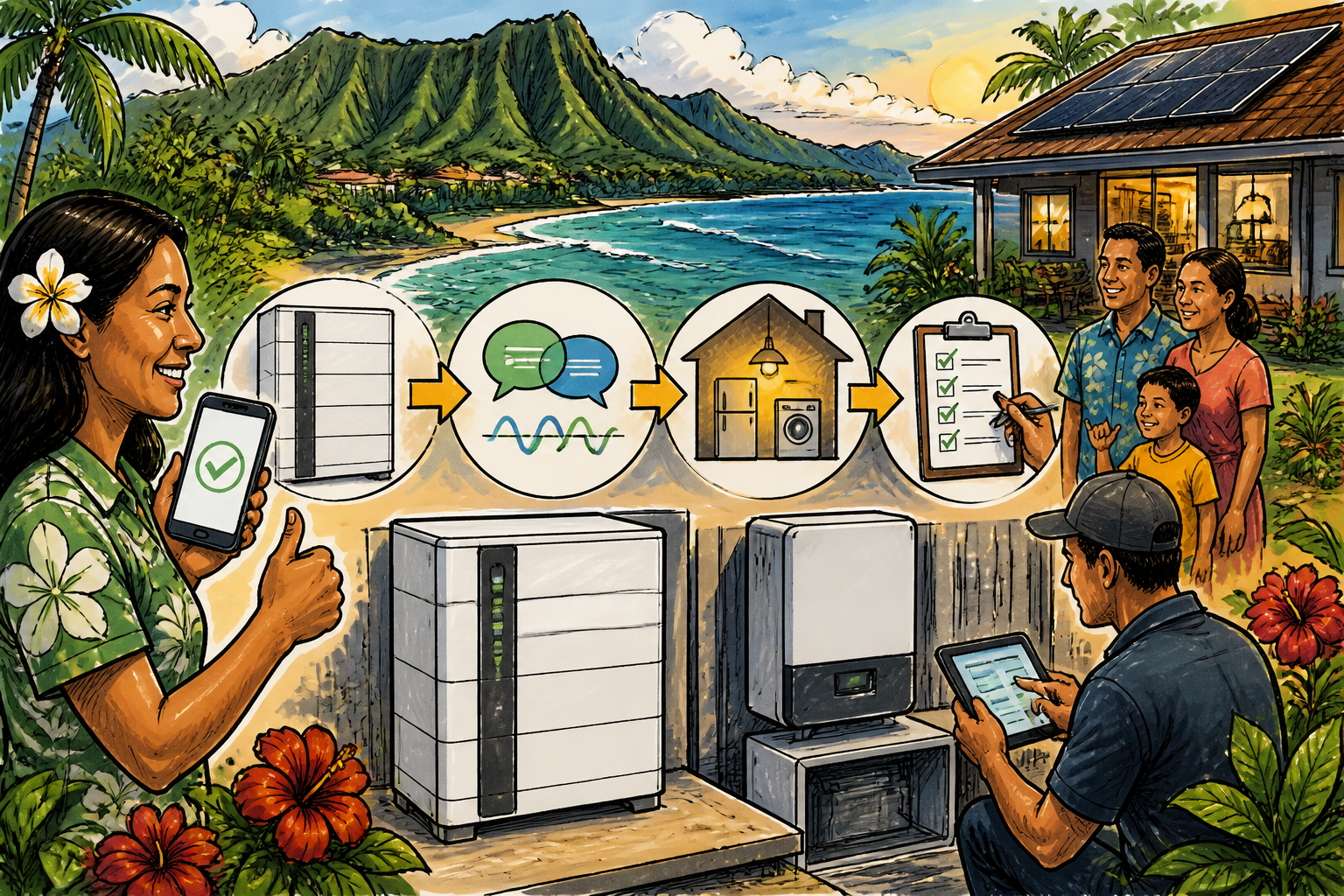
I still want to explain what that confirmation does—and does not—settle. A supported battery pairing is not the same thing as a finished wiring plan. We still have to match the exact battery revision, inverter model, communication method, firmware, battery limits, and household loads.
What the V16 brings to the pairing
The Pytes V16 is a 51.2-volt lithium iron phosphate battery with 16 kilowatt-hours of rated energy. Pytes lists 150 amps, or about 7.68 kilowatts, as the recommended continuous discharge level. Its maximum continuous charge and discharge rating is 200 amps, or about 10.24 kilowatts.
That is a substantial amount of storage and battery-side power in one outdoor-rated enclosure. The V16 is IP66-rated, uses an internal heating film, and supports wall or ground mounting. For a Hawaii project, that gives us useful placement flexibility when an indoor battery room is not the best fit. Ground mounting does require the appropriate additional bracket, and the location still needs to leave room for access and service.
The ENVY DUO 21 is also designed around a 48-volt-class battery system. Fortress lists a 40-to-60-volt battery range, maximum charge and discharge limits of 250 amps, and 12 kilowatts of continuous battery-only output.
Here is the important part: the inverter’s 250-amp limit does not turn one V16 into a 250-amp battery source. One V16 has its own current limits. I would plan the battery quantity and backed-up loads around the lower system limit, along with the starting demands from equipment such as air conditioners, pumps, compressors, or other motors.
Why the direct confirmation matters
Fortress describes the ENVY platform as battery-agnostic, and its public technical sheet includes Pytes as a supported battery brand. But the Pytes models shown on that sheet are the E-BOX 48100R, E-BOX 4850, and V5—not the V16.
That distinction matters. A brand-level compatibility list is not automatically a model-level approval. The direct V16 confirmation answers the specific question we care about: can this exact Pytes battery be considered with this exact Fortress inverter? In this case, Fortress Engineering has told SolarMan that it can.
Pytes documents CAN and RS485 communication for the V16 and provides inverter-specific communication selections in its battery documentation. The V16 material I reviewed does not give us an ENVY DUO 21 protocol, cable pinout, or switch position to guess from. Fortress publishes its own communication ports and commissioning sequence, but those documents also do not replace the project-specific confirmation.
How I would turn approval into a system
First, I’d record the exact V16 revision, the exact ENVY DUO 21 model, and the current manuals and firmware versions. Then I’d confirm whether the approved installation uses closed-loop battery communication or an open-loop arrangement, along with the correct cable and inverter settings.
Next, I’d match the V16’s current capability to the inverter and the loads. Sixteen kilowatt-hours tells us how much energy the battery stores; it does not tell us how many large appliances can start together or how long every load will run. Battery quantity, conductors, overcurrent protection, the backed-up load panel, and inverter limits all belong in that same design conversation.
Commissioning should then prove that the system understands the battery. Pytes instructs installers to power the V16 before turning on the inverter. Fortress’s startup sequence calls for checking battery voltage and state of charge, applying the appropriate firmware and settings, and confirming that the backed-up loads operate correctly before the homeowner depends on the system.
The official Pytes V16 installation lesson is a useful visual companion. It walks through mounting, the conduit box, inverter preparation, power and communication connections, and startup. It shows the installation flow clearly, while the exact ENVY-specific communication method still needs to come from the approved project documentation.
This is why I’m interested in the Pytes V16 with the Fortress ENVY DUO 21. The direct engineering confirmation gives us a credible path instead of forcing us to guess from a similar battery or a generic 48-volt statement. If you’re considering this combination for a Hawaii home, cabin, or off-grid project, contact SolarMan. I can help match the battery quantity, inverter role, communications, loads, location, and commissioning plan before we turn the approval into a complete system.