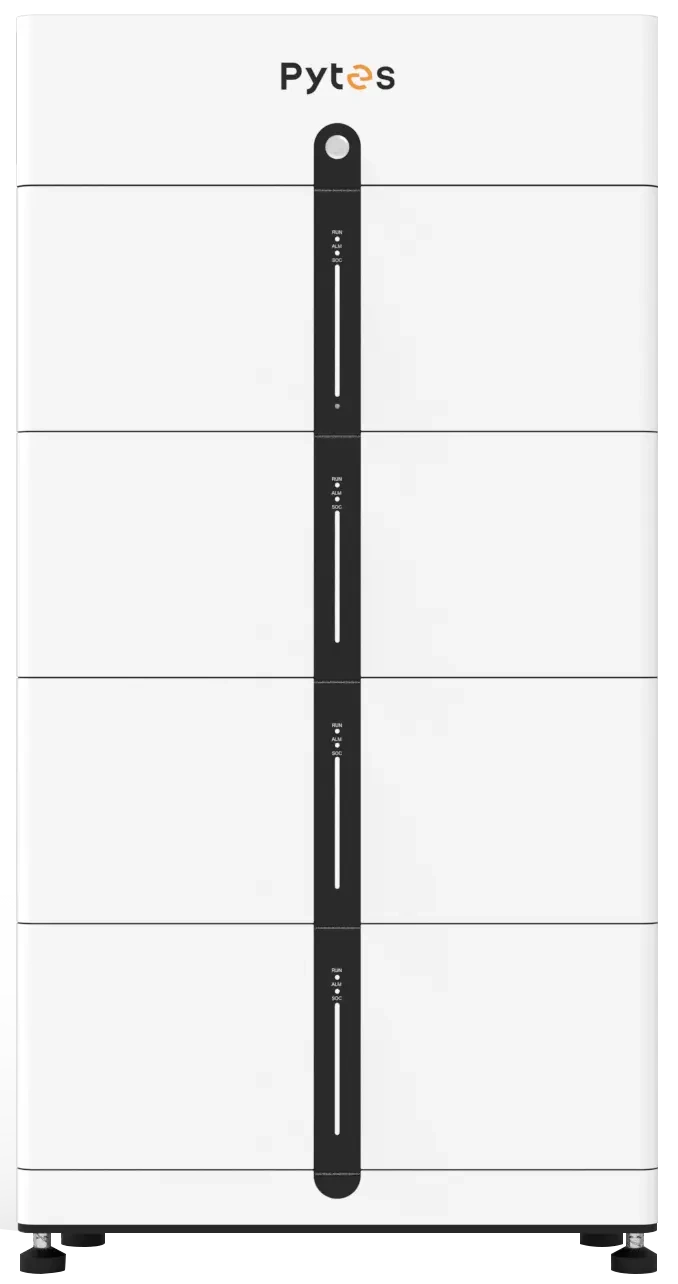
When a Hawaii home has a narrow side yard, a compact utility area, or limited room near the electrical equipment, the battery’s footprint can matter just as much as its kilowatt-hours. That is where I see the Pytes Pi LV1 becoming interesting. Its published stack dimensions stay about 26.8 inches wide and 9.5 inches deep, while the storage capacity grows upward through Battery Management Units, or BMUs.
The Pi LV1 is not one oversized battery box that forces every customer into the same layout. A stack uses individual Pi LV1 BMUs together with the Battery Control Unit, or BCU. The BCU is the stack controller that organizes the battery system’s communication with the inverter. That architecture gives us more room to match the battery to the property instead of trying to make the property fit one battery shape.
The footprint stays nearly the same as the stack grows
Pytes lists a two-BMU stack at about 31.5 inches high with 10.24 kilowatt-hours of nominal energy. Four BMUs reach about 52 inches and 20.48 kilowatt-hours. Six BMUs reach about 72.4 inches and 30.72 kilowatt-hours.
That is a useful planning difference. If floor space is difficult but vertical clearance is available, adding battery capacity does not automatically require a wider battery wall. It still requires careful access, a suitable base, clearance, and a structure that can safely support the weight.
Pytes’ documentation is not completely consistent on the six-BMU weight. One official U.S. user manual lists 358 kilograms, or 788.2 pounds, while another Pytes technical revision lists 338.2 kilograms, or 745.6 pounds. I would confirm the exact supplied revision and nameplate before finalizing a platform or floor plan. Either figure tells us this is not a piece of equipment I would casually place on an ordinary shelf or light platform.
For many customers, the four-BMU version is a practical conversation starter. It gives you 20.48 kilowatt-hours of nameplate storage while keeping the published stack height near 52 inches. That does not predict your exact runtime, because the home’s loads, inverter losses, battery reserve settings, and operating conditions determine how much energy you can actually use. It does show how the Pi LV1 lets us discuss capacity and physical space together.
The BMUs and BCU need to work as one system
The stackable design is more than placing batteries on top of one another. Each BMU has its own battery management functions, while the BCU coordinates the group and communicates with the inverter. The inverter needs the correct battery profile and communication path so it can receive information such as battery state and charging or discharging limits.
That is why I treat inverter compatibility as part of the product choice, not as a detail to solve later. Pytes provides specific configuration material for supported systems, including Sol-Ark arrangements. The exact inverter model, communication cable, firmware expectations, battery count, and settings all need to agree. A battery can have plenty of stored energy and still be a poor match if the inverter cannot communicate with it properly.
Pytes’ Sol-Ark configuration guide shows the practical order clearly: bring the Pi LV1 online first, then start the inverter, set the battery capacity to match the installed modules, select the supported lithium battery communication mode, and confirm that battery information appears on the inverter screen. Those are commissioning tasks for a qualified installer, but they are useful for you to understand because they explain what a successful handoff should look like.
Outdoor capability still needs an exact model check
Pytes’ current U.S. product page contains both IP66 and IP55 enclosure references, while the user manuals and technical documents list IP55. I would use the exact documentation and nameplate for the revision being supplied before finalizing an exposed outdoor location.
That does not take away from the Pi LV1’s appeal. It simply means placement should be based on the actual unit, not a general picture of the product. Hawaii installations also need attention to rain exposure, salt air, drainage, service access, and the local electrical requirements.
Where I think the Pi LV1 fits best
I would put the Pi LV1 high on the list when you need meaningful battery capacity but do not have much floor width. It can fit a compact equipment area, a retrofit location, or a planned battery room where vertical space is easier to provide than additional wall length. I would be less interested if the only available location cannot support the stack’s weight or does not leave safe access around it.
Pytes’ lesson on connecting the Pi LV1 to a Sol-Ark inverter is useful because it walks through the stack, the BCU, communication, and inverter setup. It is a general installation lesson, not a substitute for the installation manual or a design for your house. The next step is to compare your available width, depth, height, floor support, essential loads, and inverter choice. Contact SolarMan and I can help determine whether the Pi LV1 stack fits the space and the job you want the battery to do.