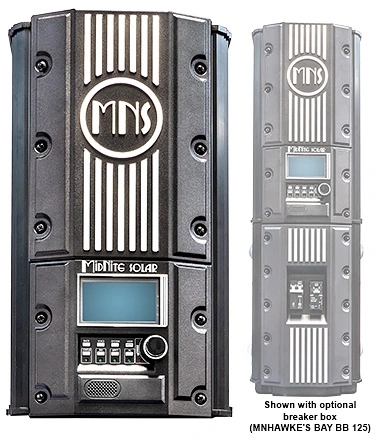
What I like about the MidNite Hawke's Bay is that it lets us keep the solar side at a useful high voltage while charging a 48-volt battery bank. For the same amount of power, higher photovoltaic voltage means lower current on that PV run. That can make a larger array or a longer run to the power equipment easier to plan.
The important part is understanding that the solar input rating and the battery charging rating are not the same number. MidNite lists the Hawke's Bay as a 48-volt-only controller with a photovoltaic maximum open-circuit voltage of 600 volts and a maximum power point tracking window of 185 to 585 volts. Maximum power point tracking, or MPPT, is the process the controller uses to find the array's best operating point and convert that solar power into useful battery-charging current.
For final string design, I use the exact Hawke's Bay model and documentation for the equipment being supplied. The voltage window is not a target, and the array's cold-weather open-circuit voltage must stay below the controller's maximum input voltage.
Solar voltage comes in; controlled current goes out
The Hawke's Bay platform comes in a 90-amp model and a 120-amp model. Those are battery-side maximum output ratings. They do not mean the photovoltaic array must operate at 90 or 120 volts, and they do not mean the panels' operating current or short-circuit current is automatically limited to 90 or 120 amps.
Here is the simple planning example I use with customers. At the battery bank's nominal 48 volts, 90 amps represents about 4,320 watts of battery-side power, while 120 amps represents about 5,760 watts. That is arithmetic for understanding scale, not a promise of delivered power. Actual charging voltage, conversion losses, temperature, battery limits, and the controller's settings all matter.
MidNite's brochure describes the Hawke's Bay platform as a 6,600-watt, 600-volt-to-48-volt MPPT charge controller. I treat that as a platform-level description, not a promise that every model sends 6,600 watts into the battery. The selected Hawke's Bay model, battery voltage, temperature, settings, and battery limits determine the useful charging output.
There is another current distinction worth keeping straight. MidNite's manual provides separate Max IN Amps and Max OUT Amps controls. The first concerns current coming from the photovoltaic array; the second limits current going out toward the battery side. Your panel string's operating current and short-circuit current are separate design numbers, so I do not use the 90-amp or 120-amp label as a substitute for checking the exact array and controller requirements.
What happens when the array is larger?
A slightly larger photovoltaic array can still be useful because panels rarely produce their nameplate rating all day. Clouds, heat, haze, roof direction, and seasonal sun all reduce production at different times. A properly planned array may reach the controller's output limit only during the strongest part of the day. When that happens, the Hawke's Bay limits output rather than passing every additional amp into the battery. That is commonly called clipping.
Clipping isn't automatically a fault. It becomes a design question. If the array is only occasionally above the controller's limit, the extra panel capacity may help you collect more energy during weaker parts of the day. If the array is regularly producing more than the controller can use, you may be paying for solar power that the battery side cannot accept.
The battery still sets the rules
This is where the battery documentation comes back into the conversation. A battery bank may have its own maximum charge current, even if the Hawke's Bay can produce more. MidNite's manual identifies the Max Charge control for limiting current to the battery bank. Its MPPT configuration also includes Max OUT Amps, which limits the controller's output. For lithium batteries, the battery-management system may also reduce or stop charging when temperature, state of charge, or another protection limit calls for it.
So I don't choose the 90 or 120 by looking at panel watts alone. I look at the battery bank's permitted charging current, the amount of solar you want to install, the expected battery charging voltage, and whether you may add more panels later. The 120 can give a growing system more charging headroom, but the 90 may be the better match when the battery or array does not need that extra capacity.
Why this fits certain Hawaii systems
The Hawke's Bay makes the most sense when you have a 48-volt battery system and want a high-voltage photovoltaic design without giving up detailed charging control. It supports adjustable battery settings for different chemistries, battery-temperature sensing, data logging, and communication with other MidNite equipment through Controller Area Network, or CANBUS.
It is not a universal answer for every roof. The array still has to stay inside the controller's voltage limits, and the battery-side wiring, over-current protection, battery profile, and final equipment layout need to be designed for the exact system. The Hawke's Bay is intended for indoor or compartment installation, not exposure to Hawaii rain or direct moisture.
AltE Store's lesson Solar Panels for Beginners: 60 cell vs 72 cell solar panels is useful for understanding the high-voltage side of this conversation. It explains how MPPT charge controllers let a higher-voltage solar array charge a lower-voltage battery bank, using 60-cell and 72-cell panel examples. That gives you the basic idea; I would then apply it to the exact Hawke's Bay model, battery, and panel layout we are considering for your property.
If you're planning a 48-volt system or adding solar to an existing battery bank, contact SolarMan. I can help you compare the array's real operating numbers with the Hawke's Bay 90 or 120 and make sure the battery, controller, and solar design are all telling the same story.