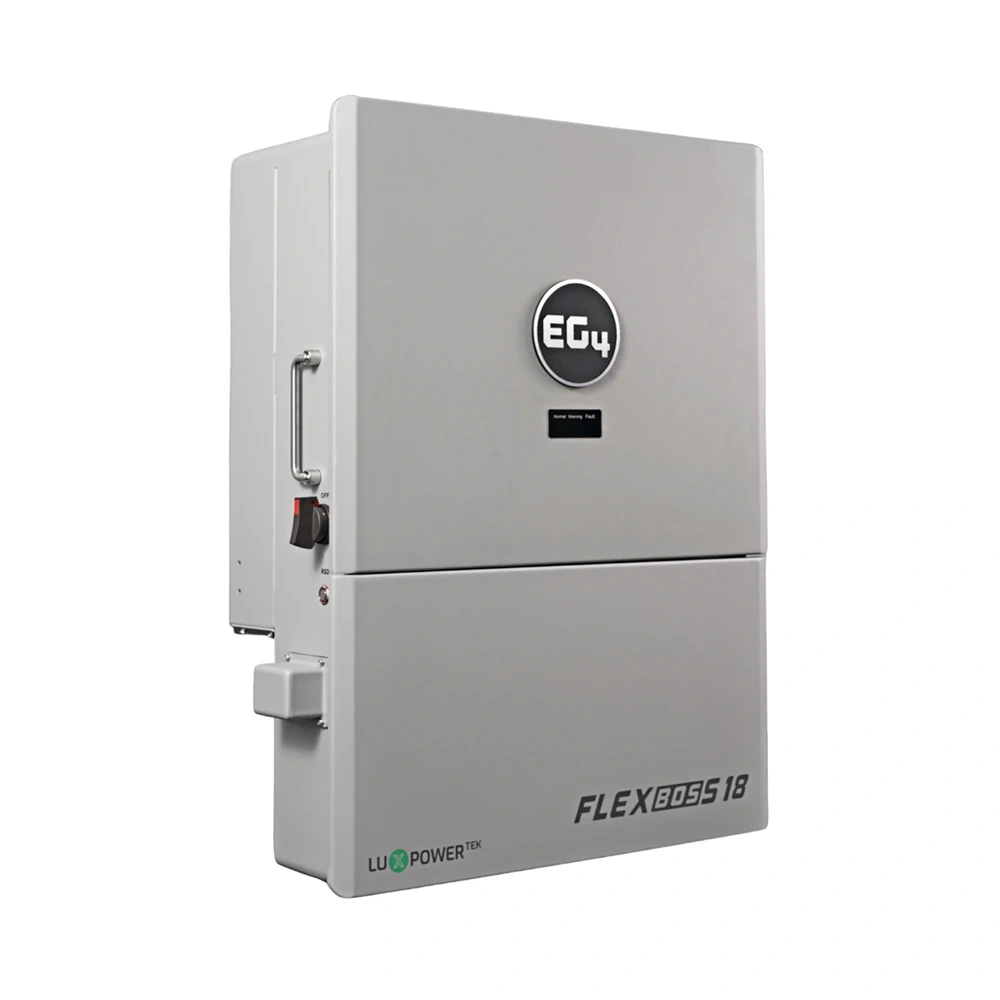
I like the EG4 FlexBOSS18 because it gives us a strong starting point without forcing every customer into the same system design. It can operate as a standalone hybrid inverter, yet it also has a clear path into a larger EG4 system with batteries, monitoring, and the GridBOSS gateway.
That makes the important question less about whether the box has enough numbers on its label. The better question is whether its power, battery, and communication relationships fit the way you want your Hawaii system to work.
A useful amount of power in one inverter
The FlexBOSS18 is a 120/240-volt split-phase inverter. EG4 rates it for up to 13 kilowatts of continuous output when PV and the grid are available, and 10 kilowatts from the battery alone. That difference matters when we talk about backup.
For example, a customer may have solar helping run daytime air conditioning or a water pump. In that situation, the photovoltaic (PV) array can contribute to the load while the battery supplies the balance. After sunset, or during a cloudy outage, the battery-only limit becomes the more important number.
I would not use 13 kilowatts as a promise that every appliance in a home can run at once. We still need to examine starting loads, continuous loads, battery discharge capability, and which circuits deserve priority. But 10 kilowatts of battery-only output gives us a meaningful starting point for a serious backup conversation.
Why the system relationship matters
The FlexBOSS18 has two maximum power point tracker (MPPT) inputs. Each MPPT is rated for 26 amps of operating current and 31 amps of short-circuit current, with a maximum PV voltage of 600 volts DC. Those are separate checks: operating current describes how the array normally runs, while short-circuit current is the protective limit used in the design review.
The inverter can use up to 18 kilowatts of PV input under standard test conditions. That gives us room to build a substantial array, but the number of panels and strings still depends on the actual module electrical values, roof areas, shade, temperature, and the two MPPT inputs.
On the battery side, the FlexBOSS18 uses a nominal 51.2-volt battery platform and lists a maximum charge and discharge current of 208 amps. That tells us something important: inverter output power and battery storage are not the same decision. A battery bank must have enough usable energy for the hours you want backup, and enough continuous current for the loads you want it to support.
Standalone is possible; GridBOSS adds another layer
The FlexBOSS18 can be used on its own. The optional EG4 GridBOSS is a separate Microgrid-Interconnect Device, or MID. In plain language, I think of it as a power gateway that can organize more of the system around the inverter.
EG4 describes the FlexBOSS18 and GridBOSS combination as a way to add functions such as smart loads, generator support, and AC coupling with existing or new grid-tied inverters.
That can be valuable in Hawaii. Maybe you want to direct surplus solar toward a flexible load. Maybe you want a generator available when the grid is down and solar production is not enough. Maybe you already have a grid-tied inverter that needs to become part of a battery-backed system. Those are different designs, but the FlexBOSS18 and GridBOSS relationship gives us a framework for discussing them.
There is one detail I pay close attention to: when the FlexBOSS18 is paired with GridBOSS, EG4 specifies minimum firmware requirements and says the FlexBOSS18 firmware must be updated to at least version 1E1E. The manual also notes that the FlexBOSS18 load ports and its supplied current transformers are not used in that pairing because GridBOSS handles the system data and power connections.
That is not a customer wiring instruction. It is a design clue. The equipment should be chosen and commissioned as a coordinated system, not assembled as unrelated boxes.
Monitoring is part of ownership
The FlexBOSS18 supports Wi-Fi, cellular, and Ethernet monitoring options, and the manual’s packing list includes a Wi-Fi dongle. Through EG4’s monitoring app and web platform, you can view system information, battery status, grid activity, alarms, and operating history.
I especially like having that information available after the installation is complete. If the system is not behaving as expected, we have a better starting point than a customer simply saying, “The power went out and something changed.” We can look at the event history, battery communication, state of charge, and operating mode before deciding what needs attention.
EG4’s Power Hour lesson featuring Nick from The Solar Scouts focuses on the FlexBOSS18 and the BOSSBox enclosure. It is useful for seeing how EG4 presents the inverter as part of a larger battery-backed system and why equipment layout matters. The BOSSBox is an enclosure, not the GridBOSS gateway, so I would use the video as a general system lesson rather than as a GridBOSS-specific design guide or a review of your particular home.
Where I would consider the FlexBOSS18
I would consider it for a customer who wants substantial solar input, 120/240-volt backup capability, a 48-volt-class battery system, and room to choose between a simpler standalone arrangement and a more integrated EG4 architecture.
I would want to review your service equipment, essential loads, battery location, PV layout, generator plans, and utility requirements before recommending the final arrangement. If you are comparing solar-and-storage options, contact SolarMan and we can match the FlexBOSS18 to the system you actually want to own—not just the rating printed on the front.