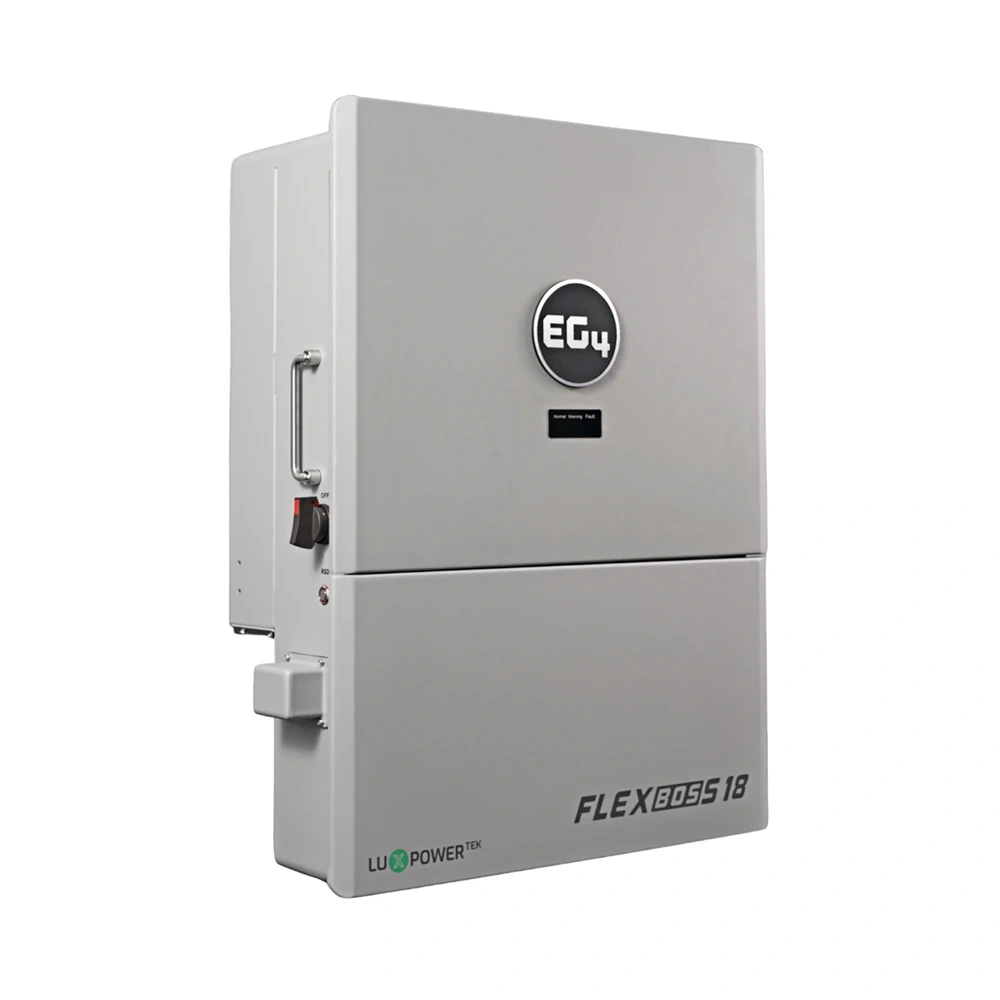
I like the EG4 FlexBOSS18 because it gives you a strong starting point without forcing the entire system to be oversized on day one. One unit can manage solar, batteries, utility power, and backed-up loads. If your home or small business needs more later, the FlexBOSS18 can also become part of a larger GridBOSS system.
That makes the first design conversation more useful than simply asking, “How many kilowatts do I want?” I want to know which loads you need during an outage, how much battery power those loads require, where the solar will connect, and whether your electrical service may need a broader backup plan in the future.
Start with the loads you actually want to protect
The FlexBOSS18 is rated for up to 10 kilowatts from the battery alone. Its 13-kilowatt output figure applies when photovoltaic (PV) power and grid support are available. That distinction matters when we decide which loads belong on backup and how much battery capacity the system needs.
A battery bank has to supply the inverter when the sun is down or clouds reduce solar production. Ten kilowatts is a substantial amount of battery-side power, but it still does not mean every large load should automatically be placed on backup. Air conditioning, water pumps, well equipment, compressors, and electric cooking loads can all change the battery and inverter requirements.
For example, I might begin by protecting refrigeration, lighting, internet equipment, selected receptacles, and a properly evaluated air-conditioning circuit. Then we can decide whether the battery bank and solar array can support more. The goal is not to back up every breaker just because the inverter is powerful. The goal is to give the inverter a job it can perform well.
The solar input gives you room to build around the battery
EG4 lists 18 kilowatts as the FlexBOSS18’s recommended maximum solar-array power at standard test conditions. The inverter has two maximum power point tracking (MPPT) channels. Each MPPT is listed for 26 amps of operating current, with a separate 31-amp short-circuit-current limit. Those are different checks, and I keep them separate when matching an array.
The PV input can reach 600 volts DC, with an MPPT operating range of 120 to 440 volts DC and a listed startup voltage of 200 volts DC. That gives the designer useful flexibility with string length, but the final string still has to stay within the exact voltage and current limits after temperature and array configuration are considered.
An 18-kilowatt array also does not mean the panels will produce 18 kilowatts all day. It is the array’s rated starting point. Sun angle, shade, roof direction, temperature, and battery state all affect what the system can deliver at a particular moment.
GridBOSS changes the conversation from one inverter to the service
When the FlexBOSS18 is paired with the EG4 GridBOSS, the design can be organized around the home’s electrical service rather than treating the inverter as a separate appliance. GridBOSS provides three hybrid-inverter ports, four configurable smart-load or alternating-current-coupling ports, separate backed-up and non-backed-up load paths, and generator input.
That is where I see a practical path for a customer whose needs may grow. One FlexBOSS18 can be the starting point. Later, the system may be expanded with additional compatible inverters if the load calculation, battery bank, service equipment, and local approvals all support it. Adding another inverter is not just adding another box; the rest of the power system has to grow with it.
The same principle applies to a generator. With GridBOSS, generator input and automatic two-wire start/stop functions can be organized through the gateway. The generator still has to be correctly sized, electrically compatible, and configured by the installer. I would not treat the generator connection as an afterthought.
Commissioning is part of the architecture
Before the GridBOSS is brought into the final system, the FlexBOSS18, battery bank, and PV array need to be checked as working pieces. EG4’s GridBOSS documentation calls for inverter configuration, battery and PV confirmation, correct parallel operation when multiple inverters are used, and current firmware before the gateway is commissioned.
That sequence helps avoid a frustrating handoff where the equipment is connected but the system does not yet agree about batteries, monitoring, or operating roles. The FlexBOSS18 also supports remote monitoring through EG4’s software and closed-loop communication with compatible 48-volt batteries, so those communication choices belong in the design from the beginning.
If you want a system that starts strong but leaves a sensible path for expansion, the FlexBOSS18 is worth considering. I can help you compare your essential loads, battery size, solar layout, service arrangement, and whether a GridBOSS-based system makes sense for your property.
EG4’s Power Hour: FlexBOSS18 & BOSSBox gives a broader technical lesson on the inverter and related system equipment. It is useful background before we sit down with your actual load list; it is not a substitute for designing your specific installation.