When a customer tells me, “I need a big battery,” I want to separate two different needs before choosing equipment. How much energy do you need after sunset? And how much power must the battery deliver when several loads run at once?
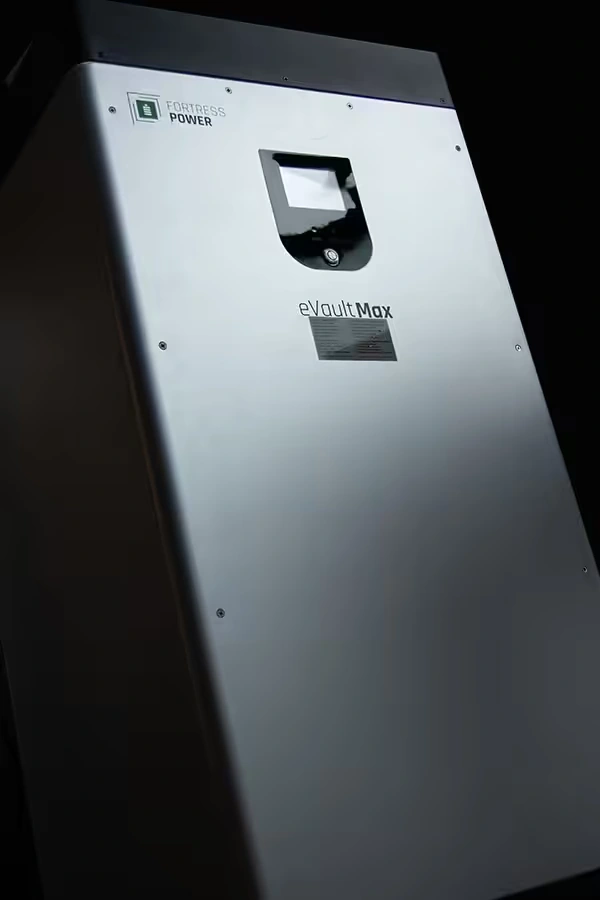
That’s where the Fortress Power eVault MAX 18.5kWh LFP Battery makes a lot of sense. One unit stores 18.5 kilowatt-hours (kWh) and uses a 51.2-volt battery platform. It gives us a substantial starting point for whole-home backup, a large off-grid home, or a light-commercial system without immediately building a wall of smaller batteries.
Start with the energy you use overnight
Suppose your essential loads use an average of 2.5 kilowatts for five hours after sunset. The simple arithmetic is 2.5 × 5, or 12.5 kWh. That is the energy those loads consume. Your actual battery plan also has to account for inverter conversion losses, the reserve you want to keep available, weather, and changing loads.
For a conservative planning illustration, 80% of the eVault MAX’s 18.5 kWh nameplate energy is 14.8 kWh. That is not a promise that every system will deliver exactly 14.8 kWh to your loads. It is a useful planning allowance before we account for inverter losses and operating conditions.
In that example, one eVault MAX gives us a reasonable starting conversation because the 12.5 kWh example load is below the 14.8 kWh planning figure. If your overnight use is higher, or you want more reserve for cloudy weather, two batteries provide 37 kWh of nameplate storage. The right answer depends on your measured loads, not just the size of the house.
Then check the power, not just the kWh
A battery can have plenty of stored energy and still be a poor match for an inverter or a large starting load if the power path is undersized. Fortress lists the eVault MAX at 180 amps maximum continuous discharge. At the nominal 51.2-volt battery voltage, 51.2 × 180 works out to about 9.2 kW on the battery side as a simple calculation.
For actual system sizing, Fortress uses 9 kW per eVault MAX as a general rule of thumb when battery-inverter communication is not active. Certain approved closed-loop inverter pairings can allow higher output for limited periods, but the exact inverter documentation and Fortress sizing guidance decide whether that applies. The battery, inverter, battery-management system, cables, protection equipment, and load-starting behavior still have to agree.
This matters in Hawaii homes with well pumps, catchment pumps, refrigerators, air-conditioning equipment, or workshop motors. A load may use modest energy over a day but demand a sharp burst of power when its motor starts. I want to see both numbers before I tell you that one eVault MAX is enough.
Where the eVault MAX fits especially well
I like this battery when the project needs meaningful storage in a single floor-standing enclosure, with room to expand later. Fortress lists CAN and RS485 communication, a built-in display, and closed-loop inverter communication. That communication can help the inverter receive battery limits instead of treating the battery as a box with only a voltage reading.
The current Fortress compatibility guide lists the eVault MAX with several inverter families, including Fortress ENVY models, the ENVY Duo 21, Sol-Ark models, OutBack equipment, and other supported systems. That list is a starting point, not permission to mix any inverter with any battery. The exact inverter model, firmware, communication method, and required battery count still need to be confirmed.
For parallel systems, the current eVault MAX documentation lists up to 20 batteries, or 370 kWh of nameplate storage. I would not begin by planning for the maximum. I’d start with your real overnight loads, the loads that must start together, your solar-recovery plan, and the inverter you want to use.
My practical first conversation with you
Bring me a list of the circuits you want during an outage, your overnight electric use if you have it, and the largest motors or compressors in the home. I can then compare your energy requirement with the eVault MAX’s storage, compare your peak demand with the battery and inverter power path, and show whether one unit or a parallel bank is the better fit.
For a plain-language refresher, altE Store’s short lesson uses a 100-watt solar-panel example to explain the difference between instantaneous power in watts and accumulated energy in watt-hours. It then connects those numbers to battery storage, appliance loads, and runtime. That is the same distinction I use when I size an eVault MAX system for a real home.
The eVault MAX gives us a strong foundation, but the value comes from matching it to the whole system. If you’re considering Fortress Power storage for a Hawaii backup or off-grid project, contact SolarMan and I’ll help you work through the battery count, inverter match, communication plan, and next step.