When a customer tells me they want whole-home backup, I don’t start with the battery’s biggest number. I start with two simpler questions: what needs to keep running, and how long should it run?
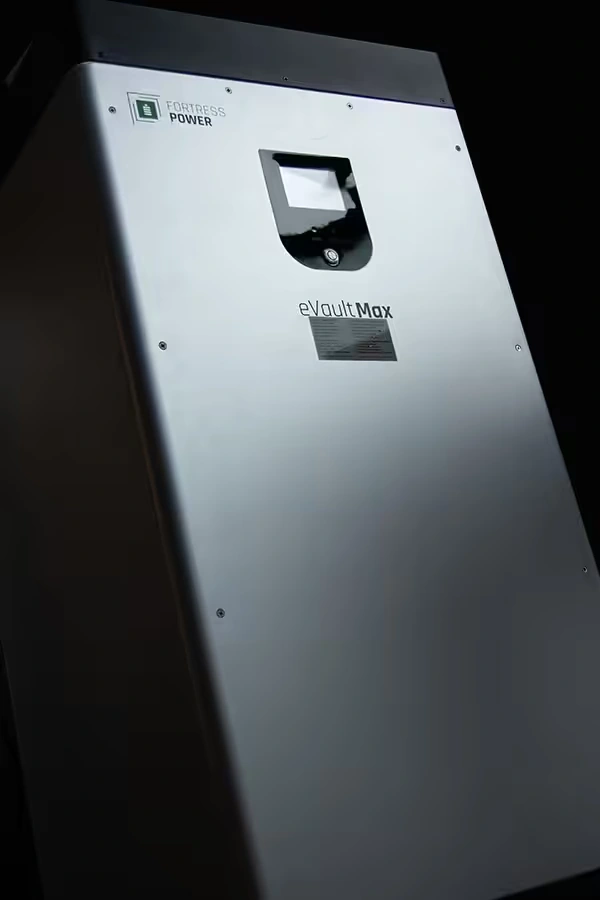
That’s where I think the Fortress Power eVault MAX 18.5kWh makes a strong starting point. It gives you a large 51.2-volt lithium iron phosphate battery in one cabinet, on the 48-volt class platform used by many battery-based inverters. The important part is understanding what that stored energy can do—and what it cannot do by itself.
Energy tells you about runtime
The eVault MAX is rated at 18.5 kilowatt-hours, or kWh. That describes the amount of energy stored in the battery. It does not mean your home can use 18.5 kilowatts continuously, and it does not predict an exact number of hours without knowing your loads.
For a simple planning example, if you choose to plan around 80% of 18.5 kWh, the arithmetic is approximately 14.8 kWh before inverter losses. That is an estimate for comparing options, not a promise of delivered energy. Reserve settings, temperature, battery condition, conversion losses, and changing household loads all affect the result.
If your selected backup loads averaged 2 kW, 14.8 kWh divided by 2 kW gives about 7.4 hours before those additional factors. At a 1 kW average, the same planning figure would suggest roughly twice the runtime. A refrigerator is one kind of load. A well pump, air conditioner, cooking equipment, or electric water heater can change the picture quickly.
Power tells you what can run together
The eVault MAX lists a maximum continuous charge and discharge current of 180 amperes. Multiplying 51.2 volts by 180 amps gives a nominal battery-side calculation of about 9.2 kW. That helps explain the battery’s power capability, but it is not automatically the output rating of your inverter.
Your inverter has its own continuous output rating, surge rating, battery-current limit, and operating rules. A 12 kW inverter, for example, may need more battery support than one eVault MAX should provide for normal operation. A short-duration battery rating is not the same thing as continuous inverter output. Fortress Power’s installation manual uses a 9 kW rule of thumb per eVault MAX when closed-loop battery-inverter communication is not being used, with limited exceptions for approved systems. That’s why I match the battery and inverter as a pair.
Communication makes the match smarter
The eVault MAX has a built-in Battery Management System, or BMS. The battery can operate without communication to a battery-based inverter, but Fortress Power recommends closed-loop communication to improve battery and inverter performance.
In plain language, that communication lets the battery and inverter exchange operating information instead of relying only on fixed settings. The exact cable, communication protocol, firmware, battery quantity, and inverter model still matter. Communication is one part of commissioning; it does not replace checking the battery settings, startup sequence, and system behavior.
Fortress Power lists the eVault MAX with its Envy inverters and Solo 6.5K, while its compatibility guide also identifies approved combinations from other manufacturers. Compatibility is not just a question of whether the battery voltage looks similar. Minimum battery quantity, closed-loop capability, inverter settings, and warranty requirements belong in the design conversation.
Where this battery fits well
I see the eVault MAX making the most sense when you want a substantial 48-volt battery bank without starting with several smaller cabinets. It can fit a whole-home backup system, a larger off-grid design, solar self-consumption, or a light-commercial installation. Fortress Power lists expansion up to 20 units in parallel, or 370 kWh, but that is a system-planning decision—not a reason to install more battery than your loads and inverter require.
The cabinet is floor-standing, weighs about 520 pounds, includes a built-in display, and has a top-access service design with an IP55 enclosure rating. Those details affect the installation location. In Hawaii, I pay close attention to heat, moisture, ventilation, clearances, and flood exposure. The exact installation manual and nameplate should control the final temperature and location decisions.
If you’re considering the eVault MAX, send me your major loads, inverter model, solar size, and whether you want backup for the whole service or selected circuits. I can help you separate runtime from power, check the battery-to-inverter match, and determine whether one eVault MAX is the right starting point for your SolarMan system.