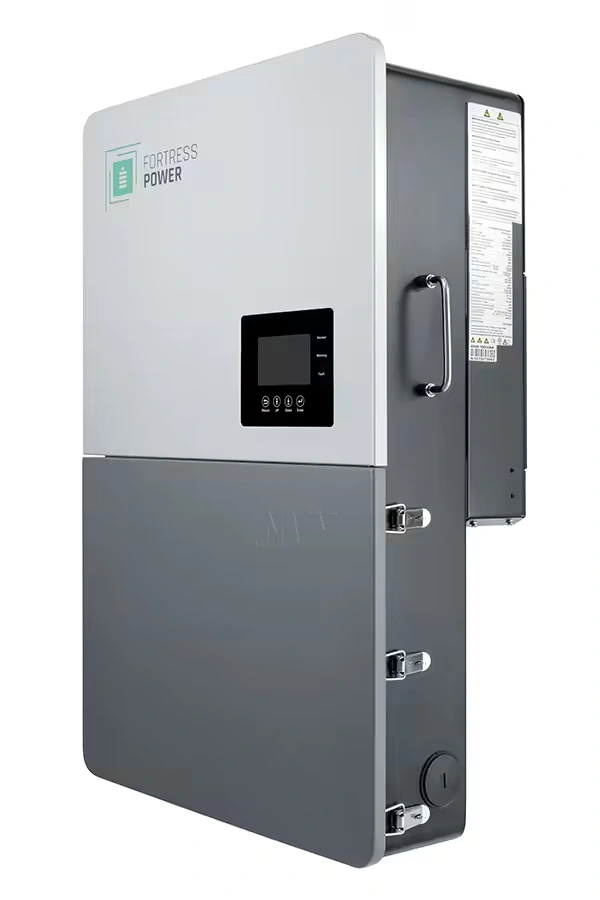
A generator is most useful when it works with the rest of your energy system instead of taking over everything the moment the grid goes down. That is one reason I pay attention to the Fortress Power ENVY DUO 21 / 12K Platform. It can coordinate a compatible generator with the backed-up loads, the battery bank, and the solar array.
That gives you more choices during a long outage. The battery can handle short-term loads quietly. Solar can contribute when the sun is available. The generator can start when the battery reaches the programmed start condition, support the backed-up loads, and charge the batteries at the same time.
What the generator connection actually does
The Envy Duo 21 has a dedicated generator connection. Fortress Power specifies compatible generator output as neutral-bonded 120/240-volt, 120/208-volt, or 120/208-volt three-phase power. When the generator is running, the loads connected to the inverter's backup output can be supplied by the generator while the battery is charged.
In practical terms, the generator is not just a last-resort source of electricity. It becomes another input the inverter can manage. That matters for a Hawaii home with a well pump, refrigeration, communications equipment, or other loads that may need to operate through a multi-day outage.
The important limit is the generator port
The generator connection has a 90-amp pass-through relay. Fortress Power recommends limiting continuous current to 80 amps, and the total backed-up load plus battery-charging current must stay within the system's capability. The number on the generator itself is not the only number that matters.
For example, a generator may be large enough to start, but the system still needs room for the household loads and the battery-charging power at the same time. I want to see those loads measured and discussed before choosing generator settings. A design that leaves reasonable headroom will be easier to operate than one that expects the generator to run at its limit every time it starts.
Automatic starting should follow the battery plan
The Envy Duo 21 can use battery state of charge or battery voltage, depending on the battery operating mode, to decide when generator support is needed. If the utility fails and the battery reaches the programmed start condition, the inverter can send a start signal through its dry-contact connection.
The generator then stops when the battery reaches the programmed charge-end condition. That is a much better conversation than simply saying, “The generator will run when the battery is low.” We need to decide how much reserve you want to protect, how much charging current the battery manufacturer allows, and which household loads should remain active while the generator is running.
The dry contacts are control contacts, not a substitute for the generator's power connection. Fortress Power lists them at up to 250 volts AC or 30 volts DC and 5 amps. The generator's own starting controls and the inverter's programmed logic still need to be matched by a qualified installer.
Gen Boost can help a smaller generator do more
The Envy Duo 21 also includes a Gen Boost function. With the generator's rated power entered correctly, the inverter prioritizes the loads and uses available surplus generator power to charge the battery. If the household demand rises above what the generator can provide, the inverter can use solar and battery power to help cover the difference, subject to the battery's operating limits.
That is useful when you want generator support without sizing the generator for every possible short-term peak. It does not make generator sizing unimportant. The generator still needs to provide stable, compatible power, and the settings need to leave room below its nameplate rating rather than asking for every last watt.
Do not confuse the generator port with AC coupling
The Envy Duo 21 can also use its generator port for an AC-coupled grid-interactive solar system, but those are different configurations. When the port is used for AC-coupled solar, the manual says not to connect a generator to that same port. Fortress Power also limits the solar system connected to each inverter to 12 kW in that arrangement.
During an outage, the Envy Duo 21 can manage excess AC-coupled solar through frequency shifting. In plain language, it raises the local frequency so the grid-interactive solar inverter reduces its output when the battery is nearly full or the loads cannot use all the solar power. That is a system-control feature, not a reason to combine incompatible sources on one connection.
Where this fits in a Hawaii system
I see the Envy Duo 21 as a strong candidate when you want substantial solar and battery capability but still want a generator for extended cloudy weather, storm recovery, or larger intermittent loads. Its 48-volt battery platform, 12 kW continuous backup output, and 25 kW maximum PV-array rating give the system room to be designed around real household needs.
The next step is to look at your generator output, backed-up loads, battery model, solar plan, and desired reserve together. Contact SolarMan and I can help you determine whether the Envy Duo 21's generator integration fits your property, and which settings and system arrangement make sense for the way you actually use power.