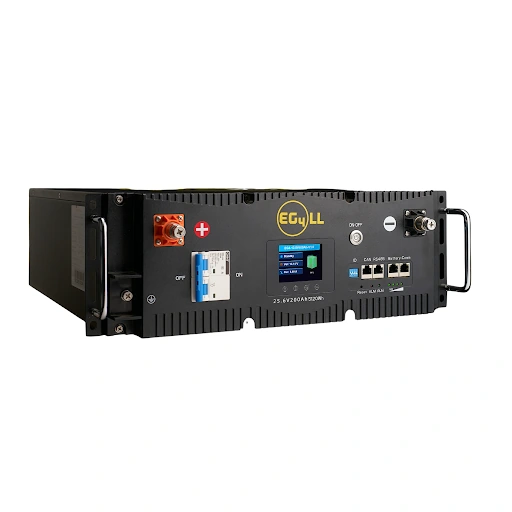
I like giving customers a battery they can actually understand. The EG4 LL 24V 200Ah has a built-in battery-management system, or BMS, plus a front liquid-crystal display (LCD) touchscreen. You can see useful operating information instead of guessing from one voltage number.
That matters in a Hawaii system. A battery can show a healthy-looking voltage while it is charging, supplying a heavy load, or settling after the load stops. The screen gives you more context, but the state-of-charge percentage still deserves to be read as part of the whole picture.
EG4 rates this battery at 25.6 volts and 200 amp-hours. The simple nameplate calculation is 25.6 × 200, or 5,120 watt-hours. That is 5.12 kilowatt-hours of nominal stored energy.
I use that number as a planning reference, not as a promise that every watt-hour will reach your appliances. Inverter losses, battery-protection limits, charging conditions, and the loads running at the same time all affect what you experience at the house.
The important point is that the battery's percentage is trying to describe the battery's remaining charge or capacity, while voltage is only one electrical condition at one moment. If you look at voltage during a large load, you may see a different number than you would a few minutes later at rest.
Why the LCD screen is useful
The EG4 LL's display can show battery information directly at the rack. EG4's manual identifies voltage, current, temperature, and state of charge as display information. It also describes the percentage as an integral calculation with a stated accuracy of 5 percent. That makes it useful, but it is still an estimate rather than a laboratory measurement.
EG4 also documents communication through Controller Area Network (CAN) or RS-485 connections, along with battery-to-battery communication when units are paralleled. The current manual supports up to 16 modules in a communicating parallel bank.
That gives us several useful clues. If the screen shows current flowing out while the inverter is working, the battery is supplying energy. If current is flowing in, the charging equipment is putting energy back. If the percentage changes in a way that does not fit the recent charging and load history, that is a reason to investigate rather than immediately blame the battery.
I also want customers to understand what the BMS does. It monitors and protects the cell pack against conditions such as excessive voltage, current, or temperature. That protection is valuable, but a protective shutdown is not the same thing as a normal operating limit for the whole system. The inverter, battery cables, over-current protection, and battery communication settings still have to be matched.
Voltage alone does not tell the whole story
Lithium iron phosphate, or LiFePO4, batteries hold a relatively narrow voltage range through much of their usable charge. That makes voltage-only estimates less precise than many customers expect.
For example, a battery under a strong inverter load may show voltage sag. A battery under charge may show a higher voltage than it would after resting. Neither reading, by itself, proves the exact state of charge. That is why I prefer to compare the displayed percentage with current direction, recent system activity, and the battery's charging history.
MATLAB's short lesson on battery state-of-charge estimation explains why a battery percentage is an estimate, not a direct measurement. It connects the estimate to current, voltage, and temperature, then shows why current-measurement errors can accumulate. That gives you useful background for reading the EG4 LL screen without expecting one number to answer every question.
When recalibration becomes part of the conversation
EG4 publishes a separate recalibration guide specifically covering the LL and LifePower4 24V 200Ah batteries. That document is especially relevant after a BMS printed-circuit-board replacement, because the replacement BMS needs to learn the battery pack it is managing.
EG4 also explains that state-of-charge drift can occur when the battery is not top-balanced or bottom-balanced over time. The guide describes manufacturer-specific voltage, current, and cell-alarm conditions for recognizing the 100 percent and 0 percent reference points. It also recommends a recurring maintenance routine to keep the displayed percentage accurate.
I would not treat that as permission to casually force a battery to an extreme state. The recalibration procedure is specific, and EG4 says work on the battery should be handled by qualified personnel. For an ordinary customer, the useful lesson is simpler: if the percentage and the system's actual behavior stop agreeing, document what you are seeing and let us evaluate the battery, inverter settings, communications, and firmware path together.
Where this battery fits for you
I see the EG4 LL 24V 200Ah as a strong fit when you want a substantial 24-volt lithium battery with a rack format, visible local information, built-in protection, and a path toward a larger parallel bank. EG4 lists 200-amp maximum continuous charge and discharge capability, a 10-year limited warranty, more than 7,000 deep cycles at 80 percent depth of discharge, and parallel expansion while maintaining battery-management communications.
Those features do not replace system design. Your inverter must be a genuine 24-volt match, the battery-side current must fit the equipment, and the communication method must be supported by the exact inverter model and firmware. If you are considering one EG4 LL battery, an expansion bank, or a 24-volt system around an existing inverter, contact SolarMan. I can help compare the battery's numbers with the loads and equipment you actually plan to use.