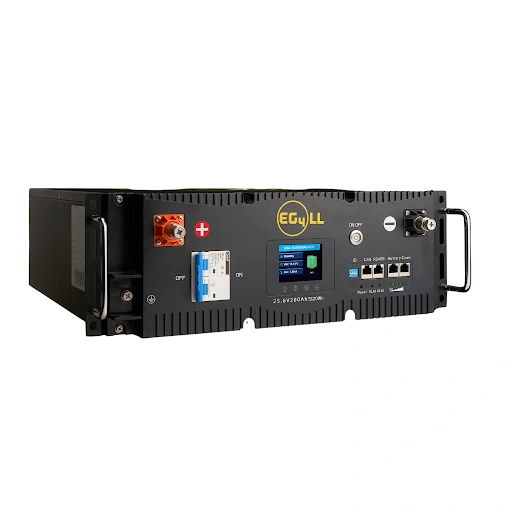
I like the EG4 LL 24V 200Ah because it gives a compatible 24-volt system a practical way to grow. If your inverter and other equipment are already built around 24 volts, adding battery storage may be cleaner than replacing the whole platform just because your first bank no longer carries the load long enough.
Each battery is rated at 25.6 volts and 200 amp-hours. The starting calculation is 25.6 × 200 = 5,120 watt-hours, or 5.12 kilowatt-hours, of nameplate storage. At the manufacturer’s recommended 80% depth of discharge, that works out to about 4.10 kWh before inverter losses. I use that as a planning estimate, not a promise that every watt-hour will reach your loads.
Parallel batteries add storage without changing system voltage
When compatible batteries are connected in parallel, the bank stays at approximately 25.6 volts while amp-hour capacity increases. Two batteries provide about 10.24 kWh of nameplate storage. Three provide about 15.36 kWh. That is the useful expansion path: more stored energy on the same nominal 24-volt platform.
There is an important limit. Parallel batteries do not turn a 3,000-watt inverter into a 6,000-watt inverter. They give that inverter more energy to work with and allow the batteries to share current, but the inverter’s own output rating still controls the maximum load it can serve.
Here is a simple way to picture the current. A 2,000-watt load divided by 25.6 volts is about 78 amps before inverter losses. The actual battery-side current will be higher while the inverter is running. That calculation helps explain why battery current, inverter rating, cables, overcurrent protection, and load duration all belong in the same design conversation.
The BMS makes the battery easier to manage
The EG4 LL includes a built-in battery management system, or BMS, that monitors battery voltage, current, temperature, state of charge, and cell information. EG4 lists 200 amps as the battery’s maximum continuous charge and discharge rating. I treat that as one component specification, not as an automatic rating for the entire system. The inverter, protection equipment, conductors, and operating settings still have to agree.
The communication side is another reason I consider this battery. The LL provides Controller Area Network, or CAN, and RS485 communication options. In a compatible closed-loop system, the BMS and inverter can exchange operating information instead of making the inverter estimate battery condition from voltage alone. That can make commissioning and ongoing support much clearer.
Compatibility still has to be checked by exact model and revision. The battery manual describes host-battery addressing, battery-to-battery communication, and protocol selection. That does not mean every inverter carrying a familiar brand name will use the same cable, protocol, firmware, or settings. I want those details matched before the battery bank is expanded.
Rack format is convenient, but location matters
The EG4 LL measures about 6.1 inches high, 19 inches wide, and 20.2 inches deep. It weighs about 99.2 pounds. That server-rack format can make a battery bank neat and serviceable, but the rack, shelf, or cabinet still needs to support the weight and leave sensible room for cables, disconnects, and maintenance access.
EG4 lists the battery as IP20, and its manual says to keep the battery away from water, direct sunlight, and high humidity. In Hawaii, that means I would plan for a dry, protected battery location rather than an exposed lanai or a damp outdoor cabinet. The batteries, inverter, disconnects, and communication path should be planned together.
When I would consider the EG4 LL
I see this battery making the most sense for a compatible 24-volt system that needs more overnight runtime, more reserve for long-running loads, or a cleaner expansion path. It can also be a reasonable starting point for a new 24-volt installation when the customer wants to begin with one module and leave room for a larger bank later.
It is not automatically the right choice for a 48-volt inverter. This is a 24-volt battery platform, and existing batteries should not be mixed just because the voltage labels look similar. The exact battery model, revision, inverter compatibility information, communication method, and bank design should control that decision.
EG4 lists more than 7,000 deep charge and discharge cycles at 80% depth of discharge, a 10-year warranty, a built-in LCD screen, and closed-loop communication support for compatible equipment. Those are meaningful reasons to consider the LL. They describe the product’s design and warranty terms, not a guarantee of daily energy production in every installation.
EG4 Electronics’ BMS Communications Demystified lesson is also useful if you want to see the battery-and-inverter conversation explained visually. It is a general communication lesson, not a review of this exact 24-volt battery, but it shows why selecting the right protocol is part of making a storage system easier to operate.
If you’re considering the EG4 LL for an existing 24-volt system, send me the inverter model, the batteries already installed, and the loads you want to run. I can help you compare adding storage with changing the inverter or planning a different battery voltage.