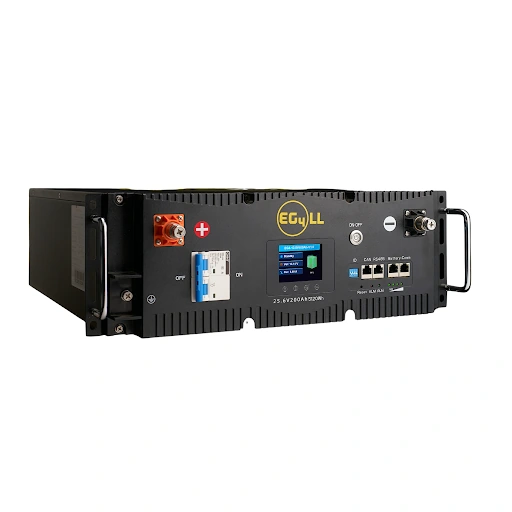
When a customer shows me a list of household loads and asks whether one EG4 LL 24V 200Ah battery will be enough, I don’t start by counting appliances. I start with the system voltage and the job the battery needs to do.
This EG4 battery is a 25.6-volt lithium iron phosphate battery with 200 amp-hours and 5.12 kilowatt-hours of nameplate energy. That gives you a useful starting point, but it does not tell us whether the battery fits your inverter or how long it will run your home. Those answers come from the loads and the complete battery bank.
One battery gives us a clear starting point
EG4 lists a recommended state-of-charge cutoff of 20 percent. Using that planning point, one battery has about 4.096 kilowatt-hours between a full charge and that cutoff: 5.12 kWh × 80% = 4.096 kWh. That is a planning estimate, not a promise of usable alternating-current energy. Inverter losses, battery temperature, wiring, and the way your loads operate still affect what you receive.
Here’s the practical way I use that number. If your essential loads consume about 2 kilowatt-hours overnight, one battery has room on paper. If you use closer to 4 kilowatt-hours, one battery leaves very little margin for conversion losses, cloudy weather, or an unexpectedly long outage. That is when I would look seriously at two batteries rather than trying to stretch one.
Parallel batteries add energy without changing 24 volts
Two EG4 LL 24V 200Ah batteries make a 24-volt bank with 400 amp-hours and 10.24 kWh of nameplate energy. Four make 800 amp-hours and 20.48 kWh. The voltage remains 24 volts because the batteries are paralleled. That matters: your inverter-charger and other equipment must be designed for a 24-volt battery bank, not a 48-volt bank.
EG4’s current product information allows up to 16 of these batteries in parallel while maintaining battery-management-system communications. That is a lot of expansion room, but I would not treat the maximum as a recommendation. Your inverter, busbars, over-current protection, rack, cable arrangement, and actual loads should determine the battery count.
Power is separate from stored energy
The battery’s 200-amp maximum continuous charge and discharge specification is a battery-side limit. At the nominal 25.6 volts, 200 amps works out to about 5.12 kilowatts on the battery side. That calculation helps us understand the scale of the battery, but it does not mean every inverter can draw 5.12 kilowatts from one unit, or that the battery should be operated at its limit all the time.
For example, a 3,000-watt inverter load would draw roughly 117 amps at 25.6 volts before accounting for inverter losses. A 5,000-watt load would be about 195 amps before losses. That is already at the battery’s 200-amp continuous discharge rating before the inverter’s losses are included, so I would want to see the inverter’s battery-current requirement, the cable and protection design, and the load’s starting behavior before calling one battery a good match.
The rack format is useful, but plan the room
Each battery weighs about 99.2 pounds and measures approximately 6.1 by 19 by 20.2 inches. EG4 lists the enclosure as IP20, and its installation guidance says to avoid wet locations, high humidity, and direct sunlight. I would plan it for a dry, protected rack location rather than exposed outdoor mounting.
The server-rack shape can make a growing battery bank neat and serviceable. It also concentrates a lot of weight in one location. I want the rack, floor, busbars, and cable paths planned before the batteries arrive. The batteries should be installed and commissioned as a system, not simply stacked wherever there happens to be space.
Communication is part of the battery match
The built-in battery-management system (BMS) monitors cell voltage, current, temperature, and state of charge. The EG4 LL also provides Controller Area Network (CAN) and RS-485 communication options for compatible equipment. When the inverter can use the battery’s communication profile, the inverter may receive operating information instead of relying only on manually entered voltage settings.
EG4’s setup guide explains why the exact battery protocol, cable path, inverter model, and firmware or settings matter. Kvaser’s CAN Basics Training Introduction is also useful here because it shows how devices share messages across a Controller Area Network. That makes the battery-to-inverter communication idea easier to understand before you get into the exact profile required by your equipment.
The video is a general communication lesson, not a configuration guide for every EG4 combination. Your installed inverter still needs its own documented battery profile and communication method.
I’d consider the EG4 LL 24V 200Ah when you have a genuine 24-volt system, a dry protected rack location, and a load plan that leaves reasonable margin below the battery and inverter limits. Bring me your inverter model, essential-load list, and the number of hours you want to cover. I can help match the battery count and communication plan before you buy equipment that does not fit together.