I like the EG4 6000XP for customers who want a serious 120/240-volt off-grid inverter without turning the system into a room full of separate equipment. It combines the inverter, battery charger, solar charge controllers, built-in switchgear, monitoring, and generator connection in one platform. But one part of the design deserves attention before we talk about big appliances: what happens when almost nothing is running?
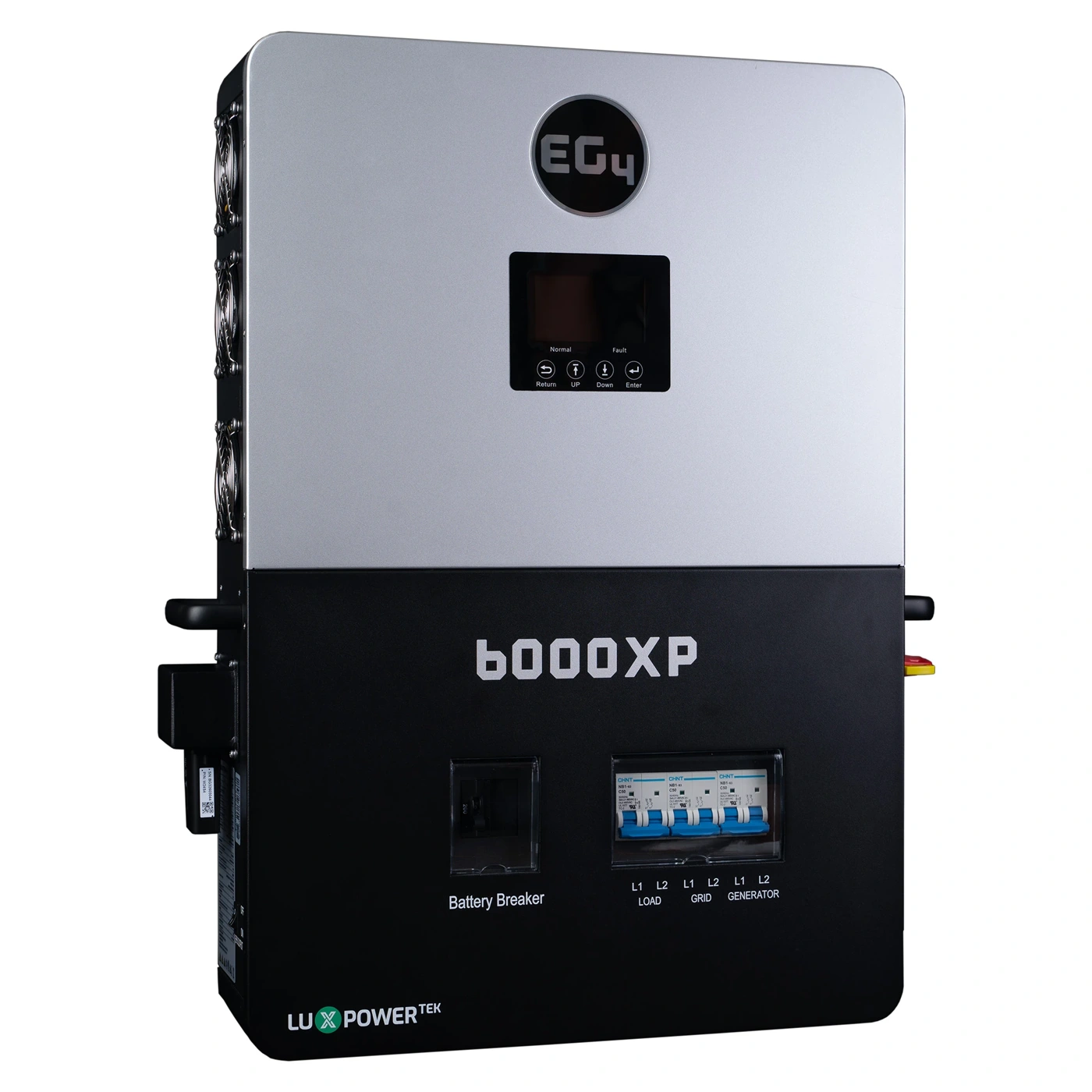
An off-grid inverter uses some energy simply to stay awake. EG4's current 6000XP documentation lists idle consumption below 30 watts with photovoltaic input, about 50 watts from the battery, and below 50 watts with alternating-current input. The photovoltaic figure was tested with a constant 300-volt source, so I treat it as a useful planning reference—not a promise that every Hawaii night will look exactly the same.
Small numbers add up overnight
Here's the simple example I use with customers. Thirty watts running for 24 hours is:
30 watts × 24 hours = 720 watt-hours, or 0.72 kilowatt-hours per day.
That is before the refrigerator, internet equipment, cameras, chargers, control transformers, or water-pump controls use anything. If the inverter is drawing closer to 50 watts from the battery during a long quiet period, the same arithmetic becomes 1.2 kilowatt-hours per day. That's not a reason to reject the 6000XP. It's a reason to include the inverter itself when we size the battery and solar array.
This matters most in a small cabin, agricultural building, or lightly occupied home. A system with only a few low-power loads can spend a surprising share of its stored energy keeping the inverter ready for those loads.
For a broader lesson, Pacific Yacht Systems' inverter/charger seminar explains why an inverter can draw power while idle, why low-power loads matter, and why the loads you expect to run should guide the inverter choice. The examples are marine, but the basic planning point applies to an off-grid home too.
What the Green Function changes
The 6000XP includes an optional Power Save Function. EG4 groups the Green Function and ECO Mode under setting 20, and both are disabled by default. When Green Function is enabled, EG4 documents that the inverter load reading below 60 watts for more than 10 minutes causes the inverter output to be cut off.
That can be useful when your system spends long stretches with no meaningful alternating-current load. Cutting the output during those quiet periods can reduce battery use. It may fit a simple workshop, seasonal cabin, or backup system where an interruption during quiet periods is acceptable and you can test how the system behaves before relying on it.
It may not fit a home that depends on continuous power for a modem, security system, medical equipment, controls, timers, or other electronics that draw very little. A device can be plugged in and still leave the inverter load reading below the Green Function threshold. That is why I don't treat this setting as an automatic better choice. I match it to the way you actually live.
My practical way to evaluate it
First, make a short list of the loads that must remain available all the time. Then separate those from appliances you use only when you are present. A refrigerator compressor or pump is a very different planning problem from a clock, router, or alarm panel.
Next, decide whether loss of inverter output during a quiet period is acceptable. If the answer is no, I would normally leave Green Function disabled and include the 6000XP's idle consumption in the battery calculation. If the answer is yes, Green Function may be worth evaluating after the system is commissioned and the actual small-load behavior is known.
I also want the battery information and operating limits configured for the actual battery model. The 6000XP can display voltage, state of charge, power, and capacity for lithium-ion configurations, while compatible closed-loop communication lets the inverter receive operating limits from the battery-management system instead of relying only on manually entered numbers. That helps, but it doesn't replace a real load list or the idle-energy calculation.
The EG4 6000XP gives us useful flexibility: 6 kilowatts of rated output, up to 8 kilowatts of photovoltaic input, two maximum power point tracking inputs, and an optional low-load power-saving function. I like that combination, but the right setting depends on your loads—not just the number on the inverter label. If you're considering a 6000XP for a Hawaii home, cabin, or agricultural system, contact SolarMan and I'll help match the inverter behavior, battery bank, solar array, and always-on loads to the system you want to live with.