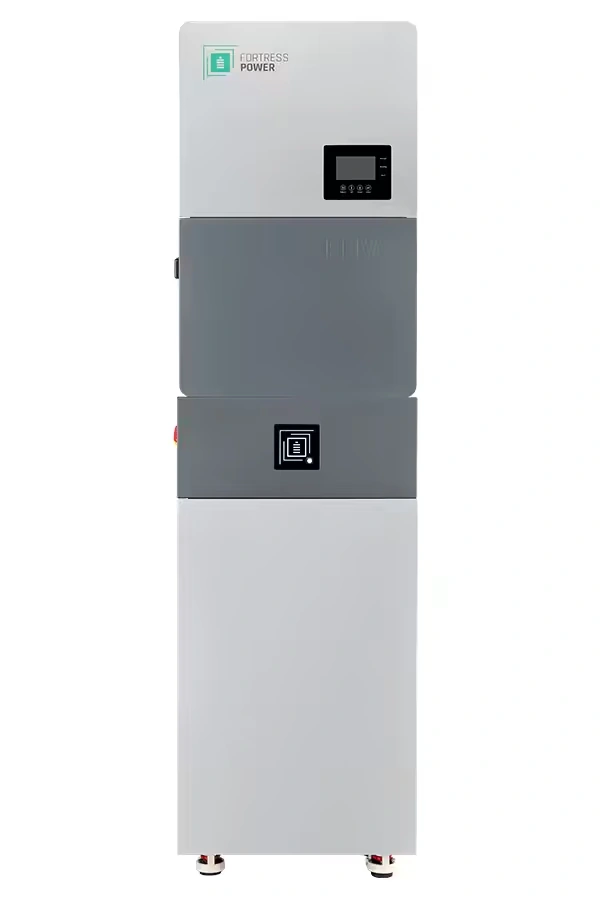
If you’re considering more than one battery, I want you to look past the simple math of adding 16 kilowatt-hours at a time. What I like about the Fortress Power eBoost is that it gives you substantial storage in one cabinet, then gives you a clear path to expand when your loads or backup goals grow.
That matters in Hawaii because a battery may be asked to carry essential loads during an outage, absorb daytime solar, support evening loads, and possibly work with a generator or whole-home inverter. More batteries can help, but only when the batteries and inverter are commissioned to operate as one system.
Parallel means more storage, not more voltage
Each eBoost is a 51.2-volt lithium iron phosphate, or LFP, battery. Fortress describes the unit as providing 16 kilowatt-hours of usable energy, while its datasheet lists 16.077 kilowatt-hours of nominal energy at the beginning of life and 25 °C. Two units therefore represent about 32.154 kilowatt-hours of nominal energy before normal system losses and operating limits are considered.
When batteries are connected in parallel, the system stays on the same nominal voltage platform. You’re adding storage capacity and available battery-side current, not creating a higher-voltage battery bank. Fortress lists closed-loop charge and discharge limits of 180 and 250 amps for one eBoost, and 360 and 500 amps for a 32-kilowatt-hour arrangement. Those are battery-system limits that still have to match the inverter, conductors, protection, and actual system design.
The first battery becomes the system’s communicator
In a parallel installation, the batteries don’t simply operate as unrelated boxes. Fortress identifies a primary battery, secondary batteries, battery-to-battery communication, and battery-to-power-conversion-system communication. In normal language, one battery takes the lead in communicating with the inverter while the other batteries share information through the battery network.
This is where careful commissioning earns its keep. The installer needs to confirm that the communication links are complete, that the correct inverter protocol is selected, and that the bank reaches a normal operating state before the system is handed to you. If one communication path is missing, the batteries may look physically connected while the inverter lacks the information it needs for closed-loop control.
I like this approach because it gives the system a defined order instead of leaving the inverter to guess what several batteries are doing. The physical connection and the communication relationship are both part of the battery-bank design.
Choose the expansion hardware early
The eWay choice matters when you’re planning more than one eBoost. The full eWay is the stronger long-term choice when you expect a larger battery bank, want Guardian mounting, need its rapid-shutdown features, or want to mount a compatible Envy inverter above the wireway.
eWay Lite is a simpler option for a single battery, but Fortress Power now also documents a two-eWay-Lite arrangement for compatible Envy inverters. That gives some projects another way to add a second battery. If you expect more than two batteries or want the broader eWay features, I’d rather choose the full eWay at the beginning than rebuild the system later.
Fortress Power’s short eBoost overview gives you the larger picture of how this battery fits residential, off-grid, and light-commercial systems. It isn’t a review of your exact installation, but it’s a useful introduction before we get into the communication and expansion decisions that shape your system.
Commissioning is part of the product
For multiple eBoost batteries, Fortress documents a sequence that includes energizing the connected equipment, turning on the required eWay controls, starting the primary battery, confirming voltage at the eWay busbar, selecting the correct inverter protocol, and checking for normal status. Those are installer procedures, not do-it-yourself terminal instructions. They show why I treat commissioning as part of the system design rather than a final administrative task.
The Fortress Power Pro App adds another useful layer when the system includes compatible Envy equipment and a Guardian monitoring device. The installer can identify the system, connect it to Wi-Fi or Ethernet, register the site, and confirm operating settings. For multiple batteries, Fortress specifically directs the Guardian connection to the primary battery. That gives the installer a cleaner handoff and gives you a better way to see whether the system is communicating after the crew leaves.
Where I see the eBoost fitting well
I see the eBoost making sense when you want a serious 48-volt storage platform and may need to grow beyond one battery. It is designed to work with Fortress Power Envy inverters and is also listed for use with the Solo 6.5K. The battery offers a 10-year warranty, IP65 protection, integrated heating elements, and parallel expansion for larger systems.
The right number of batteries still depends on your loads. A refrigerator, communications equipment, pumps, air conditioning, and well or water systems do not all place the same demand on the inverter. I want to see the loads, starting surges, solar plan, inverter model, available space, and future expansion goals before recommending one eBoost or several.
If you’re planning backup power or an off-grid system in Hawaii, contact SolarMan and let’s match the eBoost bank to the inverter and the loads you actually need to run. The goal isn’t simply to install more battery. It’s to build a storage system that communicates clearly and behaves like one dependable power source.