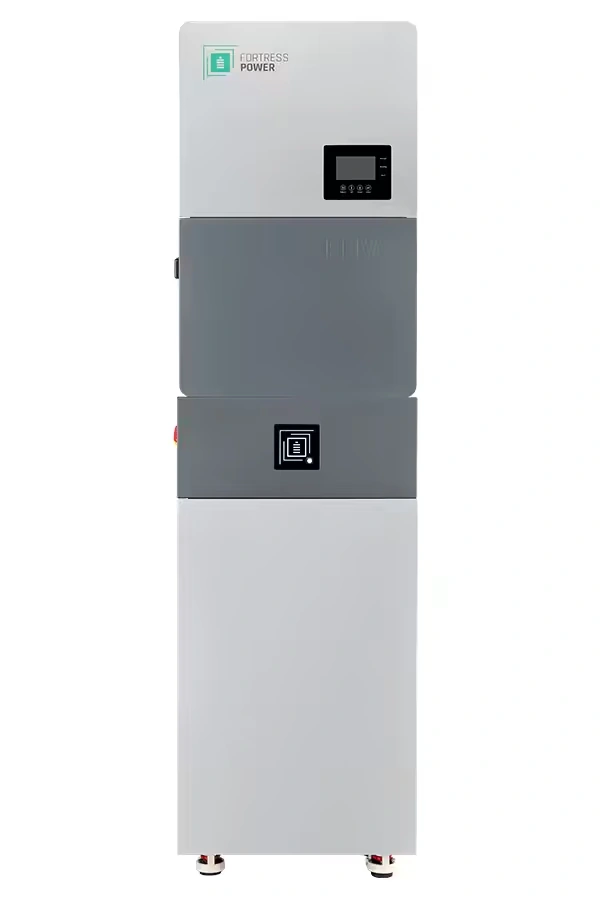
When a customer tells me they want battery backup, I like having a product that gives us a useful starting point instead of forcing the system around a very small battery module. The Fortress Power eBoost 16kWh LFP Battery gives us 16kWh of usable energy in one unit, a 51.2-volt battery platform, and a clean path to add batteries in parallel when the system needs more.
Fortress also lists 16.077kWh as the battery’s nominal energy. That is a useful specification, but it is not the same thing as promising that every home will receive that exact amount at the loads. In practice, inverter losses, reserve settings, temperature, and the way your loads operate all matter.
Start with the energy your home needs
Energy answers the “how long?” question. Suppose your essential backup loads average 2,000 watts for six hours overnight:
2 kW × 6 hours = 12 kWh
That gives one eBoost a reasonable starting point on paper. I still leave room for real-world conditions, because a refrigerator, pump, air conditioner, or other appliance does not run at one perfectly steady power level all night. The calculation helps us size the conversation. It is not a runtime guarantee.
Two eBoost units provide about 32.154kWh of nominal energy, and three provide about 48.231kWh. That is the practical advantage I see in this battery: you can begin with a meaningful amount of storage and add capacity when your load profile or backup goals justify it.
Power decides what can run together
Stored energy and instantaneous power are different questions. A battery can have plenty of energy for the night but still need to be matched carefully to the inverter and the loads you want operating at the same time.
The eBoost datasheet lists closed-loop charge and discharge limits of 180 amps and 250 amps for one battery. It also lists 16kW of surge discharge power for 10 seconds. Those figures describe the battery’s capability. They do not turn a smaller inverter into a larger one, and they do not replace the inverter’s continuous output rating or battery-current limit.
That is why I look at the largest loads you want to run together, not just your daily kilowatt-hours. A single eBoost may be a sensible match for an essential-load system. A larger inverter or a demanding whole-home plan may call for more batteries, depending on the exact inverter model and its operating limits.
Match the battery to the inverter
Fortress Power’s current compatibility table lists one eBoost 16 as the minimum battery quantity for several Fortress inverter models, including the Envy 8kW, Envy 10kW, Envy 12kW, Envy Duo 21, Solo 6.5K, and EdgeOn Duo models. That is a minimum for the listed configuration, not a complete system design. The inverter, battery quantity, firmware, communication method, and operating settings still need to agree.
Closed-loop communication means the battery management system can share status and operating limits with a compatible inverter. The eBoost provides PCS (power conversion system) CAN and RS485 communication, along with CAN communication for parallel battery systems. That gives the inverter better information than generic voltage settings alone, provided the equipment is connected and configured according to the applicable documentation.
Choose the expansion path early
If you expect the system to grow, I prefer deciding that before the equipment arrives. Fortress positions the eWay as the better choice for multi-battery and whole-home systems, while the eWay Lite is intended for simpler layouts where a compact setup is the priority.
That choice is not just about the battery itself. The wireway, busbar arrangement, inverter location, communication plan, and available space all affect how easy a future expansion will be. The eBoost gives you room to grow, but the rest of the system has to leave room for that growth too.
Watch the commissioning lesson
For a Hawaii home, I would start with your essential-load list, the largest loads you want to run together, the inverter you are considering, and how much overnight energy you want available. Then we can decide whether one eBoost is the right starting point or whether two or more make better sense. Contact SolarMan and I’ll help match the eBoost battery bank to the rest of your system.