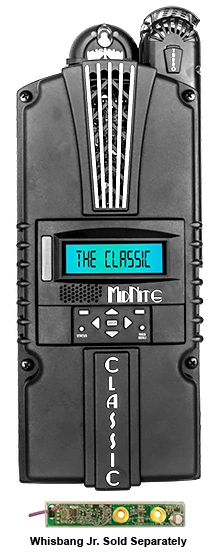
If you're looking at a Classic 150, I want you to see why I still consider it a useful controller instead of judging it by the number in its name. It can work with 12-, 24-, 36-, 48-, 60-, and 72-volt battery systems, and MidNite gives it a broad set of controls, monitoring tools, and protection features. That makes it a serious candidate for a small cabin, a legacy off-grid system, or a component-based 48-volt system.
The “150” does not mean 150 amps, and it does not mean a 150-volt battery bank. It refers to the controller's photovoltaic operating-voltage class: 150 volts maximum operating input. Your battery bank remains in the 12-to-72-volt range listed for the Classic family.
Why the 48-volt number needs a closer look
MidNite's product page gives the Classic 150 a headline maximum output of 96 amps. That is useful, but it is not the current you should automatically multiply by every battery voltage. The Rev. V manual lists 96 amps at a 12-volt battery, 94 amps at 24 volts, and 83 amps at 48 volts at 25°C.
So for a rough 48-volt example, I would start with 48 volts × 83 amps = 3,984 watts of nominal battery-side power. That is a rating-based estimate, not a promise that the controller will produce 3,984 watts all day. The actual result depends on battery voltage while charging, array size, sunlight, temperature, and the controller's operating conditions. Hawaii heat matters because MidNite also documents current derating as temperature rises.
That distinction is important when we match the controller to the battery bank. A controller can be adjustable for lithium, flooded lead-acid, AGM, and other battery chemistries, but the adjustment range does not remove the need to follow the exact battery manufacturer's voltage, current, temperature, and communication requirements.
The 150, 200, and 250 solve different problems
MidNite's Classic family gives us three photovoltaic-voltage choices. The Classic 150 is the 150-volt class, the Classic 200 reaches 200 volts, and the Classic 250 reaches 250 volts. MidNite lists headline maximum outputs of 96, 79, and 63 amps respectively, but those figures are family-level maximums. Actual output still depends on battery voltage and operating conditions.
I would choose the Classic 150 when the planned solar strings fit safely within its operating range and its current capability matches the battery bank. I would look at the Classic 200 or 250 when the array genuinely needs more photovoltaic-voltage room, perhaps because of the planned series string or a longer array-to-controller run. I would not choose the larger model just because its number is larger.
150 volts is not a string-design target
When we design the array, we check the panels' open-circuit voltage, or Voc, at the coldest expected condition. We also check normal operating voltage and current. Those are separate numbers. Panel voltage rises in cold weather, so a string that looks comfortable on a warm afternoon may be much higher early on a cold morning.
The Classic's HyperVOC feature gives it a protective zone above the normal operating voltage. In that condition, the controller stops operating until the photovoltaic voltage falls back into its normal range. I see that as useful protection, not permission to design the array casually above the 150-volt operating limit. MidNite's manual and string-sizing tools should guide the final design.
The useful part is what you can see and control
The full Classic 150 includes a local graphics display, push-button setup, Ethernet capability, data logging, remote monitoring options, built-in direct-current ground-fault protection, and arc-fault detection. It can also operate in solar, wind, and hydro modes. For a customer maintaining a component-based system, that information is valuable because you can see what the controller believes is happening.
You can distinguish resting, maximum power point tracking, bulk charging, absorb, and float instead of treating every low-production day as a failed array. You can compare photovoltaic voltage with charging current, which is much more useful than assuming that a voltage reading alone proves useful charging power is flowing.
The altE Store lesson, “Comparing Midnite Solar Classic MPPT solar charge controllers,” is a helpful general introduction to the family. It walks through the voltage and current ranges, the difference between the full Classic, Classic Lite, and Classic SL versions, and the display, monitoring, logging, ground-fault, and arc-fault features. It won't design your array for you, but it gives you a good picture of why the three Classic voltage classes exist.
If you're considering a Classic 150, bring me the battery-bank voltage, panel model, number of panels, and approximate string arrangement. I'll help you compare the controller's input and battery-side output limits with the system you actually want to build—not just with the biggest number printed on the box.