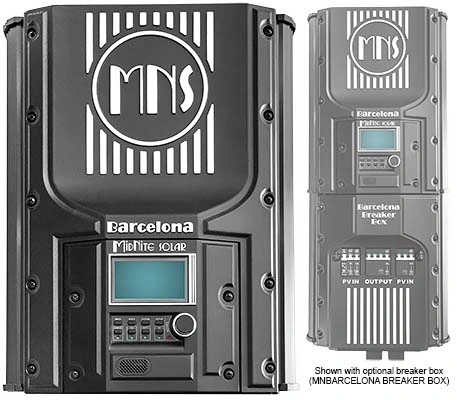
A quiet solar day doesn’t automatically mean something is wrong with the array. A cloudy morning, a full battery, or another charging source can all leave the MidNite Barcelona producing little or no current. What I like about the Barcelona is that it gives us useful information to sort those situations apart instead of guessing.
The Barcelona is built for a 48-volt battery bank and can deliver up to 200 amps of charging current, with 100 amps assigned to each of its two independent maximum power point tracking, or MPPT, channels. That is serious charging capacity. It also means the controller deserves to be understood as part of the whole system, not judged only by whether the front display says “charging.”
Start with the battery, not the weather
When I look at a Barcelona system, I first want to know what the battery is asking for. If the battery is already near its target voltage, the controller may reduce its contribution. The Barcelona manual calls this condition Resting. Resting is not one of the charging stages; it means the controller is not currently charging for a reason such as low solar intensity, insufficient photovoltaic voltage, another charging source raising the battery voltage, or a setting that has placed the controller out of operation.
That distinction matters. A controller sitting in Resting during a dark, rainy Hawaii morning may be behaving normally. The same message at midday, with strong sun and a battery that clearly needs charging, deserves a closer look.
Voltage tells me the array is present. Current tells me it is working.
The Barcelona can show the photovoltaic input voltage and charging information through its built-in MidNite Graphics Panel 2, or MNGP2. Daylight can create panel voltage even when the array is not delivering useful power. So I don’t treat voltage alone as proof that the solar array is healthy.
I want to compare the readings. Is PV voltage present on the expected input? Is the controller in a normal charging stage such as Bulk, Absorb, or Float? Is charging current appearing when the battery needs it? In simple terms, photovoltaic voltage multiplied by photovoltaic current gives photovoltaic watts. A high voltage reading with almost no current can point toward weak sunlight, a disconnected or restricted circuit, a protection device that has opened, or a problem in the array path.
The Barcelona’s high-voltage input is one reason I would plan it carefully. MidNite’s current product information lists an MPPT operating range of 185 to 585 volts direct current and a photovoltaic open-circuit voltage range of 220 to 600 volts direct current. Those are design numbers, not targets to approach casually. Array voltage changes with temperature, and the final string design needs to be checked against the exact modules, local conditions, and applicable installation requirements.
The charge stage gives the numbers some context
A single reading is only a snapshot. The charge stage helps explain what the Barcelona is trying to do. Bulk generally means the controller is delivering available charging power toward the battery. Absorb means the battery has reached the programmed absorption-voltage portion of the charge routine. Float indicates a later maintenance stage. Resting means the controller is not presently charging, but the reason still matters.
That is where the MNGP2 becomes useful for an ordinary owner. I can look at the battery voltage, PV input, charge current, timers, faults and warnings, and recent logged data as one story. The Barcelona also supports up to 365 days of data logging. That can help us compare a new concern with the system’s normal behavior rather than reacting to one unusual afternoon.
A practical example from a Hawaii system
Suppose the Barcelona shows PV voltage in the morning but remains in Resting. If the sky is overcast and the battery is already being supported by an inverter-charger, that may be normal. If the battery is low, the sun is strong, and the PV voltage disappears when the array should be active, I would look toward the photovoltaic disconnects, breakers, wiring, connectors, or array itself.
If you want to see the basic measurement idea, altE Store’s Troubleshooting a solar charge controller walks through comparing controller voltage readings with battery-side voltage and charging current. It’s a general lesson, but that same habit—checking both voltage and current before deciding something has failed—is useful when we’re reading a Barcelona.
If the controller briefly enters Bulk and then returns to Resting, the manual points us toward a different kind of investigation. A PV input voltage that falls close to battery voltage can suggest a poor connection or another input-side problem. That is more useful than simply saying, “The panels aren’t charging.” It gives us a direction for qualified troubleshooting.
Why this fits a larger 48-volt system
The Barcelona can operate by itself or communicate with other compatible MidNite products over CANbus, including a Rosie inverter. One MNGP2 can view multiple connected devices by name, which can make a larger battery-based system easier to understand. You can see the charge controller and related equipment as parts of one system instead of treating every box as a separate mystery.
I especially like that approach for a Hawaii home, workshop, or off-grid property where weather changes quickly and the battery may have more than one charging source. The Barcelona does not eliminate the need for proper array design, protection, settings, or professional measurements. It does give us a much better conversation when the system is not behaving the way you expect.
If you’re considering the Barcelona, contact SolarMan and tell me about your battery bank, solar array, inverter, and the readings you’re seeing. I can help determine whether this controller fits the job and what information we should have before choosing it.