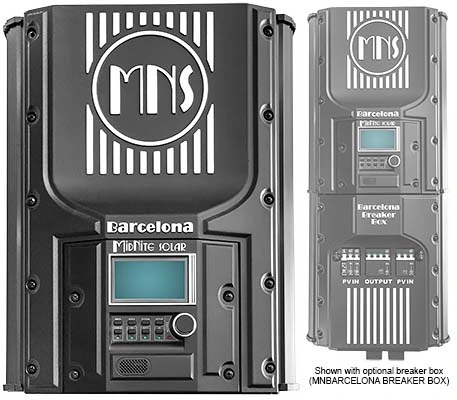
I like the MidNite Barcelona when a solar-storage system has a real job for its capacity: a substantial 48-volt battery bank, a large photovoltaic array, and a plan that benefits from organized control instead of several unrelated boxes. It gives you serious charging headroom, but it still lets the battery manufacturer’s limits set the pace.
The Barcelona is rated for up to 200 amps of combined battery charging current, with 100 amps assigned to each of its two independent maximum power point tracking (MPPT) channels. That is a lot of charging capacity for a 48-volt system. It also means the battery bank, protection, conductors, and inverter relationship need to be planned around the current the system can actually deliver.
What 200 amps means in your system
Here is a useful scale calculation. At a nominal 48 volts, 200 amps represents about 9,600 watts of battery-side charging power: 48 V × 200 A = 9,600 W. That is not a promise that the system will produce 9.6 kilowatts every day. Sunlight, array size, temperature, battery state of charge, and system settings all affect the result. Actual charging voltage is also higher than the nominal 48-volt label, so instantaneous battery-side watts will vary.
More importantly, 200 amps is the controller’s capacity—not an instruction to push 200 amps into every battery bank. If your battery manufacturer approves 100 amps of charging current for the bank, I would configure the Barcelona around that limit even though the controller can supply more.
That adjustable headroom is valuable. It can give a larger battery bank room to charge properly, allow for future storage expansion, or let the system operate below its maximum when the battery or protection equipment calls for it. The Barcelona also provides input- and output-current controls, so the installer can set the equipment around the actual system instead of treating the nameplate maximum as the target.
High-voltage solar with two independent MPPT channels
The Barcelona is not a conventional low-voltage solar controller. MidNite’s product page and the Rev. A manual introduction list a 185–585 VDC MPPT operating range and a 220–600 VDC open-circuit-voltage range. The installation section of that same Rev. A manual also prints 185–550 VDC for the MPPT range, so I would have the installer confirm the exact manual and nameplate revision before finalizing a string near the upper end.
Its two independent MPPT inputs are useful when the array has two electrically different sections. Each channel can track its own input rather than forcing every panel group to behave exactly the same way. That does not eliminate the need for proper string design, but it can give the installer more freedom when roof areas, orientations, or future array sections do not line up perfectly.
Let the battery set the charging rules
The Barcelona supports flooded lead-acid, sealed, AGM, gel, nickel-iron, lithium, and other battery chemistries. That flexibility is useful, but one profile is not automatically correct for every battery.
The installer still needs the battery manufacturer’s charging voltage, maximum current, absorb behavior, and temperature instructions. The Barcelona provides settings for absorb, float, equalization, battery capacity, maximum charge, ending amps, and temperature compensation. For lithium batteries, MidNite documents a zero temperature-compensation setting as typical because the battery management system handles that function. The battery manufacturer’s instructions remain the authority.
That is why I consider commissioning part of the product match. A high-capacity controller only helps when its settings agree with the battery bank, the inverter, and the protection equipment around it.
Why the Rosie and MNGP2 connection matters
MidNite describes the Barcelona as a companion to its 7,000-watt Rosie inverter. In a compatible system, the Barcelona and Rosie can communicate over CAN bus, or Controller Area Network. The MNGP2 display can then provide access to multiple connected MidNite devices from one interface.
For you as the owner, that means the charge controller and inverter can be viewed as one coordinated system rather than two boxes with separate information. The Barcelona also supports remote battery-voltage sensing, and one battery-sense connection can be shared across a system that includes multiple Barcelonas or a Barcelona and Rosie inverter/charger.
When I would put the Barcelona on the short list
I would look closely at the Barcelona for a large 48-volt battery bank, a substantial PV array, and either an off-grid or battery-based grid-connected design that benefits from high-voltage array wiring. It is also worth considering when future storage or additional solar is part of the plan.
The optional Barcelona Breaker Box adds two 600-volt, 30-amp PV input breakers and an 80-volt, 200-amp battery breaker in an enclosure designed for the controller. The Barcelona can operate without it, so I treat the box as a system-organization choice rather than an automatic requirement.
MidNite lists a standard five-year warranty, but the more important question is still whether the controller fits the battery, array, inverter, and protection plan. If you are considering a large 48-volt system, contact SolarMan and let me look at that match with you. The Barcelona has the capacity to do serious work, and I want that capacity supporting the right system—not creating a new limit somewhere else.