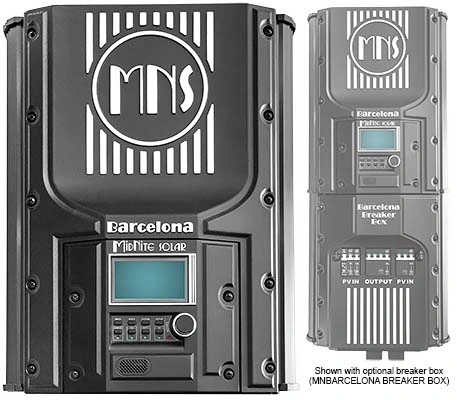
With the MidNite Barcelona, you’re not just getting a large solar charge controller. You’re adding a high-capacity charging device that can become part of the same control conversation as a MidNite Rosie inverter. That’s what I like about this combination: the equipment stays separate, but the information is easier to follow from one MNGP2 display.
That matters when you’re trying to understand a Hawaii system during a bright afternoon, a cloudy morning, or a long outage. The Barcelona handles solar charging. The Rosie handles inverter and alternating-current charging duties. Both work around the same 48-volt battery system, but each still has its own job and its own limits.
Solar charging and inverter power have different jobs
The Barcelona is a maximum power point tracking (MPPT) charge controller. It takes power from the photovoltaic array and converts it into the voltage and current needed by the battery bank. MidNite specifies two independent MPPT channels, with up to 100 amps of charging output per channel and 200 amps combined.
That is serious battery-side charging capacity. It does not mean every battery bank should receive 200 amps. Your battery manufacturer may specify a lower charge current, and the Barcelona includes controls for limiting output around the battery bank, protection equipment, and system plan.
The Rosie has a different job. It changes battery power into alternating-current power for your loads and can charge the batteries from a properly planned alternating-current source. When the Barcelona and Rosie are used together, I want the design to show clearly which equipment is making power, which equipment is storing it, and which limits belong to the battery.
What the shared MNGP2 view adds
MidNite calls the display the MidNite Graphics Panel 2, or MNGP2. The Barcelona and Rosie communicate through a Controller Area Network, commonly called CANBUS. One MNGP2 can look at multiple connected MidNite devices by their names, so you don’t have to treat the solar controller and inverter as unrelated screens.
For example, you may see the Barcelona move through Bulk, Absorb, and Float charging while the Rosie is serving the home’s loads. If another charging source is already holding the battery voltage up, the Barcelona may show Resting instead of pushing more current. That is not automatically a solar failure. It may simply mean the battery system does not need additional charging from the Barcelona at that moment.
The shared system naming is useful during setup, too. MidNite’s Barcelona manual explains that selected system-level settings can be shared across connected devices, while each device can still retain its own identity. That distinction matters if you later add another Barcelona or another MidNite product. I want the installer to know which settings apply across the system and which belong only to the selected controller or inverter.
A practical Hawaii example
Suppose your roof array has two sections feeding the Barcelona’s two MPPT channels, while a Rosie supplies essential 120-volt or 120/240-volt loads from the same 48-volt battery bank. During the day, the Barcelona tracks the two solar inputs independently and sends charging current to the battery. The Rosie can serve the loads while the MNGP2 helps you see the system’s operating state from one control point.
That arrangement can be helpful when the house has changing loads. A refrigerator, pump, or air conditioner may be running while the battery is charging. Looking only at panel wattage won’t tell the whole story. I want to see whether the Barcelona is in Bulk or Absorb, whether the battery is approaching its voltage target, and whether the Rosie is serving loads from the battery or from another configured source.
The high-voltage photovoltaic side still needs a careful design. MidNite’s current Barcelona product page lists an MPPT window of 185 to 585 volts and a 220-to-600-volt open-circuit-voltage range. The Rev. A manual’s commissioning guidance says at least 240 volts open-circuit is good for operation. Because the manual and product page present the tracking limit differently, I want the final string design checked against the exact model documentation rather than guessed from one number. Cold-weather voltage, operating current, short-circuit current, and the selected array all need to be checked together.
When this combination fits
I’d look closely at the Barcelona and Rosie combination when you want a component-based system with substantial solar charging, a serviceable inverter, and one MidNite control environment instead of a collection of disconnected displays. It can make sense for a larger off-grid system, a battery-based backup system, or a project where future expansion and clear troubleshooting matter.
The battery chemistry still drives the final charging settings. Lithium, absorbed glass mat, sealed lead-acid, and flooded batteries do not all want the same voltage, temperature compensation, or finishing behavior. The Barcelona gives you adjustable controls, but those controls should follow the battery manufacturer’s requirements.
For the communication side, Kvaser’s “Controller Area Network (CAN)” lesson explains what CAN means and how connected devices exchange information across a network. It’s a useful technical primer before we talk through how the Barcelona and Rosie would fit your particular system.
If you’re considering a Barcelona with a Rosie, contact SolarMan before choosing the array or battery count. Bring me your loads, battery model, solar layout, and backup goals, and I can help you decide whether this coordinated MidNite approach fits the system you’re trying to build.