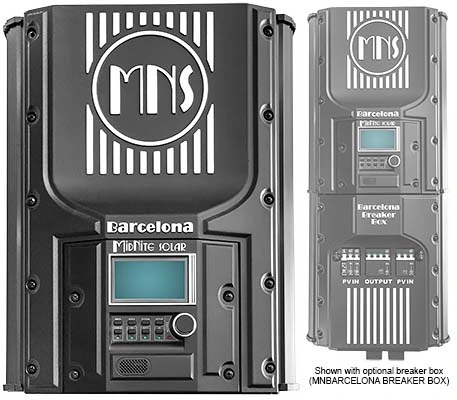
When I’m looking at a larger 48-volt solar system, I don’t want the Barcelona MPPT Charge Controller sitting in the middle of a maze of separate disconnects and protective equipment. I want the power path to be understandable. That’s where the optional Barcelona Breaker Box can earn its place.
The Barcelona itself is a serious charge controller. It is built for a 48-volt battery bank, accepts photovoltaic (PV) input up to 600 volts open circuit, and has two independent maximum power point tracking (MPPT) inputs. The controller can deliver up to 200 amps of charging current in total, with 100 amps assigned to each MPPT channel. That is a lot of equipment to support, so the protection and disconnect plan deserves the same attention as the solar array.
What the breaker box adds
MidNite’s MNBCLNA-BB is a direct companion for the Barcelona. It provides two 600-volt direct-current, 30-amp PV input breakers, plus a 200-amp, 80-volt battery-side breaker. In plain terms, each Barcelona PV input gets its own disconnect path, and the battery connection gets a substantial disconnect between the controller and the battery system.
That does not mean the Barcelona cannot operate without the breaker box. MidNite says the controller can be installed on its own. I see the breaker box as a way to make a larger installation more coherent: the equipment that protects and disconnects the high-voltage PV circuits and the battery circuit is grouped with the controller instead of scattered around the power room.
Why two PV breakers matter
The Barcelona has two independent MPPT inputs, and the optional enclosure keeps those inputs separate. That matters when the two solar sections have different electrical behavior. One array might be on a different roof plane, use a different string count, or receive shade at a different time of day.
Independent tracking does not make an unsuitable array suitable. MidNite identifies an MPPT operating window of 185 to 585 volts DC and a PV open-circuit voltage range of 220 to 600 volts DC. Those are different checks. Open-circuit voltage protects the controller from excessive voltage, while the operating range tells us whether the array can spend useful time inside the tracking window.
I also want the array’s current checked separately. The breaker-box PV breakers are rated at 30 amps each, but that breaker rating is not a substitute for checking the Barcelona’s permitted PV operating current, short-circuit current, conductor sizing, and the effect of array conditions. If we use bifacial modules, rear-side light can add current, so I account for that contribution instead of sizing only from the front-side nameplate.
A better service conversation
For a customer, one of the best benefits is simple: a qualified electrician or solar technician has a clearer place to begin when the system needs to be isolated or inspected. The breaker box includes a ground busbar and provisions for MidNite surge-protection devices. It also matches the Barcelona mechanically and visually, with an optional backplate for mounting the pair as one organized assembly.
That organization is especially useful when the Barcelona is supporting a MidNite Rosie inverter and a substantial battery bank. The Barcelona handles solar charging; the inverter handles the alternating-current side and household loads. Keeping the controller’s PV and battery protection close to the controller makes it easier to see which equipment is being isolated during service. It does not replace the rest of the system’s required protection, grounding, or disconnect planning.
Where I would consider it
I would seriously consider the Barcelona Breaker Box for a large DC-coupled system, a Rosie-based system with two substantial PV sections, or a power room where clean service access matters. I would also look at the available wall space and the route to the batteries before ordering it. MidNite’s documentation calls for indoor or compartment installation, protection from rain and moisture, a 48-volt battery bank, and a battery connection no longer than six feet.
If your system is smaller, or if your installer already has a well-planned external protection layout, the Barcelona can still be used without this enclosure. The right choice depends on the complete equipment arrangement, not on the idea that one accessory is automatically better.
AltE Store’s A DIY Off-Grid Solar Power System Overview and Wiring is a useful general lesson if you want to see how separate PV breakers, positive and negative bus bars, surge protection, and grounding fit into a small DC system. It does not review your exact Barcelona installation, but it makes the organization idea easier to see.
Bring me your proposed array layout, battery voltage, inverter choice, and equipment location. I can help you decide whether the Barcelona alone is the cleanest fit or whether the Barcelona Breaker Box would give your SolarMan system a more serviceable center.