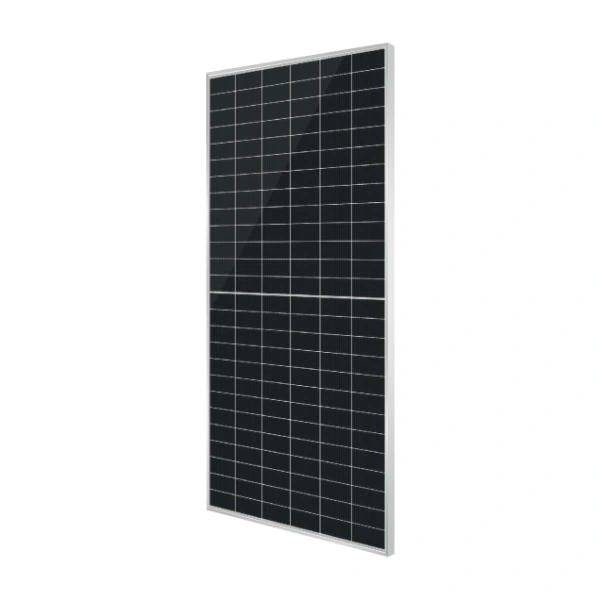
When we plan a solar system, I like starting with the job the array needs to do rather than picking a panel by wattage alone. The Hyundai HiS-T640NJ gives us a useful planning number: 640 watts of rated power under standard test conditions. That makes it easier to see how different panel counts move us toward a target array size.
Start with the array size you actually want
Five of these panels add up to 3,200 watts of rated panel power. Six add up to 3,840 watts. Eight reach 5,120 watts. That simple arithmetic can help when we’re trying to get close to a customer’s solar goal without adding one small extra panel just to cross a threshold.
That number is a design starting point, not a promise that the array will produce the same power all day. Sun angle, clouds, heat, shade, orientation, wiring, inverter limits, and household loads all affect what you actually receive. I want you to see the useful capacity of the array clearly without pretending the nameplate is a daily energy forecast.
A higher-wattage panel does not automatically mean a smaller project
The HiS-T640NJ is a large-format module, measuring about 97.0 by 44.6 inches and weighing about 76.5 pounds. Fewer modules may help the arithmetic reach a target, but they do not automatically reduce roof area, rails, attachments, structural work, conduit, labor, or total project cost. Those details depend on the roof sections, access, setbacks, mounting layout, and the rest of the system.
That is why I use the 640-watt figure as one part of the conversation. We still need to see how many modules fit each roof section, whether the inverter accepts the resulting voltage and current, and whether the array’s physical size works for the property.
The panel’s efficiency helps when usable space is limited
Hyundai lists the HiS-T640NJ at 22.90% module efficiency. In plain language, that means the panel converts a relatively strong share of the sunlight reaching its surface into electricity under the test conditions used for the rating. That can be helpful when the available roof or ground-mount area is limited, although the final layout still decides how much capacity we can install.
This is an N-type TOPCon, or tunnel oxide passivated contact, module with a double-glass bifacial construction. Bifacial means the rear side can also collect useful reflected light. Hyundai’s datasheet shows reference values of 672 watts with 5% rear-side gain, 736 watts with 15% gain, and 800 watts with 25% gain. I treat those as design references, not guaranteed field production. A roof-mounted panel close to a dark surface may see much less rear-side benefit than a raised ground-mount array over a reflective surface.
Where this panel fits best
I’d look closely at the HiS-T640NJ when you have a clear target array size, enough room for a large commercial-style module, and an inverter or charge controller that can accept the panel’s electrical characteristics. The datasheet lists 57.77 volts open-circuit voltage, 47.74 volts at maximum power, 13.41 amps at maximum power, and 14.06 amps short-circuit current for the 640-watt front-side rating.
Bifacial gain matters in that match, too. Hyundai’s 15% rear-side reference lists 15.42 amps at maximum power and 16.17 amps short-circuit current. Those are different design numbers, and neither should be treated as a universal field result. The inverter or charge controller has to be checked against the applicable operating-input current and permitted short-circuit current, with the possible rear-side contribution included.
Those figures matter because panels are not matched to an inverter by watts alone. The designer has to check the cold-weather string voltage, operating voltage, input-current limits, short-circuit-current allowance, and any additional current associated with bifacial operation. I’m happy to work through that match with you before we talk about a final panel count.
One useful lesson before we finalize the count
AltE’s lesson, “What’s worse? Mismatched solar panels with different amps in series or parallel?”, compares two same-voltage panels with different current ratings through a maximum power point tracking charge controller. It gives you a useful general picture of why voltage and current both matter when we organize an array and match it to the rest of the system.
The price I have on these Hyundai panels is excellent. The better question is whether the HiS-T640NJ fits your roof, inverter, mounting plan, and energy goal. Contact SolarMan and I’ll help you turn the target array size into a practical system conversation.