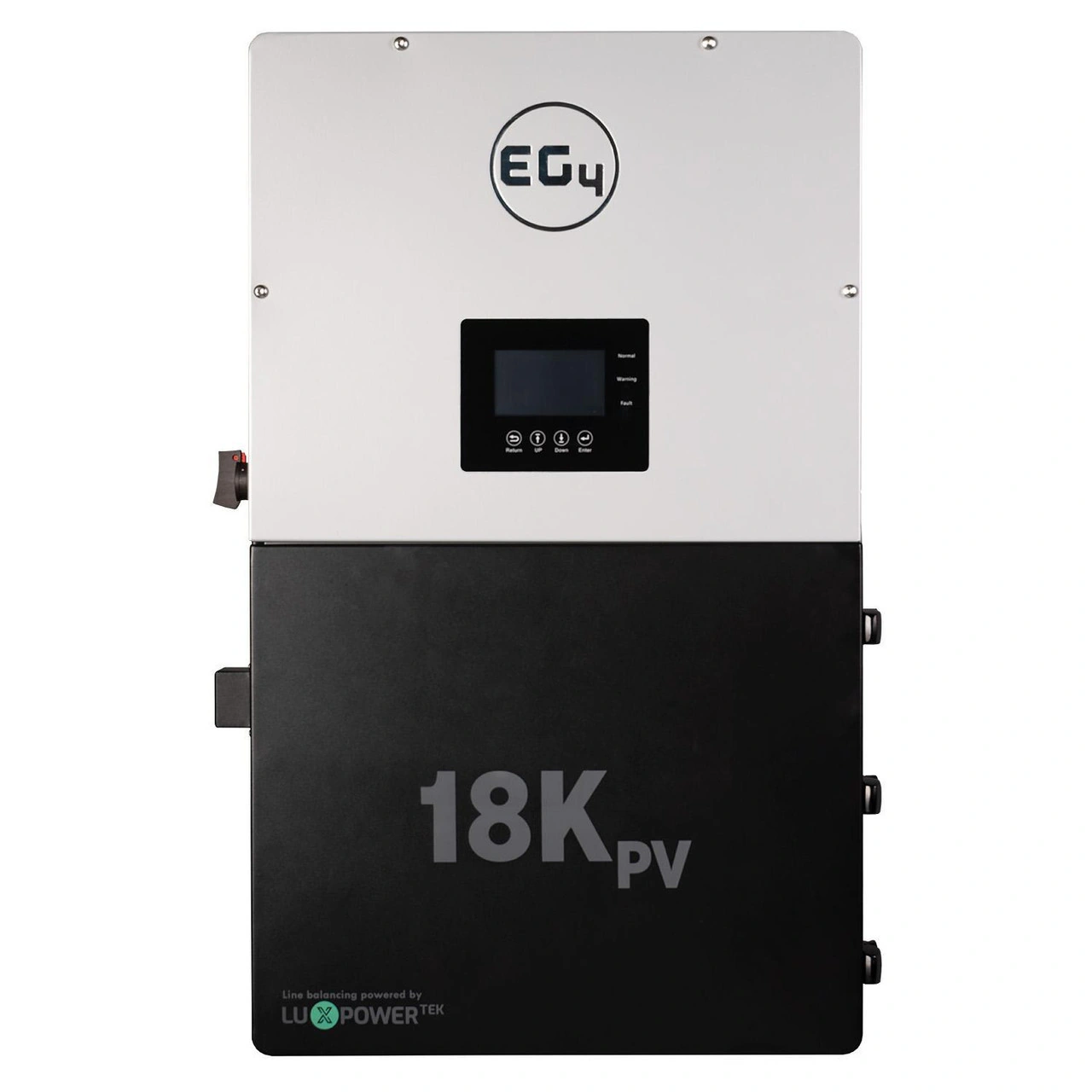
I like the EG4 18kPV because it gives a Hawaii home a lot of room to build around: 12 kilowatts of continuous alternating-current output, 18 kilowatts of photovoltaic input, and three maximum power point tracking inputs in one 48-volt hybrid inverter. The battery choice is where I want us to slow down—not because the inverter is mysterious, but because a good match involves more than voltage.
With a supported lithium battery, closed-loop communication lets the battery-management system share information such as state of charge, temperature, and charge or discharge limits with the inverter. An open-loop arrangement is a separate documented design decision, not an automatic substitute for a closed-loop pairing.
Start with the exact battery model
EG4’s current 18kPV compatibility list names specific battery families and protocol codes. It includes EG4 batteries, selected Pylon, Fortress, SimpliPhi, GSL, and other models, along with the communication method the inverter expects.
The list also shows why the model number matters. For Pytes, it names the E-BOX-48100R, E-BOX 4850, and V5, but it does not name the Pytes V16. I would want current written confirmation from the battery and inverter suppliers before treating a V16 as a supported closed-loop pairing. That is not a criticism of the battery. It is simply the difference between “the voltage looks right” and “the complete system has been documented.”
What the communication link actually does
The battery-management system, or BMS, is the battery’s internal safety and operating controller. In a closed-loop system, the BMS can report information such as battery voltage, current, state of charge, temperature, and charge or discharge limits to the inverter. The inverter can then make decisions using the battery’s reported limits instead of relying only on manually entered numbers.
The 18kPV supports battery communication through Controller Area Network (CAN) or RS-485, a wired serial communication standard. Those methods are not interchangeable just because both may use a small data cable. The cable pinout, battery port, protocol selection, and inverter battery-brand setting all have to agree. When several battery modules are used, EG4 says the inverter communication cable connects to the master battery, with the battery manufacturer’s master-and-slave arrangement followed during setup.
A useful example before installation day
Suppose you want an EG4 18kPV with a rack of lithium batteries for a Hawaii home. The 18kPV manual lists a 48-volt nominal battery system, a 40-to-60-volt battery range, and a maximum charge/discharge current of 250 amps. EG4 also lists a recommended battery capacity of at least 300 amp-hours per inverter.
That 250-amp figure is the inverter’s own battery-side limit. It is not a promise that every battery bank can supply 250 amps. We still need to check the battery bank’s permitted current, the manufacturer’s parallel-battery rules, the communication method, and the exact battery code selected in the inverter. A battery bank can have plenty of kilowatt-hours and still be a poor match if its permitted discharge current is too low for the loads you want to back up.
The 300 amp-hour recommendation also does not choose the battery bank for us. It gives us a starting point for matching the inverter’s power demand to a bank with enough capacity and current capability. The final choice still depends on the battery model, the loads, the backup plan, and whether the system needs the inverter’s full output.
This is also where firmware matters. EG4 specifically notes that LifePower4 V1 batteries require a firmware update for closed-loop communication with the 18kPV. That is the kind of detail I want identified before the equipment is mounted, not discovered after the system is supposed to be operating.
What I want checked before we call it ready
During planning, I want the exact battery model and revision identified first. Then we confirm whether EG4 lists it, whether the connection uses CAN or RS-485, whether the battery firmware and inverter firmware are appropriate, and whether the battery bank has a defined master unit when multiple modules are installed.
After commissioning, a closed-loop system should show believable battery information rather than simply displaying a battery icon. If the inverter reports a battery communication alarm, the installer should check the approved protocol, cable pinout, selected battery brand, master-battery arrangement, and battery alarm status. EG4’s troubleshooting guidance points to those checks.
Kvaser’s “Physical layer properties” lesson gives a useful general explanation of what Controller Area Network communication is doing: a two-wire bus, multiple connected devices, differential signaling, and the physical arrangement that lets those devices exchange data. It won’t choose the EG4 battery code for us, but it makes the communication conversation easier to follow.
If you are considering the EG4 18kPV, bring me the exact battery model, the number of batteries you want, and the loads you expect to run during an outage. I can help you separate stored energy, battery-side current, and communication compatibility before we turn a promising equipment list into an expensive mismatch.