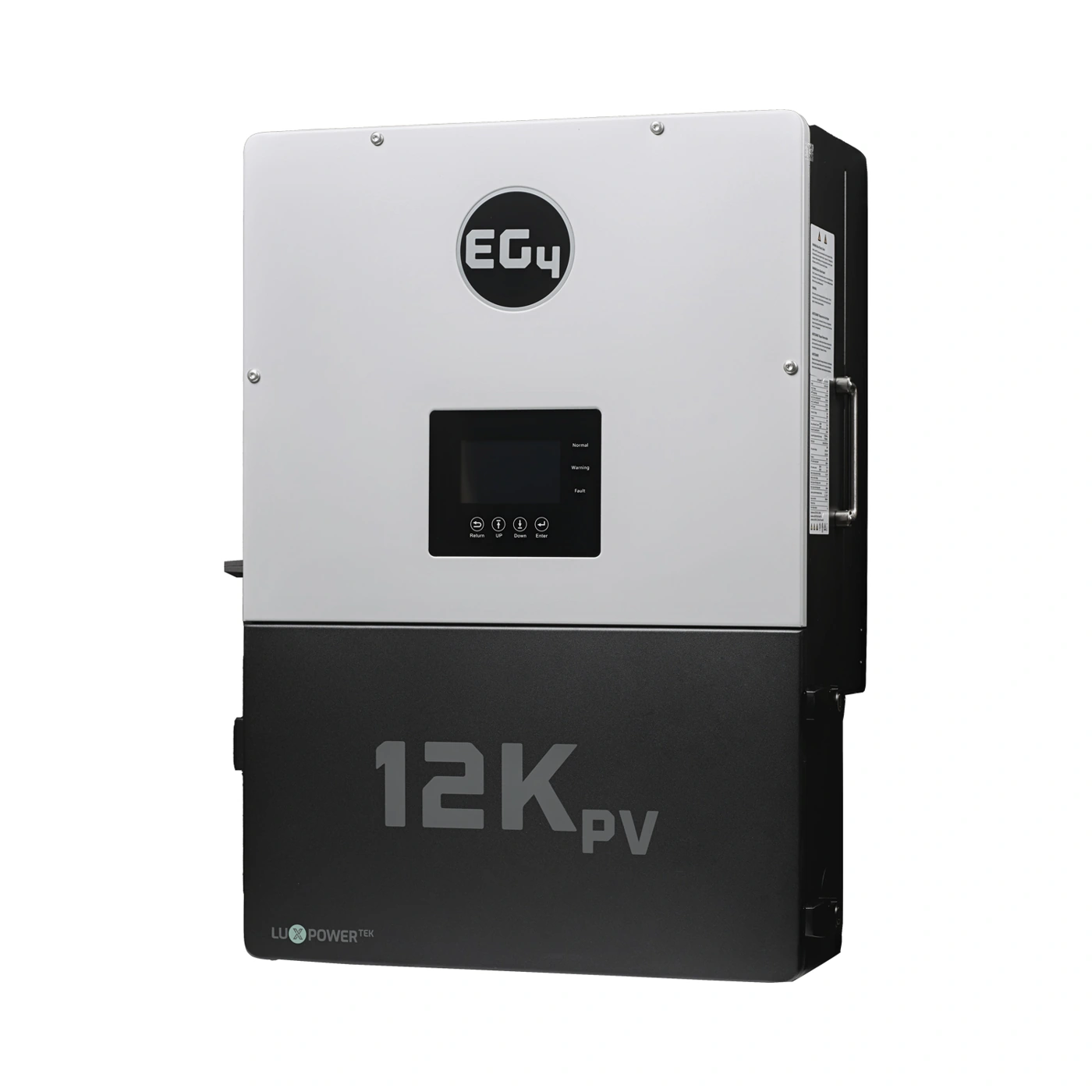
The EG4 12kPV gives you a lot of inverter in one enclosure: 12 kilowatts of photovoltaic input, 8 kilowatts of continuous alternating-current output, and a 48-volt battery system. I like that combination for a Hawaii home that wants meaningful backup power, but there’s one part of the design I want to keep clear: the battery bank has to carry its share of the job.
People often start with amp-hours because that’s the number printed on a battery label. Amp-hours describe stored capacity. They do not, by themselves, tell us whether the battery can deliver the current the inverter needs during a large load.
Eight kilowatts becomes serious battery current
Here’s the simple starting point. At the 12kPV’s nominal 48 volts, 8,000 watts divided by 48 volts is about 167 amps on the battery side. That is before allowing for inverter losses and the fact that battery voltage changes while the system operates.
EG4 publishes 167 amps as the 12kPV’s maximum charge and discharge current at 48 volts. Treat that as a battery-side limit, not as a promise that the inverter can always deliver 8 kilowatts of alternating-current power from the battery alone. EG4 lists a 40-to-60-volt battery operating range, so the same 8,000-watt calculation would already be 200 amps at 40 volts before losses. The inverter’s battery-to-grid efficiency also matters.
That’s why a full-load design is not just an inverter question. It is a battery, battery-management-system, cable, disconnect, and connection-design question too. A refrigerator, lights, and a few outlets might use a small fraction of the available power. An air conditioner, pump, range of backed-up loads, or several large appliances can move battery current much higher very quickly.
Capacity and current answer different questions
EG4’s connections guide recommends more than 200 amp-hours of battery capacity per 12kPV inverter. That is a useful starting point for stored energy, but it is not a promise that every battery bank above that capacity can support every 12kPV load.
Capacity answers, “How long can the battery support the loads?” Current capability answers, “Can the battery safely deliver the power the inverter is asking for right now?” You need both answers.
For example, a 200-amp-hour, 48-volt bank has roughly 9.6 kilowatt-hours of nominal stored energy using simple arithmetic: 200 amp-hours × 48 volts. A battery labeled 51.2 volts would produce a different nominal-energy calculation. Neither figure is the same as energy delivered to your appliances. Usable energy depends on the battery’s permitted depth of discharge, inverter losses, temperature, battery-management controls, and the loads running at the same time. This is a math example, not a recommendation to stop at 200 amp-hours; EG4's stated starting point is more than 200 amp-hours per inverter.
If your home has modest evening loads, a battery bank above the manufacturer's starting capacity, with suitable current capability, may be a reasonable starting point for discussion. If you expect long air-conditioning runs, pump starts, or several hours of heavy backup use, I may recommend more stored energy, more parallel battery current capability, or a different load plan. Those solve different problems, so we size from your actual load pattern rather than treating one number as right for every house.
The battery has to speak the inverter’s language
The 12kPV can use lithium or lead-acid batteries, but the settings are not interchangeable. With a lithium battery, the exact battery model and communication method matter. EG4 publishes a 12kPV battery compatibility list with battery families and protocol codes, so I want to match the installed battery to that document instead of guessing from a similar-looking product.
Closed-loop communication can give the inverter useful information from the battery, including state of charge and battery operating limits. Without compatible communication, the inverter uses voltage-based control and manually configured limits instead. Communication does not make an undersized battery bank larger. The battery still needs enough current capability, the system still needs properly sized conductors and protection, and the exact firmware and protocol path still need to be confirmed.
That is also why I don’t recommend changing lithium settings casually from a generic menu screenshot. EG4’s settings guide says some settings may need adjustment by the installer after installation, and it tells users to consult the installer or distributor before changing settings that could conflict with the system. The battery manufacturer’s limits and the inverter configuration need to agree.
Where the 12kPV fits well
I’d look closely at the EG4 12kPV when you want one 48-volt hybrid inverter to coordinate solar, batteries, grid power, and backed-up loads without immediately building a much larger parallel system. The unit can be paralleled with other 12kPV inverters when the design eventually needs more output, but the first battery bank still has to be planned around the work one inverter will do now.
Bring me your large loads, expected overnight use, battery model, and whether you want short outage backup or longer off-grid operation. I can help separate the battery’s stored-energy requirement from its battery-side current requirement, then match the EG4 12kPV to a practical system plan. Contact SolarMan and we’ll work through the right fit before equipment is ordered.
If you want a broader lesson before we apply the 12kPV-specific numbers, the University of Maryland Extension’s How to design and size a solar battery system walks through daily energy use, system losses, battery-bank voltage, days of autonomy, temperature, depth of discharge, and the final amp-hour calculation. It gives you the planning foundation without pretending to select your exact battery.