If your OutBack inverter is getting old, I wouldn’t begin by assuming the entire solar system has to go. In many Hawaii systems, the solar array, battery bank, and separate charge controllers may still be useful. The first job is finding out what is healthy, what is compatible, and what has become the weak link.
That is where the MidNite Rosie 7048 can make sense. The MNROSIE7048RE is a 48-volt inverter/charger with 7,000 watts of rated output, a 120-amp charger, and 120/240-volt output in one unit. It can become the new center of the system while other equipment is evaluated on its own merits.
The inverter may be the part that needs to change
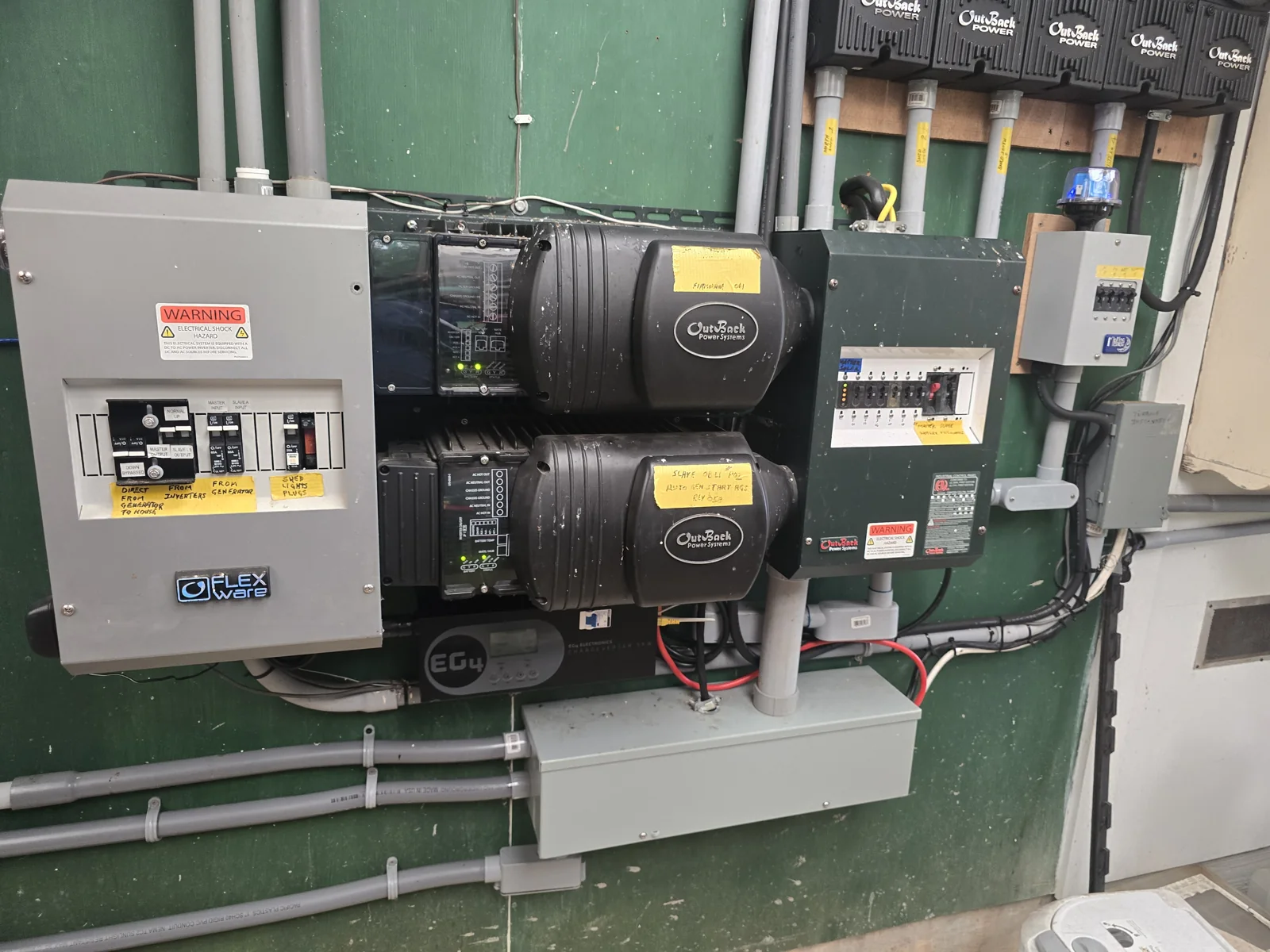
An older OutBack FX, VFX, FXR, or Radian system may have years of useful service in the battery bank and photovoltaic equipment. But the inverter is the section that handles the heavy conversion work: battery power to household alternating current, generator or utility input, battery charging, transfer operation, and the control of backed-up loads.
If that inverter has failed repeatedly, has unavailable parts, or no longer fits the loads you need to run, replacing that central section can be more practical than rebuilding every circuit. The Rosie also gives us a component-based path. If a separate solar charge controller has a problem later, that controller can be evaluated or replaced without automatically throwing away the inverter.
What may be able to stay
Separate OutBack charge controllers deserve their own inspection. A FLEXmax 60 or FLEXmax 80, for example, is a photovoltaic battery charger—not the same piece of equipment as the inverter. It has its own PV voltage, current, battery-voltage, overcurrent-protection, and environmental requirements.
That means an existing controller may be able to keep charging the same 48-volt battery bank while the Rosie handles the AC side. But I would not call that plug-and-play. I need to confirm the controller’s exact model, firmware and settings, PV input, battery charging profile, breaker arrangement, conductor condition, and how the battery voltage is sensed.
The important point is that the Rosie does not automatically make an older controller compatible just because both equipment sections connect to a 48-volt battery. Electrical compatibility and communication compatibility are separate questions. If the controller cannot share the information the new system needs, we may still keep it as a separate charger, but the operating plan has to be deliberate.
The E-Panel is where the replacement gets organized
Many OutBack systems use a GS Load Center, FLEXpower enclosure, or another custom breaker arrangement. The MidNite Rosie E-Panel is designed specifically around the Rosie inverter. It provides the AC and battery overcurrent protection, disconnects, AC input and output sections, and a bypass arrangement intended for the Rosie system.
I like that serviceability. A bypass gives us a practical way to separate the inverter from the loads during service, instead of treating the entire electrical system like one sealed box. The Rosie E-Panel also leaves room for related protection and additional circuit organization, depending on the exact version and system design.
Still, a new E-Panel does not mean the old enclosure can simply be ignored. We need to inspect where the existing PV charge controllers land, how the battery disconnect and shunt are arranged, whether the neutral-to-ground bonding scheme is correct for the operating mode, and whether the existing AC and DC conductors and breakers fit the new equipment. Those details decide what can stay.
The battery bank has to pass the new inverter test
The battery bank is another possible keeper, but age matters. I would look at battery chemistry, nominal voltage, capacity, temperature history, maximum charge and discharge current, manufacturer limits, cable condition, and the battery-management system if it is lithium.
A battery that was adequate for an older 3,000- or 4,000-watt inverter may not be a good match for a 7,000-watt Rosie if voltage sags badly under load. For example, 7,000 watts at a nominal 48 volts is roughly 146 amps before accounting for inverter losses. That is not a battery recommendation by itself; it shows why battery current capability and cable condition must be checked before we promise that the existing bank can remain.
My replacement plan starts with an inspection
I would document the existing OutBack model, E-Panel or load center, charge controllers, battery bank, PV strings, generator or utility input, protected loads, breakers, communications equipment, and any known fault history. Then I would compare those findings with the Rosie manual and the Rosie E-Panel requirements.
The goal is not to sell you a complete replacement when only the inverter section has reached the end of its useful life. The goal is a system that is electrically compatible, understandable, and serviceable. Sometimes the right answer is a Rosie with the existing charge controllers retained. Sometimes the inspection shows that the battery, protection, or wiring should change at the same time.
If you have an aging OutBack system on the Big Island or elsewhere in Hawaii, send me the model numbers and a few clear photos of the inverter, load center, batteries, and charge controllers. I can help identify what is worth keeping and whether a Rosie 7048 and Rosie E-Panel are a sensible next step.
For a broader lesson, altE Store’s Inverters: Off Grid Solar Power System Design — Step 5 explains how battery voltage, total running load, surge requirements, and AC output needs shape inverter selection. That is the same basic check I use when deciding whether an older system has a realistic path to the Rosie 7048.