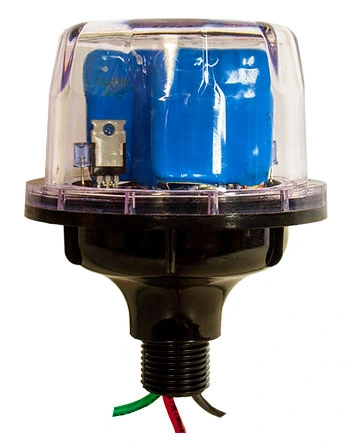
When I recommend a MidNite MNSPD, I’m not thinking of it as a magic box that makes a solar system lightning-proof. I’m thinking about the paths a surge can take to reach expensive equipment—and giving that surge a properly rated path away from the inverter, charge controller, battery wiring, or service panel.
That distinction matters in Hawaii. A solar array may be some distance from the power equipment, and those long photovoltaic wires can act like an antenna during a nearby lightning event. The surge may be induced into both the positive and negative conductors at nearly the same time. Without a planned discharge path, that rising voltage can look for one through the electronics inside the controller or inverter.
Protection starts with the path, not the product label
MidNite’s own explanation describes the surge protective device as a clamp. It begins conducting when the voltage reaches its operating threshold and redirects the event toward ground before the voltage rises high enough to damage the protected equipment. That is why I care so much about location and lead length.
The MNSPD installation manual says the device should be as close as physically possible to the panel or equipment being protected. Its connection conductors should be kept as short as practical, without unnecessary coils or sharp bends. A surge happens extremely quickly, so a long, looping connection can add impedance right when you want the protective path to respond cleanly.
In plain language: putting a surge protector somewhere in the building is not the same as protecting the equipment that matters. The protection needs to be planned at the point where the array, battery bank, utility, or generator path meets sensitive electronics.
One solar system can have several surge paths
For example, an off-grid system might have a roof array feeding a charge controller, a battery bank connected to an inverter, and a generator or utility connection feeding the alternating-current side. Those are different electrical paths. Protecting only one of them may leave another route into the system.
That does not mean every system needs every MNSPD model. It means we should look at the system as a whole before choosing one. MidNite places the MNSPD-115 on lower-voltage battery circuits, including 12-, 24-, and 48-volt systems. The MNSPD-300-AC is for 120- or 240-volt alternating-current circuits. The MNSPD-300-DC is intended for off-grid photovoltaic combiners and charge-controller inputs up to 300 volts direct current. The MNSPD-600 is aimed at higher-voltage alternating-current circuits, grid-tied photovoltaic combiners, and non-isolated grid-tied inverter inputs.
I want to emphasize one selection rule: the model’s maximum continuous operating voltage must be above the system voltage. For photovoltaic circuits, we also account for the worst-case array voltage used in the design. Choosing by the word “300” or “600” alone is not enough. We match the model to the actual circuit and its calculated voltage.
Why layered protection can make sense
Suppose your array is mounted away from the equipment room. I may want direct-current surge protection near the array combiner or charge-controller input, where the long photovoltaic conductors first reach the electronics. If the home also has a 120/240-volt service entrance, an alternating-current MNSPD may protect that larger entry point.
A separate battery-side device may also be appropriate when the battery cables form another exposed path. That is a system-layout decision, not an automatic rule for every battery bank.
This is a planning conversation, not a reason to install devices randomly. The grounding and bonding arrangement, system voltage, equipment location, and local electrical requirements all matter. Installation should be completed by a qualified electrician who can verify the grounding system and the correct over-current protection for the selected device.
What an MNSPD can—and cannot—promise
A properly selected MNSPD can reduce the voltage that reaches connected equipment during induced surges and many nearby lightning events. It cannot guarantee that equipment will survive a direct lightning strike or an event that enters the system outside the protected path. Good grounding remains part of the protection system, not an optional detail added afterward.
I also like that the MNSPD gives you visible blue status LEDs. MidNite says the lights show that voltage is present. On a photovoltaic circuit, they can go dark at night simply because the array is no longer producing voltage. That indicator is useful, but it is not a promise that no surge can ever get through.
That is why I like the MNSPD family for a carefully planned solar installation. It gives us practical choices for the alternating-current side, direct-current photovoltaic side, and battery side, while keeping the protection visible and easier to inspect and replace. If you’re adding an inverter, charge controller, or battery system—or reviewing an older installation after storm damage—contact SolarMan. I can help map the system’s exposed paths and determine which MidNite protection approach fits the equipment you actually have.
For a plain-language companion, HeatSpring’s lesson on surge protection for photovoltaic and energy-storage systems explains why grounding matters and why protection belongs at the points where lightning can enter the system. It’s a useful way to see the MNSPD as one part of a broader protection plan rather than a substitute for proper system design.