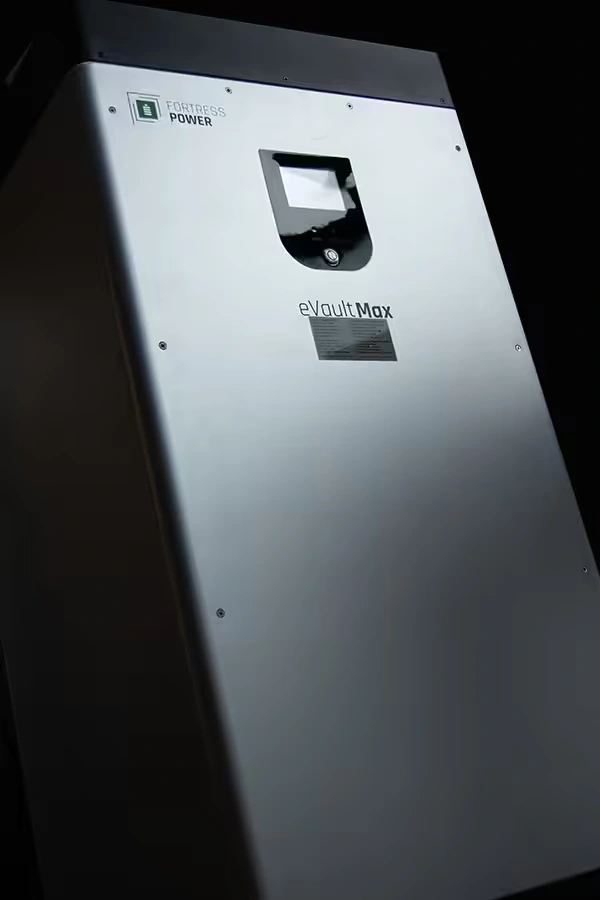
The Fortress Power eVault MAX 18.5kWh is the kind of battery that can make a whole-home backup system feel substantial. It stores 18.5 kilowatt-hours, uses a 51.2-volt nominal battery system commonly called 48-volt class, and can grow into a much larger bank. But this isn't a battery I want us to treat like a box that can be squeezed into whatever corner is left.
Fortress lists the eVault MAX at 520 pounds and about 42.2 inches high, 20.3 inches wide, and 20.3 inches deep. That gives us a useful planning picture: before we discuss cables or inverter settings, we need to know how the battery gets to its final room and how a technician will work around it later.
Start with the delivery route
Measure the full path, not just the doorway. Include the gate, steps, turns, narrow hallways, and the room entrance. The cabinet has wheels to help with service and positioning, but Fortress says those wheels are not the permanent support. The eVault MAX is designed to rest on its adjustable floor legs.
That matters here in Hawaii, where a battery room may be reached through a side yard, garage, utility room, or a tight lanai access path. A route that looks fine on paper can become a problem when the cabinet has to make a sharp turn. I want that conversation before the equipment arrives, not while it is sitting in the driveway.
The final room needs to do more than fit
Fortress's installation manual calls for an indoor, waterproof, level location away from flammable materials, with controlled temperature and minimal dust and dirt. The current product information lists an IP55 enclosure, but that rating is not permission to place the battery where rain, standing water, or direct sea spray can reach it.
A dry utility room or protected battery area is usually a better fit than an exposed outdoor corner. The floor needs to support the cabinet securely, and the installer needs room to use the top service area. The terminals and communication equipment are accessed under the top cover, so putting a shelf, pipe, or stored equipment directly above the battery defeats one of the eVault MAX's practical design advantages.
Leave room for the work that comes later
Battery installation is not the only time access matters. A technician may need to read the display, inspect the breaker, check connections, review an alarm, update firmware, or service the communication area. I like to see a clear working zone around the cabinet rather than a finished room that forces someone to work sideways.
The manual identifies one inch as the minimum required spacing between units and walls under its UL9540A large-scale fire-testing note. It recommends at least five inches between eVault MAX units to leave room for conduit bodies. The exact installation still belongs to the qualified installer and the authority having jurisdiction, but the customer decision is simple: don't design the room so tightly that the documented spacing and service access disappear.
Expansion changes the room plan
One eVault MAX provides 18.5 kilowatt-hours of nameplate storage. Two provide 37 kilowatt-hours, and three provide 55.5 kilowatt-hours. Fortress documents up to 20 eVault MAX units in parallel, or up to 370 kilowatt-hours, when the system is designed and commissioned appropriately.
That doesn't mean every home needs multiple cabinets. It means we should decide whether future expansion is realistic before placing the first one. Parallel batteries need balanced physical and electrical planning, including identical cable length and type from each battery to the common battery connection point. The batteries stay in parallel; they are not placed in series to create a higher-voltage bank.
For example, if your first eVault MAX is planned for a small mechanical room with no open floor area left beside it, adding a second battery later may require rebuilding the room. If we reserve that space now, expansion becomes a design option instead of a construction problem.
Plan the communication path, too
The eVault MAX has a self-contained battery-management system, so communication with a battery-based inverter is not required for the battery to operate. Fortress still recommends closed-loop communication when the inverter and communication method are supported because it can improve battery and inverter performance. That means the physical location needs to support both the battery cables and the communication path to the exact inverter or battery combiner.
Fortress lists Controller Area Network (CAN) and RS-485 serial communication options. Kvaser's Physical layer properties lesson is a useful general primer because it explains how a CAN network uses connected devices, a two-wire communication path, and termination. It isn't a Fortress setup guide, but it makes one point clear: the communication route deserves planning before a wall, shelf, or conduit problem blocks access. The exact cable, protocol, and inverter settings still come from the Fortress and inverter documentation.
A clean commissioning plan starts with the room
Before delivery, I want the room dimensions, access route, final floor condition, inverter model, communication route, and possible expansion area written down. That simple review can prevent a large battery from arriving at a location where it cannot be moved, opened, serviced, or expanded properly.
If you're considering an eVault MAX for a Hawaii backup, off-grid, or light-commercial system, send me the room dimensions, access route, inverter model, and the loads you want protected. I can help you determine whether one battery fits the job, whether future expansion deserves room now, and what the installer should confirm before delivery.