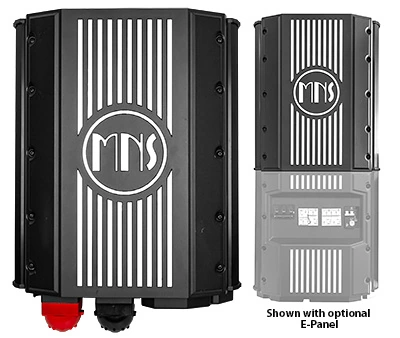
One reason I like the MidNite Rosie 7048 is that it doesn’t force your whole system into one box. The Rosie can handle the battery-to-house power job, while separate Maximum Power Point Tracking (MPPT) charge controllers handle the solar array. That gives me more freedom to match the solar equipment to your roof, carport, ground mount, and battery bank instead of making every decision around one all-in-one inverter.
For a Hawaii home or cabin, the model I’m talking about is the stationary MNROSIE7048RE. It is a 48-volt battery inverter/charger with 120/240-volt split-phase output. The “RE” model has common AC neutrals for renewable-energy systems, while MidNite lists the separate “M” version for mobile applications. That distinction matters when we’re planning a house rather than an RV or boat.
Solar charging and AC charging do different jobs
The solar charge controllers take power from the photovoltaic array and regulate it into the battery bank. The Rosie does not replace that solar-controller function. Instead, it converts battery power into clean alternating current (AC) for your loads and can charge the batteries from an AC source such as the grid or a properly matched generator.
That gives the system two useful charging paths. During a normal sunny day, the MPPT controllers can do the solar charging. During a long cloudy stretch, heavy household use, or an outage, the Rosie can use its AC input to charge the battery bank when that source is available. You’re not asking a generator to run every minute just to keep the house alive; you’re using it as a controlled charging source when the battery needs help.
The numbers make the division of labor easier to see. The Rosie is rated for 7,000 watts of inverter output and up to 120 amps of DC battery charging from its AC charger. That 120-amp figure is not a promise that every battery bank should receive 120 amps. I still match the charge limit to the battery manufacturer’s instructions, the battery-bank size, and the rest of the system.
A simple example of the system relationship
Imagine a 48-volt battery bank with two separate solar sections: one on a house roof and another on a carport. Rather than forcing both sections into the same physical arrangement, I can evaluate the array sections and choose compatible MPPT equipment for them. Those controllers feed the shared battery bank, and the Rosie supplies the home’s 120/240-volt loads.
If the sun is doing the work, the solar controllers provide the charging current. If a generator starts because the battery reaches its programmed threshold, the Rosie accepts the qualified AC source, transfers power as configured, and charges the batteries through its multi-stage charger. The battery remains the common meeting point, while each charging source follows its own control method.
That arrangement is especially helpful when your panels don’t all face the same direction or when you expect the array to grow later. The final controller count, PV voltage, battery charging current, and protection equipment still have to be designed together. But the Rosie gives us a strong center without requiring the entire solar side to be replaced when the array plan changes.
Why I pay attention to the E-Panel
The optional Rosie E-Panel is not the inverter itself, but it can make the system much easier to organize. MidNite’s E-Panel provides the AC input, AC output, and battery over-current protection and disconnect sections designed for the MNROSIE7048. It also includes bypass equipment, a ground busbar, and provisions for optional surge-protection devices.
In plain language, that means fewer separate boxes competing for wall space and a clearer path for service. The E-Panel is an indoor or protected-compartment component, not something to mount out in Hawaii weather. Its value is in making the battery inverter, source wiring, backed-up loads, and maintenance bypass easier to understand and support.
Where the Rosie 7048 fits best
I’d look closely at the Rosie when you want a serious 48-volt battery-based system, 120/240-volt service, a separate solar-controller strategy, and the option to use grid or generator charging. It is also a good conversation for customers who prefer serviceable system sections rather than replacing one large integrated unit if a single function ever needs attention.
The right next step is to look at your actual loads, battery chemistry, solar-array sections, and backup priorities together. Contact SolarMan and I can help determine whether the stationary Rosie 7048, the optional E-Panel, and the appropriate MidNite MPPT equipment make sense for your system.