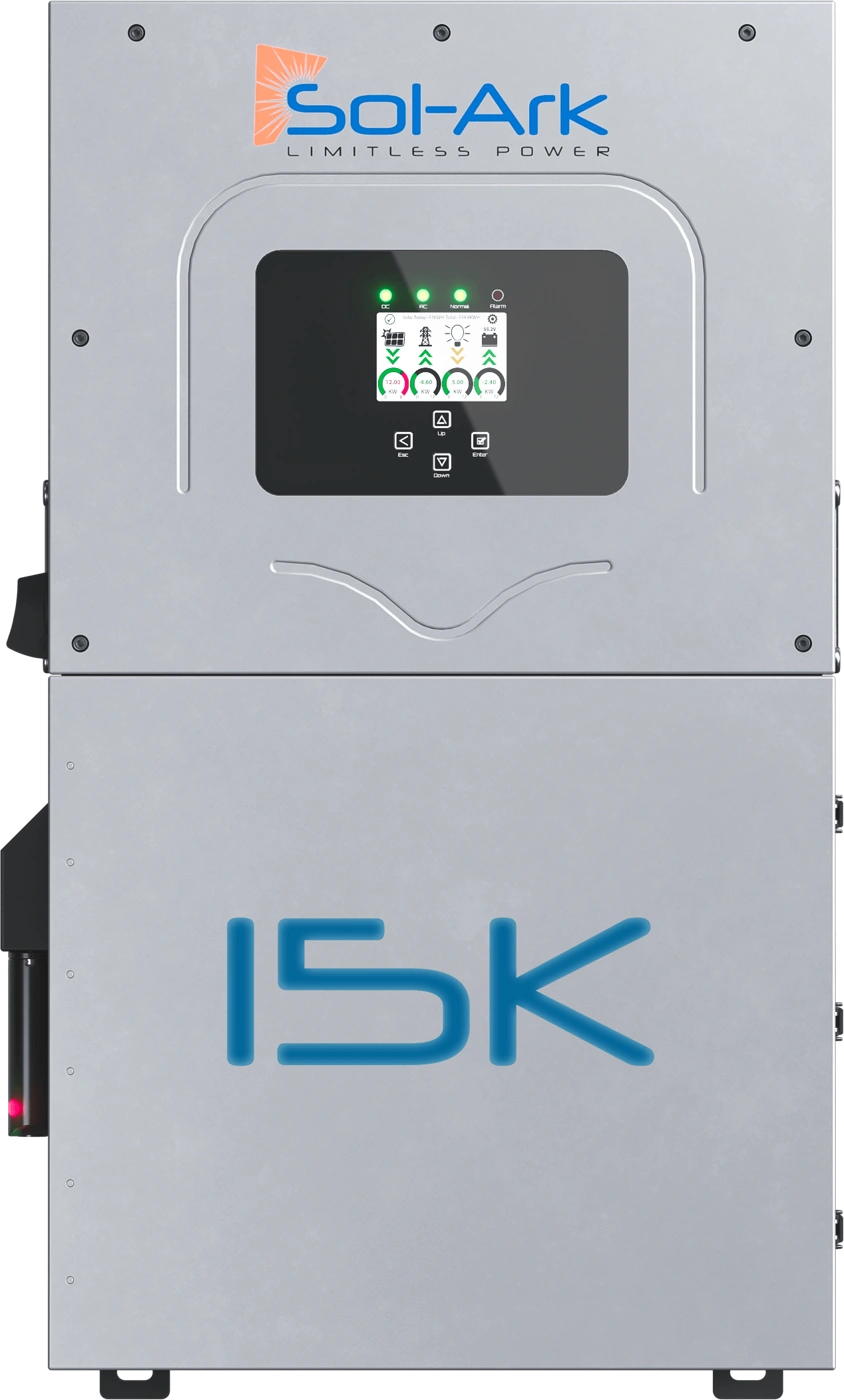
Some customers want backup power for the occasional outage. Others want a system that can operate without depending on the utility at all. That second job changes the conversation, and it’s one reason I pay attention to the Sol-Ark 15K-2P.
The 15K-2P brings solar input, a 48-volt battery platform, household load control, and generator capability into one inverter. Sol-Ark lists 15 kW of nominal real power for its grid-connected output, while the current datasheet lists up to 12 kW of continuous off-grid output at 240 volts. It also has three maximum power point tracking (MPPT) channels, 200-amp grid pass-through, and two battery inputs. That gives us a serious platform to discuss for a Hawaii home, cabin, or property with substantial loads.
One model detail I check before using any numbers in a final design: Sol-Ark’s current documents identify this platform as the Limitless 15K-2P-LV. I match the equipment label and the applicable manual revision before I finalize a system around it.
Off-grid operation is a different design goal
In a normal grid-connected backup system, the utility is always waiting in the background. In a fully off-grid system, your battery becomes the buffer between changing solar production and changing household demand. The inverter has to keep the backed-up loads supplied when clouds pass, the sun goes down, or a motor starts.
That’s why I don’t start an off-grid discussion with the inverter’s biggest number. I start with the loads and the battery. In off-grid operation, power is delivered through the inverter’s LOAD side. In a whole-home design, that side can be arranged to serve the main service panel, but the connection and load plan have to be designed that way. The 15K-2P nameplate does not automatically make every circuit available without limits.
Refrigeration, pumps, air conditioning, cooking equipment, and well or water systems may all be manageable, but their run time and starting demand have to be part of the plan. A motor can need much more power for a moment when it starts than it uses after it is running.
The battery is what makes the system feel steady
The 15K-2P uses a low-voltage 48-volt battery system and lists a maximum battery charge and discharge current of 275 amps when both battery inputs are used. Sol-Ark notes that using only one battery input derates inverter and charger output capacity. That is a useful reminder that inverter power and battery capacity are related but different questions. A battery may have plenty of kilowatt-hours on paper and still not be able to deliver the current needed for a large load or starting surge.
For example, using the inverter’s 12,000-watt battery-output figure, 12,000 watts divided by a nominal 48 volts equals about 250 amps. That is before conversion losses and changes in actual battery voltage. It isn’t a battery recommendation. It shows why I match the 15K-2P with a bank that has enough continuous-current capability, communication support, and usable energy for the customer’s actual loads.
I also want the battery bank sized for the quiet hours. If the home uses 3 kW for four hours after sunset, that is 12 kWh of load energy before inverter losses, reserve capacity, and heavier loads are considered. A larger battery bank can make the system more comfortable overnight, but the final size still depends on solar production, weather expectations, generator use, and how much load you want to carry.
The operating mode matters as much as the hardware
Sol-Ark’s off-grid guidance identifies “Limited Power to Load” as the recommended work mode for a single-inverter off-grid system. The same guidance says not to use Grid Sell mode when operating off-grid. In plain language, the inverter is configured to serve the loads connected to the LOAD side from the available energy sources instead of treating a nonexistent utility connection like a grid-export project.
That setting is not something I’d leave for the last five minutes of commissioning. The installer needs to confirm the system topology, battery settings, charge and discharge limits, generator behavior if present, and the way the household loads are connected. Sol-Ark’s MySolArk Installer app brings hardware validation, battery setup, grid configuration, energy-management profiles, connectivity, and commissioning reports into one guided workflow.
A generator can be a useful partner, not a failure
In Hawaii, a generator may be practical insurance for several cloudy days or an unusually heavy load period. The 15K-2P includes integrated two-wire automatic generator-start capability, but the generator still has to be compatible with the system and correctly matched to the charging and load requirements.
The generator connection is a coordinated control function, not simply a source plugged into an extra receptacle. Sol-Ark’s guidance describes starting from a battery-voltage or battery-percentage condition, along with generator and grid settings that must be selected for the installation. I want those choices made with the battery manufacturer’s limits and the customer’s operating habits in mind.
I like that approach because it lets the customer choose a sensible balance. Solar can handle normal daytime energy, the battery can carry evening loads and short interruptions, and a generator can step in when the battery reaches the agreed starting point. That can be more practical than sizing every component to survive the longest possible stretch of poor weather.
When this Sol-Ark makes sense
I would look closely at the Sol-Ark 15K-2P when you want substantial 120/240-volt power, a real 48-volt battery system, room for a large solar array, and the option to operate independently from the utility. It can fit a fully off-grid home, a remote property, or a grid-connected home designed around strong outage resilience.
If you want a visual introduction before we talk about your property, Sol-Ark’s video “How to Set Up a Sol-Ark Hybrid Inverter Off-Grid” gives a general lesson on bringing panels, batteries, an inverter, and loads together. It isn’t a review of this current 15K-2P, but it helps show why those pieces have to be planned as one system.
The right next step is a load and battery conversation—not just an inverter quote. Tell me what must run, what can wait, whether you have a generator, and how much energy you expect to use overnight. I can then help determine whether the Sol-Ark 15K-2P is the right center for your Hawaii system.