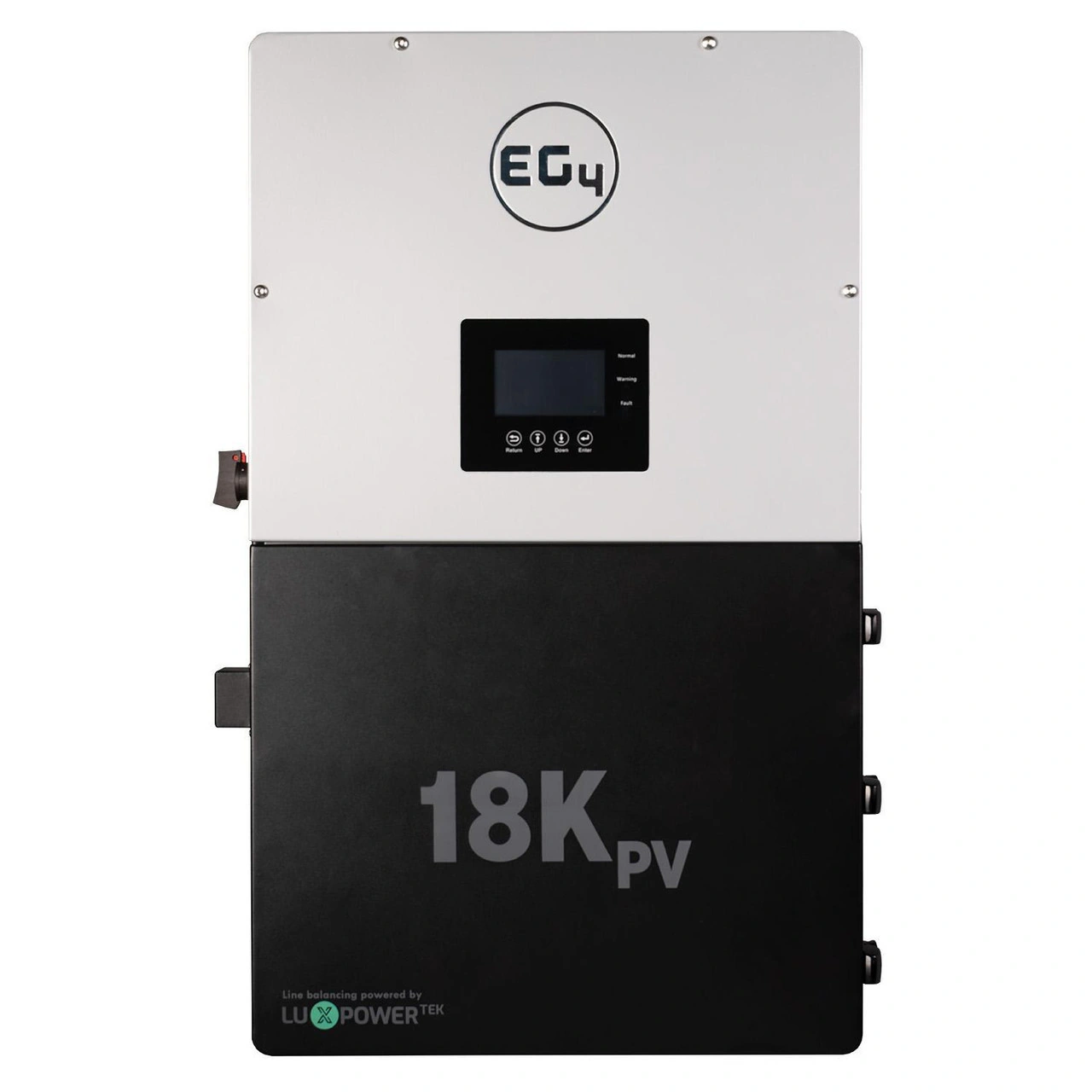
One reason I like the EG4 18kPV is that its solar side gives you room to build a strong array without pretending the inverter has to make the same number of kilowatts continuously. On a 120/240-volt system, the unit is rated for 12 kW of AC output, while EG4 lists 18 kW as maximum utilized solar power and 21 kW as the recommended maximum solar input.
That difference can be useful in Hawaii. Solar panels rarely produce their nameplate rating for the entire day. Morning, afternoon, cloud cover, heat, roof direction, and shading all pull production away from the perfect laboratory number. A larger array can help the system reach useful charging and operating power for more hours, even though the inverter still manages the output within its limits.
The three numbers answer different questions
Think of the EG4 18kPV as having three separate solar numbers. Its 12 kW AC output describes how much alternating-current power the inverter can deliver at 240 volts under the applicable operating conditions. Its 18 kW maximum utilized PV input describes the solar power the inverter can use. The 21 kW recommended maximum solar input is EG4’s suggested upper limit for the DC array feeding the MPPT inputs.
For example, a 21 kW array is 1.75 times the inverter’s 12 kW AC rating. That does not mean the inverter will send 21 kW into the house. It means the array has more ability to produce useful power during less-than-ideal parts of the day, while the inverter controls how much power it accepts, sends to loads, stores in the battery, or exports when the system is configured and approved for that operation.
There can be some clipping when the array could produce more than the inverter can use at that moment. I don’t automatically treat that as a problem. The right question is whether the added panel capacity improves the energy you actually collect over the day and year, and whether the battery, service equipment, roof layout, and utility rules support the plan.
Three MPPT channels make the roof easier to organize
The 18kPV has three maximum power point tracking, or MPPT, channels. MPPT is the control method that continually searches for the voltage and current combination that extracts useful power from a solar string.
MPPT 1 has two inputs, while MPPT 2 and MPPT 3 each have one. That gives the installer several ways to keep different array sections organized. A roof plane facing one direction may use one channel, while another roof plane, carport, or ground-mounted section may use a different channel. If two matched strings share MPPT 1, they must stay within that input’s combined current limits. The final layout still depends on the module data, temperature, shade, and wiring plan.
Voltage and current need separate checks
EG4 lists a 140–500 volt MPPT operating range and a 360-volt nominal MPPT voltage. The inverter’s DC input range is listed as 100–600 volts, with 600 volts as the maximum that must not be exceeded. Those are not numbers to guess at from a panel count. The installer needs to calculate the string’s cold-weather open-circuit voltage and make sure the operating voltage lands in the proper range.
The current checks are separate. The 18kPV lists maximum usable operating current of 25 amps for MPPT 1 and 15 amps each for MPPT 2 and MPPT 3. It separately lists maximum short-circuit input current of 31 amps, 19 amps, and 19 amps.
Operating current helps describe how much current the MPPT can use while tracking the array. Short-circuit current is a separate permitted-input and protection check. I want both reviewed, especially with modern high-current or bifacial modules. With a bifacial module, light reaching the rear side can add to the module’s output, so rear-side irradiance may increase current as well as power. The exact module datasheet and its applicable bifacial test condition should be used rather than assuming the front-only numbers tell the whole story.
The battery has to keep up with the solar plan
A large PV array is most useful when the rest of the system has somewhere sensible to send that energy. EG4 lists the 18kPV as a 48-volt inverter with a maximum charge/discharge current of 250 amps and a recommended battery capacity of at least 300 amp-hours per inverter.
That does not mean every customer needs the same battery bank. It means I don’t size the solar array in isolation. We look at your daytime loads, evening loads, backup priorities, battery communication, and how much solar power the battery can accept. The inverter may be capable of handling a large array, but the battery bank and operating settings still shape how much of that solar power becomes useful stored energy.
The EG4 18kPV is a good fit when you want a 120/240-volt hybrid platform with substantial solar input, battery integration, and room to plan around different array sections. It can also be paralleled for larger systems, but that is a complete system-design decision, not simply a matter of adding another box.
AltE Store’s general lesson on sizing MPPT charge controllers is useful background for understanding why voltage, current, battery size, and array wattage all have to be considered together. It is not a review of the EG4 18kPV, but it gives a practical explanation of array sizing, voltage limits, and why some systems intentionally use more panel capacity than their continuous output rating.
If you’re comparing an 18kPV plan, send me your service size, roof or ground-mount layout, battery goal, and the loads you want backed up. I can help you see whether the extra PV capacity is genuinely useful for your property and whether the EG4 18kPV is the right center for the system.