When I’m planning a Big Island off-grid system, I don’t always want every function packed into one large box. I want the battery inverter to do its job well, then I want the solar charge controllers, battery bank, disconnects, and generator controls arranged around the home’s actual needs. That’s where the MidNite Rosie 7048 can make good sense.
The Rosie 7048 is a 7,000-watt, 48-volt inverter/charger that can provide 120-volt or 120/240-volt output from one unit. For a home with well pumps, pressure pumps, workshop tools, refrigeration, or other 240-volt loads, that split-phase capability gives us a much cleaner starting point than trying to build the system around several smaller 120-volt inverters.
A clear center for the system
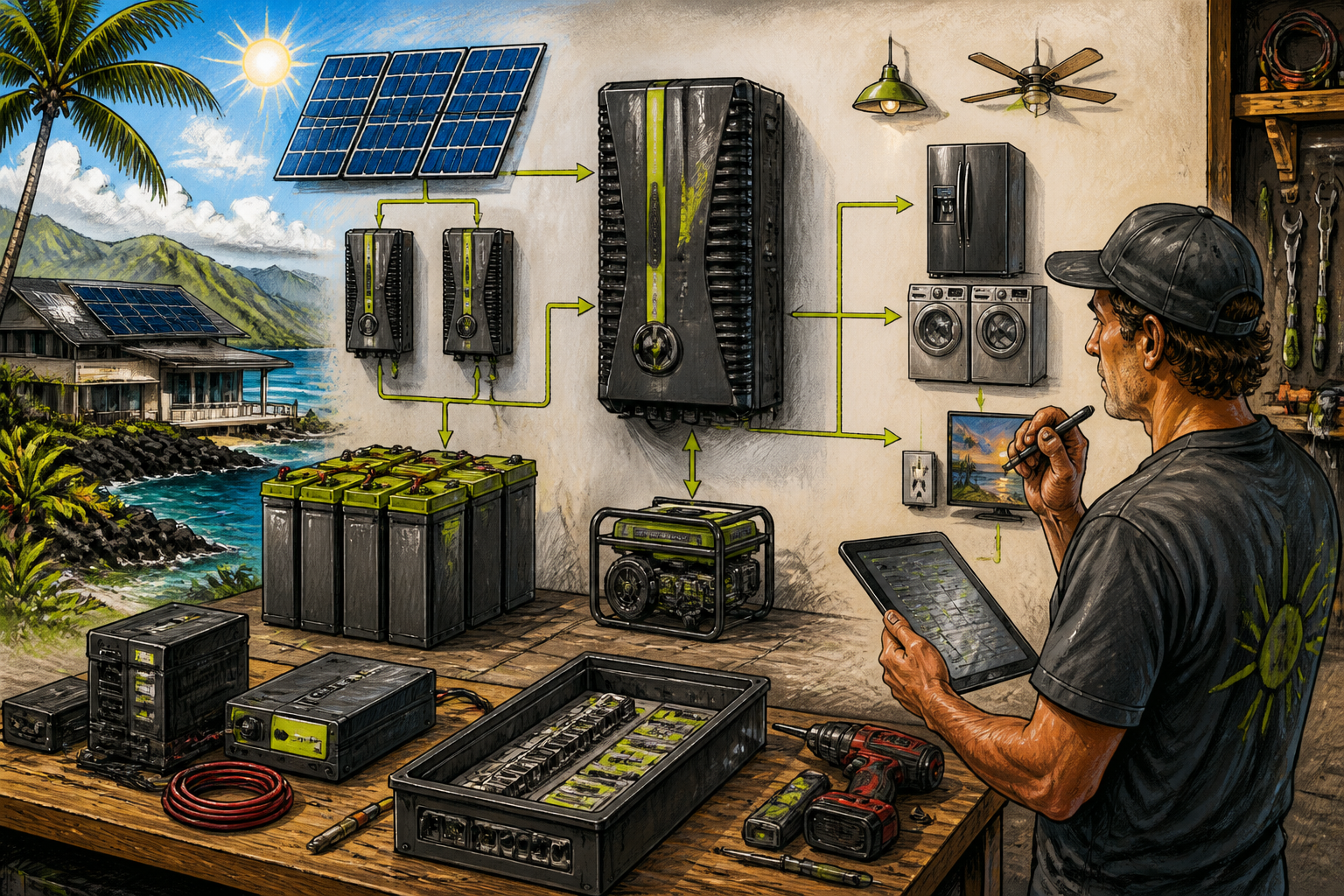
I think of the Rosie as the system’s power-conversion center. The battery bank connects to the Rosie, the Rosie supplies the backed-up loads, and the charging sources are selected separately. Solar can come through one or more MidNite maximum power point tracking (MPPT) charge controllers. A compatible generator can connect through the Rosie’s alternating-current input and battery charger.
That separation is useful on the Big Island because roof layouts, ground arrays, battery locations, and generator locations are rarely identical from one property to the next. We can choose the charge-controller arrangement that matches the solar array instead of buying an all-in-one inverter whose built-in solar inputs may not fit the site.
Choosing the solar side separately
For a smaller or more conventional 48-volt array, the MidNite Classic 150 is one possible partner. It is rated for up to 150 volts of operating input, supports 12- to 72-volt battery systems, and has a listed maximum output current of 96 amps. That makes it a practical choice when the array can be designed within its voltage window.
If the array needs higher-voltage strings or a different physical layout, MidNite also offers the Hawke’s Bay and Barcelona controller families. The important point is not that one controller is always better. It’s that the Rosie lets us choose the controller after we understand the array’s string voltage, current, orientation, shading, and future expansion.
For example, a roof array and a separate ground array might not deserve identical strings or identical controller inputs. With a component-based system, each solar section can be evaluated on its own while both controllers charge the same battery system under a coordinated plan.
Battery integration needs an honest check
The Rosie is built around a 48-volt battery system, but a matching nominal voltage is only the beginning. With lithium batteries, I still need to confirm the battery’s permitted charge and discharge current, inverter settings, battery-management-system communication, cable requirements, and the exact equipment revisions.
The Rosie includes CANbus communication and state-of-charge monitoring options, but that does not automatically prove closed-loop compatibility with every lithium battery. If the battery and Rosie do not have a documented communication profile together, we need a documented open-loop plan with carefully chosen voltage, current, and shutdown settings. I would rather settle that question before equipment arrives than discover it during commissioning.
Why the generator connection matters
Cloudy weather is part of real off-grid life. A generator is not there to replace the solar array; it gives the battery bank a recovery path when weather, heavy loads, or a long stretch of poor production pushes the system lower than planned.
The Rosie supports generator operation through its AC input, includes a two-wire automatic generator-start function, and has a dedicated generator operating mode with a wider voltage and frequency range than its normal grid mode. That matters because a generator does not always produce power as cleanly or as tightly regulated as the utility.
The generator still has to be compatible with the inverter and sized around the home’s loads and charging needs. I don’t treat a generator’s nameplate rating as automatic battery-charging capacity. We need room for the backed-up loads, the Rosie’s charger, starting events, and the generator’s real operating behavior.
Where the Rosie E-Panel helps
The optional Rosie E-Panel gives the system a more organized center. It combines over-current protection and disconnects for the battery, AC input, and AC output, and it includes an AC bypass arrangement. That bypass is valuable for service because it gives a qualified person a way to isolate the inverter while keeping the system’s wiring and load arrangement understandable.
The E-Panel can also provide space for additional breakers and surge-protection devices. I’m not saying every installation needs the same enclosure or breaker arrangement. I’m saying the E-Panel can reduce the amount of custom equipment layout we have to invent around the Rosie.
Serviceability is part of the value
This is the part I like most for a long-term off-grid customer. If the inverter, solar charge controller, and battery bank are separate components, a problem in one section does not automatically mean replacing the whole energy system. MidNite also emphasizes repairable Rosie and charge-controller assemblies, which can make future service more practical than discarding a complete all-in-one unit.
That approach fits a home where access matters. We can leave working equipment in place, diagnose the failed section, and plan the repair around the actual problem. It doesn’t eliminate maintenance, but it can make the system easier to understand and support years later.
If you want a visual introduction before we get into your own equipment list, altE Store’s lesson on battery-based inverters walks through how inverter voltage, household loads, surge requirements, and off-grid system planning fit together. It’s a useful way to see why I start with the loads and battery platform before choosing the rest of the system.
If you’re considering the Rosie 7048 for a Big Island home, send me the loads you want to run, the battery type you’re considering, your solar-array location, and whether a generator is part of the plan. I can help you decide whether a component-based Rosie system gives you the flexibility and serviceability your property needs.