The Hyundai HiS-T640NJ gives us a lot of panel power in each module, and the price I have on these panels is excellent. The important part is not simply counting 640 watts over and over. I want to match the panel string to the inverter or charge controller so the array can operate in the equipment’s useful voltage and current range.
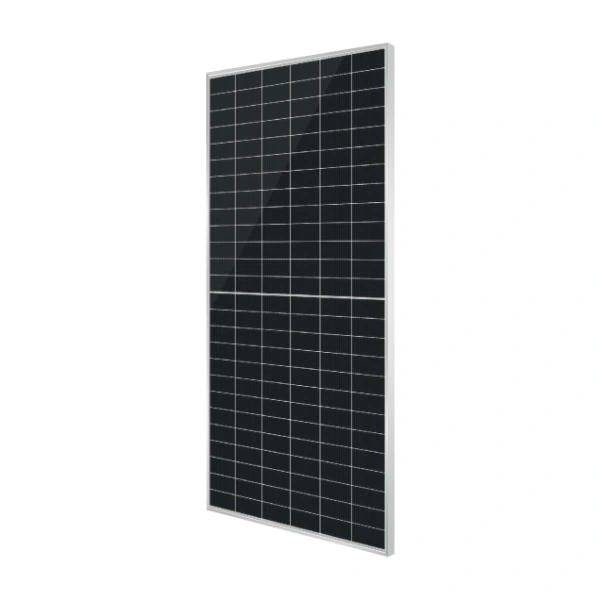
That distinction matters because series and parallel connections change different things. Put panels in series and their voltages add while the current stays about the same. Put equal strings in parallel and the current adds while the voltage stays about the same. That is the basic idea behind turning a large panel into a sensible system instead of just a large number on a proposal.
One panel gives us the starting numbers
For the HiS-T640NJ, the published standard test condition (STC) figures are approximately 47.74 volts at maximum power, or maximum power point voltage (Vmpp); 13.41 amps at maximum power, or maximum power point current (Impp); 57.77 volts open circuit (Voc); and 14.06 amps short circuit (Isc). Maximum power point (MPP) is the operating point where the panel is producing its rated power under the test conditions.
Those are not interchangeable numbers. The 13.41-amp figure describes normal rated operation at the panel’s maximum-power point. The 14.06-amp figure is the panel’s short-circuit current. When I match panels to an inverter, I check the inverter’s operating-input current limit separately from its permitted short-circuit-current limit.
A simple five-panel string
Five HiS-T640NJ panels in series add up to 3,200 watts of rated panel power. The string’s operating voltage is approximately 5 × 47.74, or 238.7 volts at maximum power. Its open-circuit voltage is approximately 5 × 57.77, or 288.9 volts before temperature correction. The string current remains about 13.41 amps at maximum power.
That example shows why a high-wattage panel does not automatically create a high-current string. The panel gets to 640 watts partly by operating at a fairly high voltage. A five-panel string may be a good starting point for some high-voltage maximum power point tracking (MPPT) inputs, while the same string may be unsuitable for a lower-voltage controller. The exact inverter model, MPPT window, maximum operating current, and permitted short-circuit current still decide the fit.
Two strings change the current conversation
If we place two equal five-panel strings in parallel, the array remains near 238.7 volts at maximum power, but the operating current becomes approximately 26.82 amps. The short-circuit current is approximately 28.12 amps before any design adjustment for conditions or rear-side contribution.
That is where I want to slow down with a customer. An inverter may allow one current value during operation and a different value for array short-circuit current. A design that checks only the 640-watt label can miss the current limit.
The bifacial part matters here, too. In one manufacturer test condition with 15% rear-side gain, the datasheet lists 15.42 amps at maximum power and 16.17 amps short circuit for one module. For two equal strings under that same reference condition, the simple arithmetic becomes 30.84 amps at maximum power and 32.34 amps short circuit. Those are test-condition values, not a promise of what your array will produce; rear-side output depends on the mounting height, spacing, shade, and surface below it. It does show why a bifacial design should not rely only on the front-side nameplate current.
Cold voltage still has to be checked
Panel voltage rises as the cells get colder. Hawaii usually gives us a favorable climate, but the installation site still has a design temperature, and the string’s cold-weather open-circuit voltage must remain below the inverter or controller’s maximum photovoltaic (PV) input voltage. I also check that the warm operating voltage remains inside the equipment’s MPPT range.
This is one reason I do not recommend choosing a string count from wattage alone. Five panels may be reasonable for one inverter and wrong for another. Six panels may improve operating voltage on one input but push the cold open-circuit voltage too high on another. The equipment manual and the project’s temperature assumptions settle that question.
Where this panel fits best
I see the HiS-T640NJ as a strong option when we have enough roof or ground-mount space for its large format and an inverter or charge controller that can use its electrical characteristics. Ten panels provide 6,400 watts of rated panel power. That does not mean the array makes 6,400 watts all day, but it gives us a clear design starting point for daytime loads, battery charging, and inverter input planning.
The next step is to match the exact panel revision and the exact inverter or controller. I can help you work through the string voltage, current limits, cold-weather check, layout, and current SolarMan pricing before you order equipment. Contact SolarMan and bring me the inverter model you are considering; then we can see whether these 640-watt panels give you the right combination of power and usable electrical range.
For a general lesson on series wiring, AltE Store’s “How to wire solar panels in series.” demonstrates how series connections raise solar-array voltage while the current stays about the same. That gives you useful background before we match the Hyundai panel string to your inverter or charge controller.