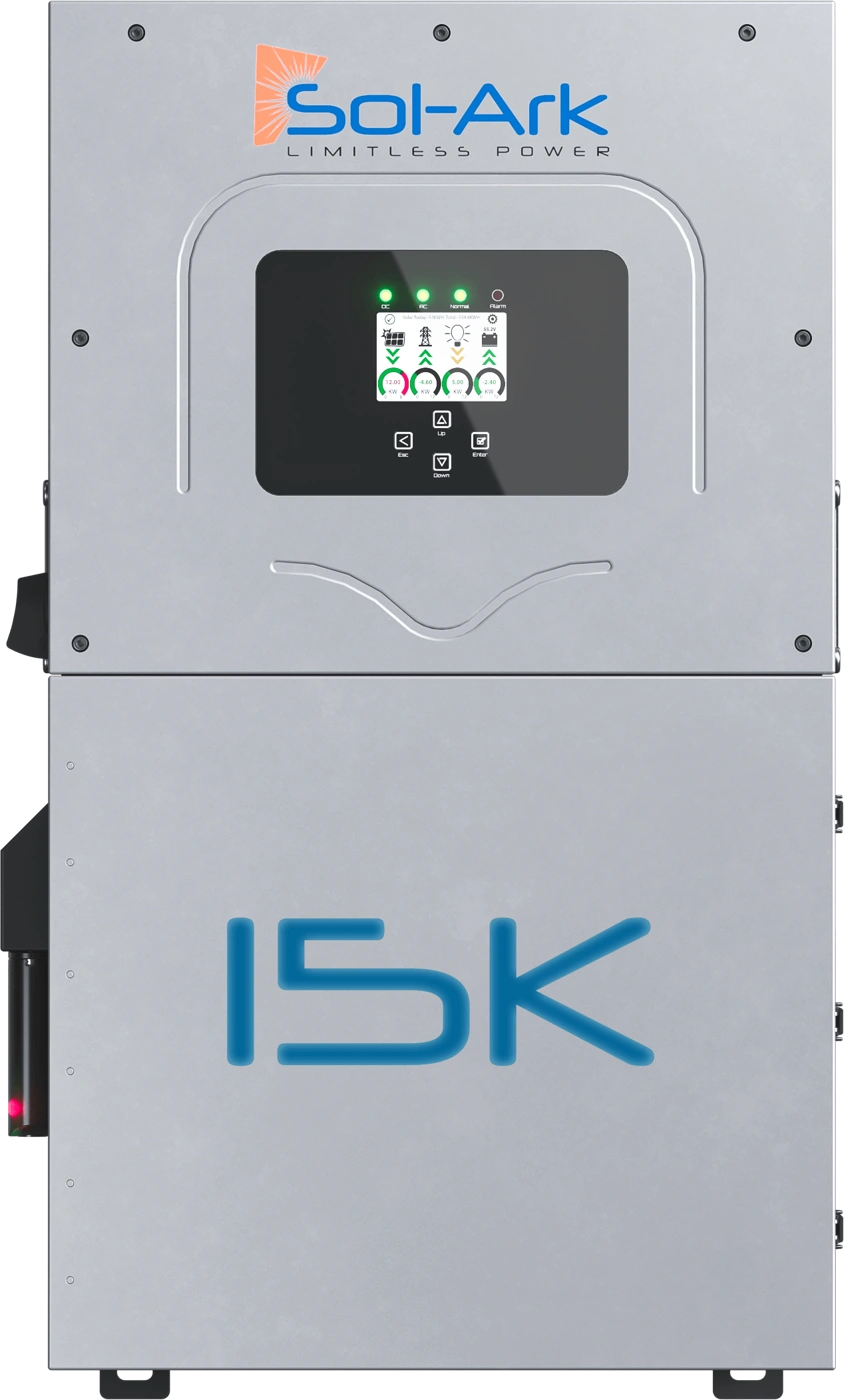
The Sol-Ark 15K-2P is the kind of inverter I like for a customer who wants more control than simply “solar goes in, power comes out.” Its Time-of-Use, or TOU, settings let us decide how the battery should behave during different parts of the day.
That matters in two common Hawaii situations. You may want to keep a reserve ready for an outage, or you may have a utility plan where power costs more during certain hours. The Sol-Ark can support either goal, but the schedule has to match the battery manufacturer's limits and the way you actually want the system to operate.
Think of TOU as a battery boundary
The most useful TOU setting is the battery value assigned to each time period. Depending on the battery setup, that value can be state of charge (SOC), meaning the battery's estimated remaining charge, or a voltage value on systems using voltage-based control.
Suppose we create an evening period with a 30% minimum SOC. While the grid or another available alternating-current (AC) source is present, the Sol-Ark can use the battery for normal loads during that period. Once the battery reaches the selected boundary, it stops discharging for ordinary loads and uses another available source instead. That does not create more battery energy. It simply keeps the lower portion available for backup.
I would not choose 30% automatically for every system. Your battery manufacturer may specify a different operating limit, and a battery-management system may impose its own protections. The point is that the Sol-Ark gives us a practical place to express the reserve you want.
A simple example for a long evening
Imagine a home with solar during the day, a battery bank, and a customer who wants the battery to help with household loads from 5 p.m. to 9 p.m. but still wants reserve after that window.
We might use one TOU period for the evening, select the desired minimum SOC, and set a maximum battery power appropriate for the battery bank. During that period, the inverter can draw from the battery until it reaches the selected boundary. Afterward, the grid can carry normal loads while the reserved battery capacity remains available if the grid fails.
The “Power (W)” field deserves attention. It is not the size of the inverter, and it is not the stored energy of the battery. It is the maximum battery power the schedule allows during that period. Sol-Ark's own guide connects this setting to the battery bank's permitted charge and discharge current. I want the battery model, communication method, and manufacturer limits confirmed before choosing that number.
TOU can also charge the battery
A TOU time block can include a charge instruction. If the battery is below the selected target when that period begins, the grid or generator can charge it until it reaches that target, provided the system and source are configured for that operation.
That can help after several cloudy days, but it is not automatically the best choice. Charging from the grid may cost more than waiting for solar, and generator charging brings its own fuel, noise, and operating limits. Solar energy can still charge the battery when available, whether or not AC charging is selected in a particular TOU period.
For a backup-first customer, I may prefer a schedule that protects a higher reserve and lets solar do most of the daily charging. For a customer with a genuine lower-cost charging window, a carefully matched charge period may make sense. Those are different goals, even though they use the same menu.
Watch the settings work together
TOU is only one part of the Sol-Ark's energy-priority system. Battery reserve, grid-charging permissions, export settings, operating mode, and battery communication all affect what you see on the screen. With TOU disabled, the battery is generally treated as backup-only rather than being scheduled for ordinary daily discharge.
I also want the inverter's clock and seasonal schedule correct. A well-designed schedule running at the wrong time is still the wrong schedule. After commissioning, we can compare the battery SOC, household load, solar production, and grid use in MySolArk to see whether the system is behaving as intended.
For a helpful general lesson, Big Dog Solar's “How Solar Batteries Help Manage Time-of-Use Rates” explains why electricity prices can change by hour, how a battery can save daytime solar for expensive evening periods, and how flexible loads fit into the plan. It is a useful way to see the scheduling idea before we discuss settings for your Sol-Ark system.
If you're considering a Sol-Ark 15K-2P, contact SolarMan and tell me what you want the battery to do: stay ready for outages, reduce grid use during selected hours, or support both goals. I can help match the inverter, battery bank, solar array, and control strategy before anyone starts changing settings.