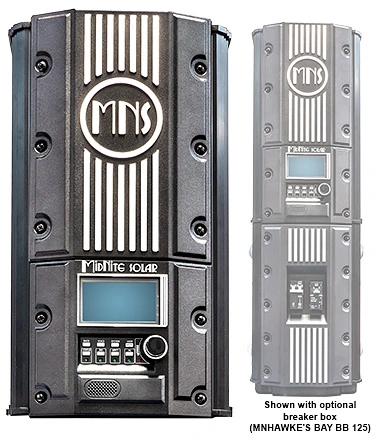
If your solar array will sit on a detached garage, carport, or ground mount, the MidNite Hawke’s Bay gives me a useful design option. It is a 48-volt battery charge controller using maximum power point tracking, or MPPT, that accepts a much higher-voltage photovoltaic, or PV, string than traditional low-voltage controllers.
MidNite’s current product pages publish a 185–585V MPPT window and a 600V maximum PV input. The installation manual currently linked by MidNite contains a different 185–550V MPPT figure, so I treat the exact manual and nameplate for the unit being installed as the final authority. Either way, 600 volts is a ceiling, not a target.
Why higher PV voltage can help
When solar modules are connected in series, their voltages add while the string current stays approximately the same as one module. For the same general amount of solar power, moving it at higher voltage means moving it at lower current.
Here is the simple relationship: 4,000 watts at 400 volts is about 10 amps. The same 4,000 watts at 200 volts is about 20 amps. Real systems must use the actual module ratings, temperature, conductor length, and equipment limits, but that example shows why higher PV voltage can make a long run easier to manage.
It may reduce voltage-drop concerns and give the installer more flexibility with conductor sizing and array location. It can also reduce the need for several parallel strings, depending on the array and controller design. The actual benefit still depends on distance, conductor size, disconnects, overcurrent protection, and the final layout.
Keep the two sides of the system straight
The Hawke’s Bay converts the higher PV voltage into the lower voltage needed to charge a 48-volt battery bank. That means the PV side and battery side have different design questions.
The array may be far from the power room, but I still want the controller close to the batteries. MidNite’s manual warns that long direct-current, or DC, wiring can reduce efficiency and overall controller performance. In a good layout, the higher-voltage PV run does the traveling while the lower-voltage battery connection stays reasonably short.
That is one reason I see this controller fitting well when the panels and battery equipment cannot share the same wall or room.
The voltage check that comes first
I do not begin by counting panels. I begin with the exact module datasheet and the string’s open-circuit voltage, usually called Voc. Panel voltage rises as the cells get colder, so the maximum-voltage calculation must use the module’s temperature coefficient and the lowest design temperature for the site.
The cold-weather string Voc must stay below the Hawke’s Bay’s 600-volt maximum. That is one check. The string’s operating voltage must also remain inside the applicable MPPT window for the exact controller documentation. Those numbers answer different questions: one protects against excessive open-circuit voltage, while the other confirms that the controller can track the array’s maximum-power voltage.
The controller also needs enough PV voltage to operate. MidNite lists a 220V minimum Voc requirement and describes 300–600V as the ideal range on its product pages. That is why a string that looks fine on paper at a lower voltage may not be a good match for this controller.
This is especially important when someone proposes using a similar-looking panel instead of the actual module on the quote. Large-format and bifacial modules can have different voltage and current values. I want the exact panel model, datasheet revision, and controller documentation before approving a string design.
Where the Hawke’s Bay makes sense
I see the Hawke’s Bay as a strong candidate for a 48-volt battery system with a separated array, a longer PV path, or an array that benefits from fewer higher-voltage strings. It is available in 90-amp and 120-amp versions.
The bigger number is not automatically the right answer. The choice should follow the battery bank’s permitted charging current, the array’s expected output, and the rest of the system’s protection and distribution equipment. A battery manufacturer may specify a maximum charge current, and that limit matters just as much as the controller’s headline output.
The high-voltage equipment between the array and controller must also be rated for the actual system voltage. That includes disconnects, breakers, fuses, enclosures, wiring, and any other equipment in that PV circuit. This is a design for a qualified installer, not a terminal-by-terminal do-it-yourself wiring project.
A good MidNite system is easier to follow
I also like the Hawke’s Bay as part of a MidNite system. It can communicate over Controller Area Network, or CAN bus, with compatible MidNite equipment such as the Rosie inverter/charger. The MNGP2 graphics and programming panel can communicate with multiple compatible devices, giving the owner one place to view equipment and settings instead of several unrelated displays.
That does not replace proper commissioning, but it can make the finished system easier to understand and support.
The altE Store demonstration below is a helpful general lesson on what an MPPT controller does when it converts higher PV voltage into useful battery-charging current. It is not a review of the Hawke’s Bay, but the principle is the same one behind this controller’s high-voltage PV input.
If you are considering a detached-array layout, a longer PV run, a larger 48-volt battery system, or a Hawke’s Bay paired with a Rosie, contact SolarMan. I can help compare the actual module datasheet, cold-weather string voltage, battery charging limits, equipment locations, applicable controller revision, and protection requirements before you commit to the design.