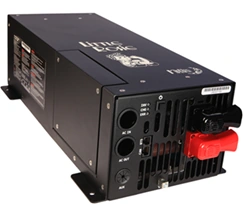
One reason I like the stationary MidNite MNLR4548RE Little Rosie is that it doesn’t force the whole solar system into one box. The Little Rosie can be the inverter, battery charger, transfer device, and control point while a separate maximum power point tracking (MPPT) charge controller handles the photovoltaic array.
That separation can make a lot of sense for a Hawaii cabin, small home, office, or backup system. Solar does its best work during the day. The battery carries energy into the evening. The Little Rosie turns stored direct current into true-sine-wave 120-volt alternating current for the loads. If clouds linger, a qualified utility or generator source can charge the batteries through the Little Rosie’s built-in charger.
Give each part one clear job
The Little Rosie does not have a photovoltaic input. Its solar partner is a separate MidNite MPPT controller, such as a Hawke’s Bay or Barcelona, selected for the array and battery bank. MidNite specifically describes the Little Rosie as pairing with its MPPT chargers, and that is the relationship I want customers to understand before we talk about equipment size.
The MPPT controller takes the changing voltage from the solar array and manages charging into the 48-volt battery bank. The Little Rosie then uses that battery bank to supply the home’s 120-volt loads. Keeping those roles separate gives us flexibility when the roof has an unusual layout or when a high-voltage solar controller is a better fit than trying to build everything around the inverter.
It also makes troubleshooting more understandable. If the battery is low during a sunny afternoon, we can ask whether the solar controller is receiving useful photovoltaic power, whether the battery is accepting charge, and whether the loads are using energy faster than the array can replace it. Those are different questions, and a component-based system lets us look at them separately.
The built-in charger still matters
The Little Rosie includes a multi-stage 60-amp battery charger. When a qualified utility or generator source is available, the unit can charge the battery while its internal transfer function passes incoming AC power directly toward the connected loads. That pass-through is a separate path from battery charging; the generator does not have to fill the battery before it can serve qualified loads. The current owner manual lists 30 amps as the AC pass-through capability, so the source, wiring, and connected loads still have to be matched to the equipment and installation requirements.
Using 56 volts as a planning example, 60 amps represents roughly 3,360 watts of battery-side charging power before losses and before the charger reduces current as the battery fills. That is a useful reference, not a promise that every battery will accept 60 amps continuously. The battery manufacturer, temperature, state of charge, and charger settings still control the real result.
This is also why I don’t describe the Little Rosie’s 60-amp charger as a replacement for a solar charge controller. The built-in charger uses an AC source. The separate MPPT controller uses the solar array. They can both support the same battery bank, but they are different charging paths.
A practical day-to-night example
Imagine a small off-grid home with daytime refrigerator use, communications equipment, water pumping, and ordinary evening loads. During the day, the MPPT controller sends available solar energy into the battery while the Little Rosie supplies the AC loads. After sunset, the Little Rosie draws from the battery and continues making 120-volt power.
If a storm reduces production for two or three days, the system does not have to wait helplessly for perfect sun. A compatible generator can feed the Little Rosie’s AC input. In standby mode, the unit charges the battery and passes qualified generator power through to the connected loads. If the generator stops or the incoming AC fails, the Little Rosie can switch back to inverter operation and draw from the battery.
The generator still needs to be sized and configured for the actual system, and the battery must be able to accept the charging current. But this architecture gives us a second recovery path instead of asking the solar array to solve every cloudy-weather problem by itself.
There’s a useful general inverter-charger lesson from Pacific Yacht Systems that explains pass-through, battery charging, inverter operation, and load sizing in plain language. It gives you a good foundation for understanding what an inverter-charger is doing when an outside AC source is present.
Where I would consider the Little Rosie
I would look seriously at the Little Rosie when you want a 120-volt system with a separate solar controller, a 48-volt battery bank, generator or utility charging, and equipment that can be evaluated one function at a time. The current owner manual identifies 4,500 VA of continuous output at 25°C, a five-second surge rating of 6,750 watts, and a 60-amp charger. Those ratings help us begin the conversation, but they don’t replace a load calculation or battery-current check.
The Little Rosie is not automatically the right answer for a 120/240-volt whole-home system, and it is not the mobile model for an RV, truck, or boat. The stationary MNLR4548RE is intended for house, office, and cabin applications with common input and output neutrals. That distinction matters before we discuss an E-Panel, generator, or battery.
Bring me the loads you want to run, the battery chemistry you’re considering, the solar-array location, and whether you expect generator recovery. I can help you decide whether the Little Rosie should be the center of the system and which separate MPPT charging path makes sense around it.