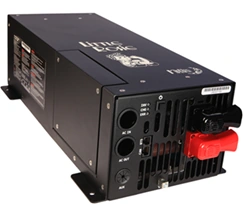
A battery voltage reading is useful, but it’s only one moment in the story. When you’re deciding whether your Hawaii cabin can make it through the night, or whether the battery is genuinely full after a cloudy day, I’d rather give you more information than a single number.
That’s where the stationary MidNite MNLR4548RE Little Rosie can benefit from a MidNite Whizbang Jr. and a properly installed shunt. The combination measures current moving into and out of the battery bank and can present a more useful estimate of state of charge, or SOC, through the MNGP2, MidNite’s graphics and programming remote control.
Voltage is a snapshot; current tells the story
Imagine a 48-volt battery bank showing a healthy-looking voltage just after a charging source stops. That reading can change when a refrigerator, pump, or other load starts. A battery under load may read lower, while a battery that has just been charged may read higher than its settled value.
A shunt gives the monitoring system another measurement point. It measures the current flowing into and out of the battery bank. The important part is that the current you want counted must pass through the shunt. If a charger, inverter, or other load bypasses it, the monitor cannot include that current in its battery picture.
The Whizbang Jr. uses that current information, along with the battery-bank settings, to estimate how much charge remains. It isn’t magic, and it doesn’t replace correct battery programming, but it gives you a much better operating picture than voltage alone.
For example, if your system ran overnight and the voltage looks acceptable in the morning, the SOC reading can help show whether the bank actually recovered or is simply sitting at a temporarily elevated voltage. That distinction matters when you’re deciding whether to run a generator, reduce discretionary loads, or let the solar array continue charging.
Little Rosie can use that information while charging
The MNLR4548RE manual documents an Ending Amps setting. This gives the charger a current-based indication that the battery has reached the end of its absorption stage. The Little Rosie can move to Float when the Absorb timer finishes or when the Ending Amps target is reached, whichever happens first.
That is a useful relationship: the charger is not only looking at a clock. It can also consider how much charging current the battery is still accepting. The correct value comes from the battery manufacturer and the actual battery bank, not from a generic number I would apply to every installation.
The MNGP2 remote is important here because it provides the control and display interface for the Little Rosie. MidNite also documents battery-capacity and amp-hour-efficiency settings. Those values need to represent the actual bank. If they’re wrong, the SOC estimate can be wrong too. A monitoring accessory is only as useful as the information it receives.
What this looks like in a real system
Suppose your overnight loads use energy from the battery, then the morning solar begins charging. The shunt measures that battery current, the Whizbang Jr. tracks the exchange, and the MNGP2 gives you a view of the bank’s estimated SOC and charging status. You can compare that information with the day’s loads, solar conditions, and generator plans.
It also gives us a better way to talk about system changes. If the battery reaches Float early on sunny days but struggles after two cloudy days, we can look at actual energy use and recovery rather than guessing from voltage. That may point toward different load priorities, more solar charging, a larger battery bank, or a generator-recovery plan.
The Little Rosie itself remains a 120-volt inverter/charger with 4,500 volt-amperes of continuous output at 25°C, a separate battery bank, and separate solar-charging equipment such as a MidNite MPPT controller. The Whizbang Jr. does not add inverter power or battery capacity. It adds better information and charging control to the battery side of the system.
When I’d recommend this approach
I’d give this monitoring setup serious consideration for an off-grid home, cabin, workshop, or backup system where battery decisions affect comfort and generator fuel use. It is especially helpful when loads change during the day or when you need to understand whether the battery is recovering fully after several cloudy days.
Pacific Yacht Systems’ short lesson What Is The Purpose of a Shunt? is a useful general introduction. It explains how a shunt lets a battery monitor measure current and why charging and load paths that bypass the shunt can make the battery reading incomplete. It won’t configure your Little Rosie, but it makes the reason for the shunt much easier to see.
If you’re considering a Little Rosie system, contact SolarMan and tell me what battery bank, loads, charging equipment, and backup expectations you have. I can help determine whether the Whizbang Jr., shunt, MNGP2, and Little Rosie make sense together for your system.